

































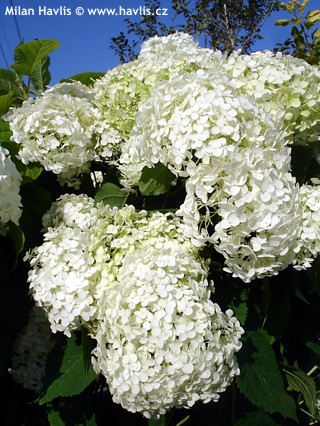


Hydrangea arborescens 'ANNABELLE' sevenbark, smooth hydrangea

 Symbivit Tric (arbuscular)
 Symbivit (arbuscular)
Hydrangea
The genus Hydrangea comprises approximately 70–75 species of woody plants, occurring naturally mainly in East Asia, with a smaller number found in North and South America. The greatest species diversity is concentrated in Japan and China, where hydrangeas have long formed part of both the cultural landscape and garden tradition. The genus was first scientifically described by Carl Linnaeus in 1753 in his Species Plantarum. Later botanical research also documented fossil remains of hydrangeas from the Tertiary period in North America, pointing to a long evolutionary history. Hydrangeas were introduced to Europe towards the end of the eighteenth century through botanical expeditions and quickly became popular ornamental shrubs.
Hydrangea arborescens, commonly known as smooth hydrangea or sevenbark is a deciduous woody plant native to eastern North America, where it grows along woodland margins, in open groves and in moist valleys. The species was scientifically described in 1789 by the American botanist William Bartram (1739–1823), one of the key figures in the early exploration of North American flora. It entered European botany at the turn of 18th and 19th centuries through plant exchanges between American and European gardens, particularly in England and France, where it was initially cultivated mainly as a botanical curiosity.
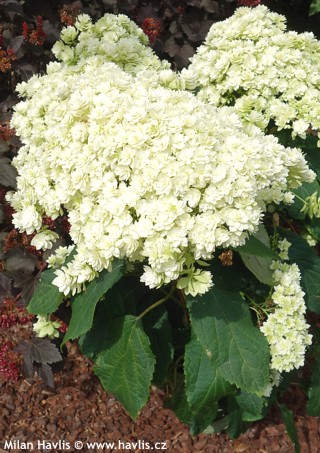
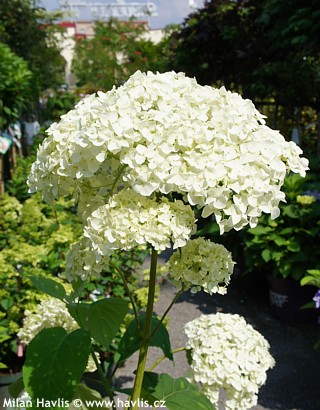
The cultivar Annabelle is one of the best‑known and most influential forms in the history of smooth hydrangea. It is a deciduous shrub with almost pure white flowers arranged in rounded flower heads 20–25 cm in diameter, the size of which is directly influenced by the availability of nutrients and moisture in the soil. Flowering takes place from June to July on the current season’s growth, ensuring reliable performance even after hard spring pruning. The plant does not naturally flower a second time, but after a stronger back-pruning following the main flowering period it may, under favourable conditions, produce a smaller number of flowers again in late summer. The deciduous leaves are 15–25 cm long, elongated and heart‑shaped, with finely toothed margins; they are fresh green, matt and soft to the touch. They form a dense canopy of foliage that gives the shrub a full appearance and provides a calm backdrop for the white flower heads. A characteristic feature of this cultivar is its softer, more flexible stems, which may bend slightly under the weight of fully developed flower heads – a trait that later became one of the impulses for breeding structurally stronger cultivars.
The origin of ‘Annabelle’ dates back to 1910, when an unusually free‑flowering form of the species was discovered near the small town of Anna in southern Illinois (USA). The plant was found by Harriet Kirkpatrick, who, while riding on horseback, noticed a shrub with strikingly large, spherical flower heads, clearly distinct from the surrounding wild populations. She transplanted the plant into her garden, where it soon became a local curiosity.For several decades this hydrangea was distributed informally among gardens in southern Illinois, without an official name and without commercial introduction. It was not until 1960 that the plant attracted the attention of Professor Joseph C. McDaniel, an American botanist and long‑standing lecturer at the University of Illinois specialising in woody plants and ornamentals, who rediscovered it in a garden in Urbana, where it had been brought from its original location. McDaniel traced its origin, secured vegetative propagation and prepared its introduction into horticulture. The cultivar was released onto the market in 1962 and given the traditional name ‘Annabelle’, which, with a gentle play on words, refers to its place of origin: Anna (the town of discovery) and belle (French for “beautiful”).
Smooth hydrangeas work well in the garden both as specimen shrubs and in mixed plantings with contrasting colours. Do not be afraid to experiment with more vivid perennial companions – purple Salvias, golden Trolliums or Geums, purple‑leaved Actaeas or Ligularias, as well as red Lobelias. It should always be borne in mind, however, that hydrangeas prefer moist soil, and neighbouring plants should therefore have similar requirements. For calmer compositions based more on texture than colour, combinations with ferns work particularly well, their finely divided fronds gently balancing the simpler leaves of the hydrangea. ‘Annabelle’ also looks beautiful in containers and in modern, single‑species ambient plantings, where its regular shape stands out and provides interest over a long period, especially if spent flower heads are removed after flowering, which encourages the formation of new flower buds towards the end of summer.
Last update 09-09-2009; 16-03-2026
Cultivating smooth hydrangea is relatively straightforward. It performs best in full sun or light partial shade, where sufficient light prevents the stems from stretching excessively. It tolerates full sun throughout the day provided it is watered during dry periods; prolonged drought is poorly tolerated and leads to rapid wilting, browning of leaves and reduced flower size. Additional watering is particularly important during bud formation. Short‑term waterlogging is tolerated, but permanently wet sites are unsuitable. The soil should be deep, humus‑rich and well drained; soil pH is not critical. Mulching is beneficial, helping to keep the soil cool and moist while protecting the roots. Feeding is not essential, but the shrub may be supported with a balanced fertiliser low in nitrogen after leaf emergence and again before flowering, ideally using organic products. Pruning is necessary and is carried out in early spring, or in mild regions before winter, as hard cutting results in stronger stems and larger flowers. Up to 80 % of the previous year’s growth can be removed. The plant can also be grown in containers, where regular watering and feeding are required, although it performs best when planted in the ground. It is neither toxic nor allergenic and is hardy to at least –34 °C (USDA zone 4); some sources report successful cultivation even in zone 3, corresponding to temperatures as low as –40 °C.


Goods are shipped all over Europe. For Russia and U.K. and for further details please read about SHIPPING OPTIONS HERE.
Are you interested in a serious discount for orders NOV-FEB? Check your options here.
THE PRICES INCLUDE VAT of 15%. For quick conversion you can use 1 CZK = approx. 0.04 EUR
- STANDARD QUALITY - Plants of this group are 1st class quality with number of branches and overall density adequate to their size and age, considering they were container grown.
- DE LUXE QUALITY - This label guarantees a luxurious quality of manually selected plants that, compared to their height and age, are exceptionally dense and beautiful.
- EXTRA - These plants are usually mature and bigger specimens with exceptional overall appearance.
- STANDARD (as described in the plant form) means a tree with a trunk of 190-210 cm and a crown at the top, unless specified differently. The commercial size for trees is their girth measured in the height of 1m from ground.
- HOBBY - These plants are of the same quality as our standard-quality plants but younger and therefore cheaper.
- SHRUB - a woody plant with branches growing bushy from the ground level.
- HALF-STANDARD or MINI-STANDARD - a small tree with shorter trunk, its size is usually specified.
- FEATHERED - These are trees with branches growing already from the base of the trunk and up along the stem.
- GRASSES and PERENNIALS - Sizes given usually read the diameter of the pot or the clump, as specified.
