



































Hibiscus syriacus 'ARDENS' Rose-of-Sharon

 Symbivit Tric (arbuscular)
 Symbivit (arbuscular)
Hibiscus
Rose-of-Sharon deserves more attention for its abundant flowering in summer. These maintenance-free shrubs come from eastern Asia and are the inevitable ingredient of every summer garden which they highlight with a wide range of coloured flowers. There has been a number of cultivars available since its discovery. They have various bloom colours, shapes and sizes, as well as varigated leaves.
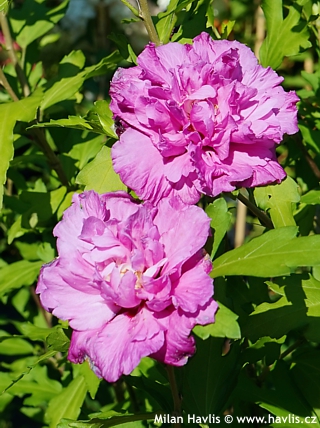
Ardens is one of the older varieties with beautiful, mauve, double, open flowers. It tends to get harder and harder to get now that new varieties come every year. This one, however, proved to be a winner, blooming profusely and reliably every year, forming a dense shrub.
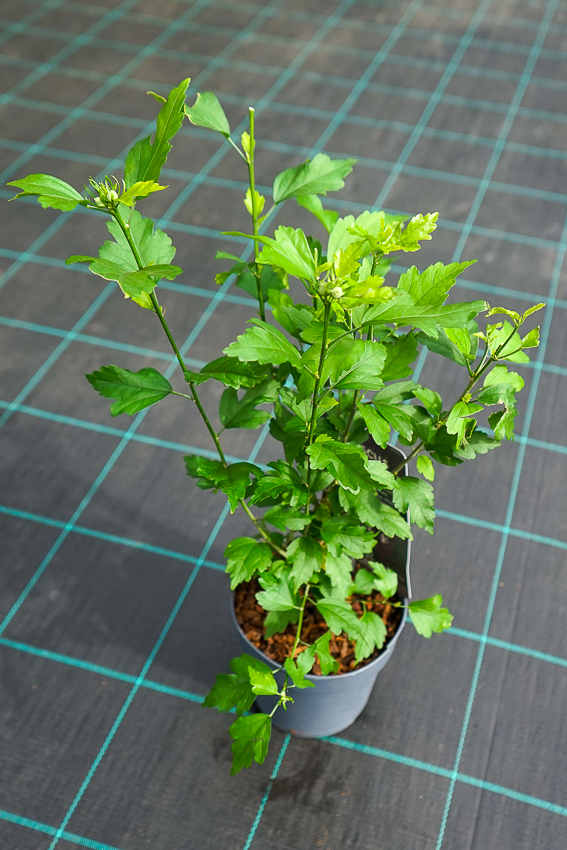
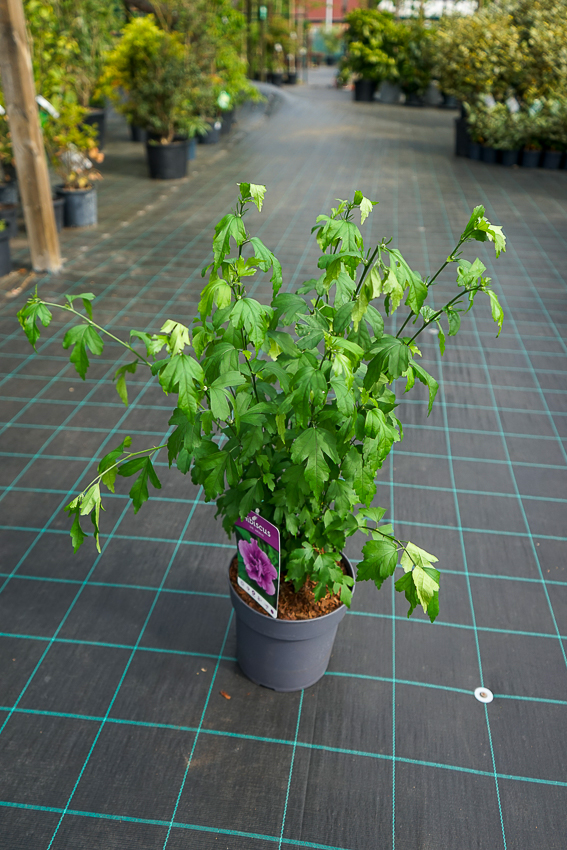
It has very decorative leaves that are unique. They are narrowly palmate, 3-lobed, mid to dark green and coarsely toothed. If they turn yellow in summer the plant manifests too much water at the roots. They are either over-watered or planted in too heavy, water-logged soil that might cause serious problems. Hibiscus is a typical example of a plant where the borderline between favourably moist soil (which they need) and wet soil can be tricky. Our advice is: water it well when you plant it, mulch it well and let it be well. Only when you see the leaves are drooping water it again.
I am quite surprised when I read comments about its pruning. Especially in older encyclopedias and on some West-European and American websites it is recommended to prune it every spring after frosts to encourage better flowering. Our hibiscus plants were only trimmed when they were young, and we did it before we planted them to achieve a compact shapes if the plants were delivered unsightly. Then nothing. They are located in different places throughout the garden with various soil types and quality, and they all grow relatively the same speed = medium slow (10-15 cm per year). Such short branches, however, are fully mature, woody and well branched which is a guarantee for profuse flowering the following year. If you prune your hibiscus hard, it may result in larger flowers but also in too long branches that will need to be trimmed again next year, and on and on. The only cut I suggest is when you need to reduce size of an old specimen.
Last update 01-03-2008.
Rose-of-Sharon is quite adaptable of soil type. As explained above it likes moist but well-drained soil, medium fertile. Older plants dislike peat. Selective fertilizers for better flowering are convenient. Place it in full sun. Fully hardy to min. -27°C (USDA zone 6, very likely 5).
Goods are shipped all over Europe. For Russia and U.K. and for further details please read about SHIPPING OPTIONS HERE.
Are you interested in a serious discount for orders NOV-FEB? Check your options here.
THE PRICES INCLUDE VAT of 15%. For quick conversion you can use 1 CZK = approx. 0.04 EUR
- STANDARD QUALITY - Plants of this group are 1st class quality with number of branches and overall density adequate to their size and age, considering they were container grown.
- DE LUXE QUALITY - This label guarantees a luxurious quality of manually selected plants that, compared to their height and age, are exceptionally dense and beautiful.
- EXTRA - These plants are usually mature and bigger specimens with exceptional overall appearance.
- STANDARD (as described in the plant form) means a tree with a trunk of 190-210 cm and a crown at the top, unless specified differently. The commercial size for trees is their girth measured in the height of 1m from ground.
- HOBBY - These plants are of the same quality as our standard-quality plants but younger and therefore cheaper.
- SHRUB - a woody plant with branches growing bushy from the ground level.
- HALF-STANDARD or MINI-STANDARD - a small tree with shorter trunk, its size is usually specified.
- FEATHERED - These are trees with branches growing already from the base of the trunk and up along the stem.
- GRASSES and PERENNIALS - Sizes given usually read the diameter of the pot or the clump, as specified.
