










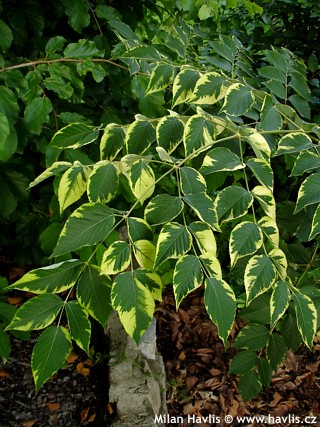


Aralia elata 'GOLDEN UMBRELLA' Japanese Angelica tree

 Symbivit Tric (arbuscular)
 Symbivit (arbuscular)
Aralia
If you are looking for an architectural plant that will attract passersby’s eyes but at the same time will require zero maintenance, and on top of that will be hardy enough for our winters, have a look at this Japanese angelica tree. Is it because the leaves that look like angel’s wings? Well, yes with a bit of poetic license. But truly it is derived from angelica which is a herbaceous plant whose flower panicles look very similar. Whichever name origin you go for, it is still a gorgeous, slow growing, small tree that is a must have for those who love exotic appeal in their gardens.
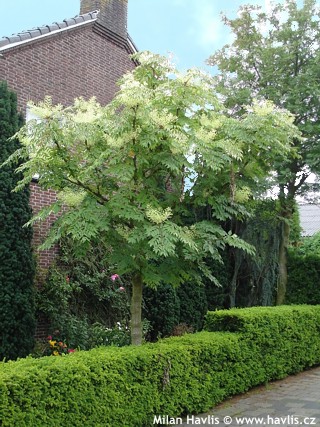
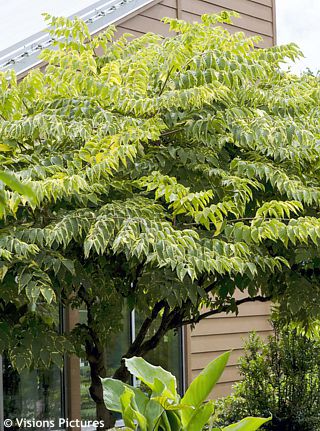
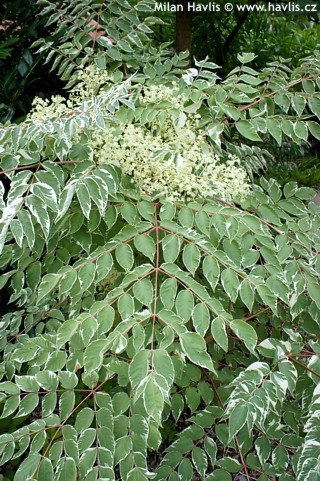
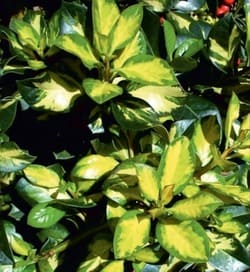
Golden Umbrella is a yellow variegated version of Japanese angelica tree. Its leaflets are irregularly mottled dark yellow in spring and the variegation gets paler to chartreuse in early summer and when the flowers appear the leaves are almost solid green. The leaves are extremely large – up to 1 meter long, bi-pinnate, compound of 3-5 cm long, up to 80 ovate leaflets, pale or silvery green on the reverse. The leaves grow horizontally from a single stem, making a tiered effect created solely by foliage because lateral branching takes many years to occur. They fall down early in the season but before they do so they change colour to fiery orange and burgundy red. From late August appear huge, erect panicles of numerous but small, creamy white flowers that may be followed by non-edible (not poisonous) purple-black berries hanging in long racemes. It provides plenty of food for insects. Young plants have spines and small thorns along the stem which disappear with age.
Angelica tree makes a great looking specimen in a Japanese style garden, or can be used in exotic landscapes where, with its large frond-like leaves, it can fully substitute a palm tree. It typically grows as a single-stemmed tree, making only short laterals (side branches) when young. Multi-stemmed trees took years to form, or plants were clipped at the top when young. To achieve a tall standard tree form remove all laterals until the central leader reaches a desired height where you want to set the crown. Then clip the top of the top in late winter so that the plant distributes its energy into production of multiple buds which will become a framework of a future dome-shaped canopy.
Last update 09-01-2009; 18-01-2020
Grow it in almost any soil type, alkaline or acidic (acidic soil will enhance autumn colours), but always well-drained. It likes equally moist soil throughout the season but will take drought once established. In many sources you can find that it takes flooding. Well, we experienced many fatal infestations of fungi diseases if plants were stuck in water-logged ground. You can tell by sudden loss of leaves during wet periods. Unless treated with a fungicide you may loose the plant irrespective of its age and size. Aralia virtually thrives on neglect. It requires no maintenance and is pest free. Suckers may appear sporadically and should be removed immediately. Fully hardy to min. -34°C, and allegedly even down to -40°C.