.jpg)

Malus domestica 'FUJI' apple - late



Malus
The Apple Tree (Malus domestica) belongs among the most important fruit trees of the temperate zone. It originated through complex hybridization of several wild species, especially Malus sieversii from present-day Kazakhstan, Malus orientalis from the Caucasus, and Malus sylvestris, the European crab apple. Botanically, it is classified in the rose family (Rosaceae), which also includes pears, quinces, and cherries. The domestic apple has been cultivated and bred by humans for millennia, with archaeological finds confirming its consumption as early as the Bronze Age. Today it is the most widespread fruit tree in the world, with thousands of cultivars differing in shape, taste, color, and ripening time. In Europe and across the temperate zone it feels so much at home that we take it for granted, while in subtropical and tropical regions apples are regarded as exotic and expensive delicacies — much as we look at their mangoes or papayas.
We Europeans consider apples our everyday treasure — both in flavor and in health. The well-known English proverb “An apple a day keeps the doctor away” has its roots in 19th‑century Wales, where it originally went: “Eat an apple on going to bed, and you’ll keep the doctor from earning his bread.” Modern research gives this saying a surprisingly firm foundation: regular apple consumption lowers cholesterol, benefits the heart, supports a healthy gut microbiome, is associated with reduced risk of diabetes and certain cancers, strengthens the body, and aids detoxification. Polyphenols act anti‑inflammatorily, and fiber (especially pectin) regulates digestion — making the apple a true “little pharmacy in your pocket.” And at the same time, it tastes wonderful. Who doesn’t know the typical Central European apple strudel, with its oldest recipe recorded in Vienna in 1697? From an aristocratic dessert it became a symbol of homely comfort even in modest households, and although it remains one of the most beloved pastries in Austria, the Czech Republic, and Germany, like all good things it has spread across the world and been warmly embraced. Incidentally, the abundance of fruit alleys along old country roads in our land is thanks to Empress Maria Theresa, who during her reign (1740–1780) ordered their planting. The trees were meant to provide shade and fruit for soldiers and travelers, while at the same time preventing looting and food theft in villages.
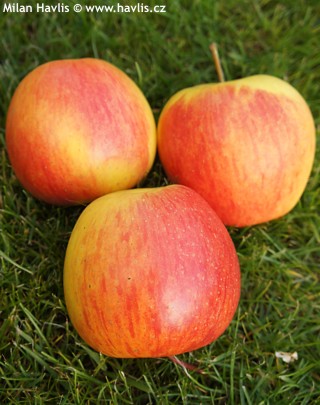
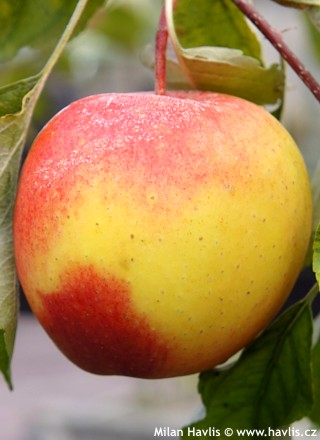
In 2003, Fuji apples ranked among the four most popular apples in the United States – alongside ‘Red Delicious’, ‘Golden Delicious’, and ‘Gala’. The fruits of this cultivar are large, round to slightly cylindrical, with a firm skin that is yellow‑green and largely overlaid with a crimson blush. The flesh is white‑cream, very juicy, crisp, and dense, with a distinctly sweet taste and a subtle honeyed aroma. Individual fruits often weigh 200–250 g, placing them among the largest dessert apples. Harvest takes place in October, eating maturity begins in November, and with proper storage the apples keep until spring, retaining both firmness and flavor. Thanks to their versatility, they are suitable for fresh consumption as well as for juices and desserts.
The cultivar was bred in Japan in 1939 at the research station in Fujisaki, Aomori Prefecture, from a cross between ‘Red Delicious’ and ‘Ralls Janet’ (also known as ‘Rawls Jennet’). It was released into practice in 1962 and from the 1980s spread rapidly worldwide, especially in the USA, China, and Australia, where it is now among the most widely grown apple trees. The tree grows vigorously, forming broadly rounded to spreading crowns of medium density with drooping branches. It flowers mid‑season and is self‑sterile, requiring suitable pollinators such as ‘Red Delicious’, ‘Golden Delicious’, ‘Idared’, or cultivars of the Gala group. It is characterized by high and regular yields, good drought tolerance, and average winter hardiness (down to about –25 °C), which makes it more suitable for warmer regions.
Apple trees in general are not demanding to grow. They thrive best in sunny sites with fertile loamy to sandy‑loam soils that are well‑drained and moderately moist. The optimal pH is slightly acidic to neutral. They do not tolerate permanently waterlogged soils, nor extremely dry and windy locations where fruit may drop prematurely. Young slender trees and half‑standards should be tied to a stake to ensure straight growth, while tall‑standards benefit from a firm wind‑brace for the first three years. During this period (and preferably longer) the soil above the roots should be kept clean of grass and weeds. Fertilization can be light, ideally organic, but is not essential. Pruning, on the other hand, is generally discouraged — it is an old and misguided habit of previous generations that often resulted in water sprouts and overcrowded crowns without fruit. Modern experience shows that, given the right site, apple trees shape a balanced crown on their own and bear reliably without intervention. Most cultivars are highly frost‑hardy, easily withstanding temperatures below –30 °C, so in our conditions they require no winter protection. At harvest and in storage, however, the fruit should be handled carefully, as even small bruises can shorten its keeping quality.
Last update: 23-02-2014, 24-10-2025