

































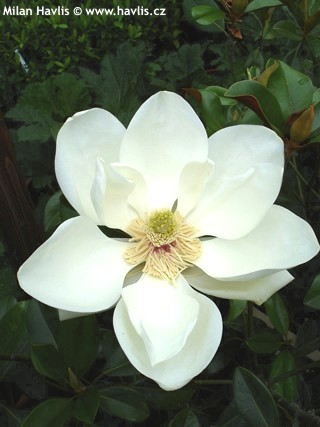


Magnolia grandiflora 'GOLIATH' (syn. 'Praecox') southern magnolia, bull bay


 Symbivit Tric (arbuscular)
 Symbivit (arbuscular)
Magnolia
Evergreen/bull bay magnolias are the queens of flowering trees. We choose the most beautiful and at the same time hardiest varieties. Goliath is a variety found by American botanist Albert Charles Smith (1906-1999) in former Caledonian Nurseries on British island Guernsey in 1910. The nursery no longer exists, only tall trees of both historical and botanical value remained on the site and were threatened by development plans in 2004 as the site was chosen for building 8 new apartment houses.
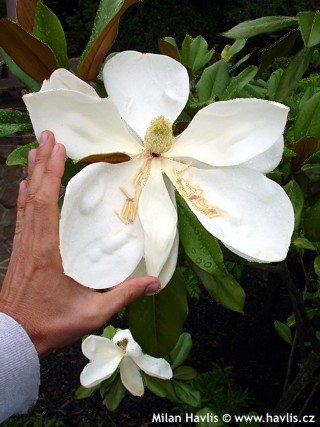
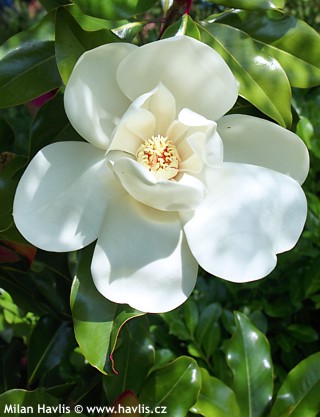
Goliath is bushier than the species. As you can tell by its name, something is going to be extraordinary here. True: the flowers are extremely large, often up to 30 cm wide, strongly fragrant and appear on the plant usually from June, often from late May if the end of spring is hot, and continue blooming throughout the summer until the last warm and sunny days of autumn. It starts flowering when only 3 years old.
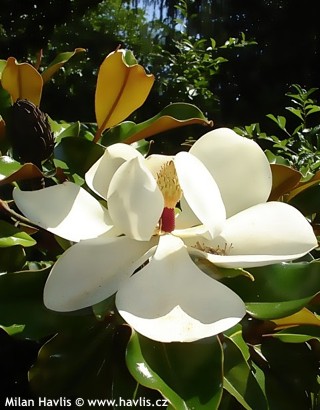
The leaves are brighter green than other bull bay magnolias with a warmer shade of green. Their rusty pubescence on the undersides is not as pronounced. They tend to curl at the tips, which are more rounded compared to the species. It is a little narrower than others and grows to some 8 m in USDA zone 6, whereas in the south of Europe it can allegedly reach over 15 m in many decades.
Find it a location with plenty of direct sunlight in summer, protected from cutting winds. If you can find such spot, grow it in winter shade. It needs slightly acidic soil, very rich in humus, moist but permeable. Pruning is not needed or recommended in our climate. If you do need to rejuvenate it do so in the spring, you always need to cut at least two thirds of all branches, not less, and follow that by regular fertilizing for 2-3 months.
Over the years we have tested its hardiness and are happy to conclude that it is hardier than most available European varieties, and its hardiness can be compared to those sought-after hardy magnolias from USA. It is perfectly hardy to min. -25°C without any damage, and to -27°C with only minor leaf damage on insolated foliage. Trials have also proved sufficient hardiness to -29°C (USDA zone 5) if protected with white woven for the 2-3 weeks while extreme frosts last. In winter provide extra watering in frost-free periods. Keep it heavily mulched all year round.
Last update 19-01-2009; 02-01-2012; 06-10-2016; 08-02-2017

Goods are shipped all over Europe. For Russia and U.K. and for further details please read about SHIPPING OPTIONS HERE.
Are you interested in a serious discount for orders NOV-FEB? Check your options here.
THE PRICES INCLUDE VAT of 15%. For quick conversion you can use 1 CZK = approx. 0.04 EUR
- STANDARD QUALITY - Plants of this group are 1st class quality with number of branches and overall density adequate to their size and age, considering they were container grown.
- DE LUXE QUALITY - This label guarantees a luxurious quality of manually selected plants that, compared to their height and age, are exceptionally dense and beautiful.
- EXTRA - These plants are usually mature and bigger specimens with exceptional overall appearance.
- STANDARD (as described in the plant form) means a tree with a trunk of 190-210 cm and a crown at the top, unless specified differently. The commercial size for trees is their girth measured in the height of 1m from ground.
- HOBBY - These plants are of the same quality as our standard-quality plants but younger and therefore cheaper.
- SHRUB - a woody plant with branches growing bushy from the ground level.
- HALF-STANDARD or MINI-STANDARD - a small tree with shorter trunk, its size is usually specified.
- FEATHERED - These are trees with branches growing already from the base of the trunk and up along the stem.
- GRASSES and PERENNIALS - Sizes given usually read the diameter of the pot or the clump, as specified.
