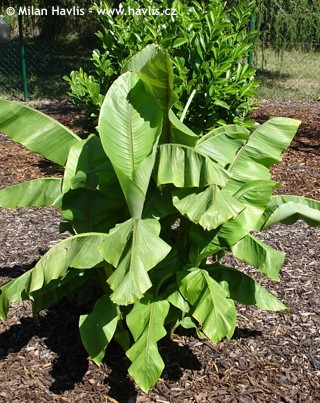


Musa basjoo 'SAKHALINE' Japanese banana


 Symbivit Tric (arbuscular)
 Symbivit (arbuscular)
Another striking feature of exotic-like gardens in our climate (zone 6) are leaves of banana trees. This selection “Sakhaline” is fully hardy and was named by the largest Russian island in the North Pacific, where its origin is. Though this island is in the same climatic zone as for example China, it is rather mountainous and in some areas temperature swings from -40°C in winter to 30°C in summer. In other parts, however, it seldom drops below -12°C and reaches no more than 16°C in summer. So you can easily guess that this climate can easily be compared to our continental central-European weather giving enough reasons for the plants to live and thrive here. This banana is a perennial which sprouts from the ground every spring and reaches 1.5-2.0m (or more depending on age of the plant) during the season. It has large, paddle-shaped leaves 1m or more long, of mid green colour, forming a false trunk with a palm-like crown. It needs light and well-drained soil with plenty of humus-rich material and enough moisture. For best results it requires frequent watering and fertilizing during the season. In the autumn when the leaves are damaged by the first frost, cut off all leaves and stems and cover the area of the plant +10 cm around with a 30-40 cm high pile of dry bark mulch. Then protect 2/3 of the top with a waterproof material to prevent it from rotting in rain and snow. In the spring remove the top and mulch to let the sun warm up the ground gradually. Should the tips of the first leaves appear before the last frosts cover them with mulch for the night. It usually sprouts late – in May. In heavy and boggy soils it may suffer from fungi diseases which must be treated with a fungicide on leaves and into the soil.