

































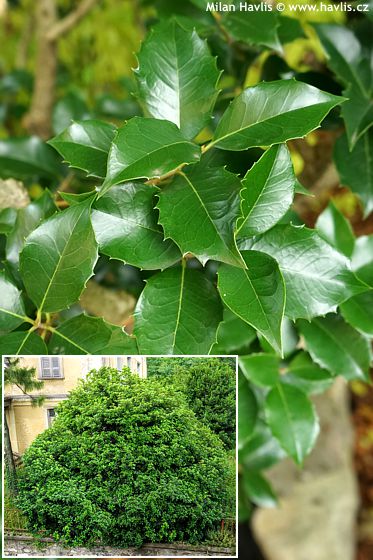


Osmanthus × fortunei (o.aquifolium) Fortune's osmanthus, hybrid sweet olive


Osmanthus
Osmanthus is a genus of only about 15-20 evergreen species and varieties, and a genus which I fell in love with the first time I saw a few plants of. Their leathery and sometimes spiny leaves resemble hollies but osmanthus plants have something extra which gave them their name derived from Greek: osme = fragrance and anthos = flower. Osmanthus has tiny but highly fragrant flowers. I was an amateur when I bought the first plants and I had no idea that in all encyclopedias they were rated too tender for our C.E. climate. And since I never knew I put them to my garden. And after some 15 years of growing I can assure you that all of them not only survived even the worst winter of 2006/2007, they thrive and some of them are taller than me and I am very close to 2m. Including the most tender one o.fragrans. I keep on trialling more species and varieties because I noticed that they have some genetic predisposition for extreme drought tolerance in summer and some are even happy with dry soil in winter. And with current lack of precipitation we will need more of drought tolerant plants.
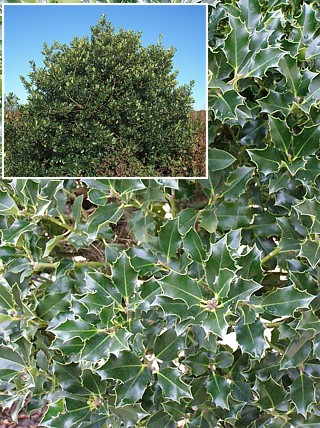
Fortune's osmanthus is a cross between o.heterophyllus (small, very spiny leaves) and o.fragrans (large, entire leaves). It was first brought from Japan to Europe to Holland Philipp Franz von Siebold in 1856. Over the years its name has developed from osmanthus aquifolium to o.aquifolium var.latifolius to currently accepted and preferred name osmanthus x fortunei in honour of Scottish botanist Robert Fortune, and including the "x" making sure it is a hybrid.
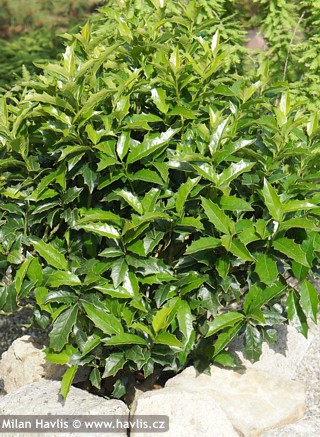
Fortune's osmanthus is a mid sized shrub or a small multistemmed tree with leathery, very stiff, deep green, and glossy leaves with sharply serrated margins. Three distinct features will tell you that it is not a holly - opposite leaves, rounded plant shape, and fragrant flowers because from mid to late autumn appear small clusters of tiny, white, strongly scented flowers. The sweet fragrance is released mostly in the afternoon and recalls a mixture of orange blossoms and plums.
The shape and luxurious foliage make this plant a jewel which was given a place of honour in my garden, put right next to the Mediterranean gazebo. Osmanthus plants are mostly cultivated in South Europe (Italy, Portugal, France) where they perfectly decorate the typical Mediterranean architecture. They respond well to pruning and bush out reliably. Spring pruning will enhance production of new twigs, summer trimming/clipping is good for shaping.
Grow osmanthus in moist but well-drained, humus rich, preferably acidic soil. It loves full sun but in colder regions find it a location hidden from late winter and early spring sunlight but with plenty of light during the growing season. Having said that we tested it in many locations of the Czech Republic and it seems reliable just like large-leaved green hollies without an extra fuss. Just make sure to transplant slightly larger plants if growing in zone 6 in order to avoid frost damage after the first winter(s). It is perfectly hardy to -20°C without damage, and to -24°C (USDA zone 6) with some sunscorch, and has even withstood 3 nights of -27°C with some burnt branch ends but regenerated quickly.
Last update 09-12-2009; 18-11-2019




Goods are shipped all over Europe. For Russia and U.K. and for further details please read about SHIPPING OPTIONS HERE.
Are you interested in a serious discount for orders NOV-FEB? Check your options here.
THE PRICES INCLUDE VAT of 15%. For quick conversion you can use 1 CZK = approx. 0.04 EUR
- STANDARD QUALITY - Plants of this group are 1st class quality with number of branches and overall density adequate to their size and age, considering they were container grown.
- DE LUXE QUALITY - This label guarantees a luxurious quality of manually selected plants that, compared to their height and age, are exceptionally dense and beautiful.
- EXTRA - These plants are usually mature and bigger specimens with exceptional overall appearance.
- STANDARD (as described in the plant form) means a tree with a trunk of 190-210 cm and a crown at the top, unless specified differently. The commercial size for trees is their girth measured in the height of 1m from ground.
- HOBBY - These plants are of the same quality as our standard-quality plants but younger and therefore cheaper.
- SHRUB - a woody plant with branches growing bushy from the ground level.
- HALF-STANDARD or MINI-STANDARD - a small tree with shorter trunk, its size is usually specified.
- FEATHERED - These are trees with branches growing already from the base of the trunk and up along the stem.
- GRASSES and PERENNIALS - Sizes given usually read the diameter of the pot or the clump, as specified.
