

































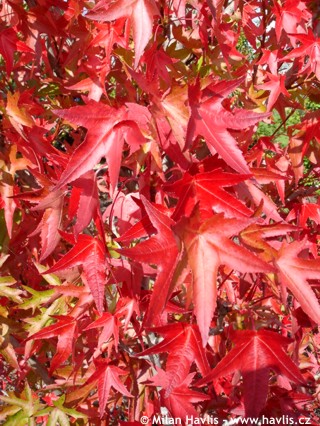


Liquidambar styraciflua ('Red Star') 'STARED' sweetgum

Liquidambar
The genus Liquidambar includes approximately 15 species of deciduous trees naturally found in the temperate zones of North America, Central America, and Southeast Asia. The best-known species, the American sweetgum (Liquidambar styraciflua), originates from the southeastern United States, where it forms part of mixed deciduous forests. The genus was formally described by Carl Linnaeus in 1753, but the first European record of sweetgum dates back to 1615, when Spanish physician and naturalist Francisco Hernández documented it during his expedition to New Spain (Virreinato de Nueva España), a vast colonial territory of the Spanish Empire in North and Central America with its capital in Ciudad de México (present-day Mexico City). He described it as a tall tree with aromatic resin resembling liquid amber – hence the genus name liquidambar. Although fossil evidence confirms the presence of sweetgums in Europe as early as the Tertiary period, today they occur here only as introduced ornamental trees.
Sweetgums are often mistaken for maples by laypeople due to their similarly shaped, deeply lobed, palmate leaves, most commonly with five tips. What you definitely won’t confuse, however, is their scent when crushed – thanks to the tree’s signature aromatic resin, which is not only fragrant but also slightly sweet. Indigenous peoples of North America – such as the Cherokee and Choctaw – collected the resin, let it harden, and chewed it as a natural treat. Its somewhat sweet taste is what gave the tree its English name sweetgum. And when it comes to autumn foliage, sweetgums are clear winners, offering a wide range of vivid colours and holding onto their leaves longer than most other deciduous trees. In regions like New England or the Appalachian Mountains, they are among the main attractions of so-called "leaf peeping" – autumn trips to places with plentiful of autumn-coloured trees, now often organized by travel agencies. It’s the American counterpart to Japan’s momijigari tradition – just with hamburgers instead of jasmine rice.
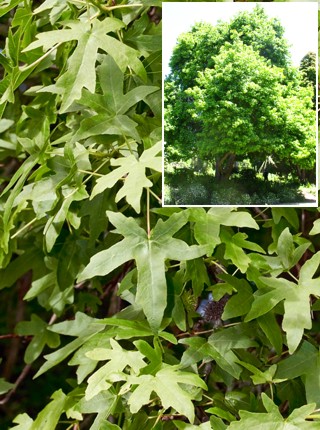
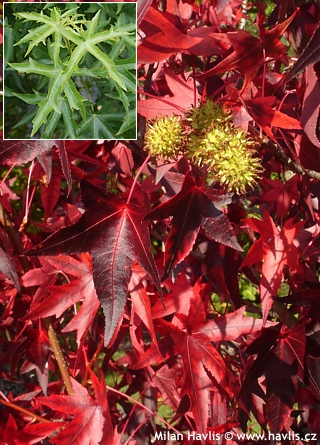
Stared is a European selection of sweetgum that appeared at the turn of the 20th and 21st centuries. Its name is a contraction of star and red, and in the literature it is sometimes also listed under the synonym ‘Red Star’. The leaves are deeply incised into 5-7 narrow lobes and hang from the branches as if by a single hair, so that at the slightest breath of wind they flutter elegantly. The whole tree then looks as though millions of tiny stars have become caught in its crown and refuse to let go.
In summer the leaves are fresh green and highly glossy, and already towards the end of summer they begin to put on a breathtaking show. They turn vivid red to maroon and remain in this state for a remarkably long time, sometimes for as much as two months. The typical sweetgum fruits are also present: lightly spiny balls about three centimetres across. They are not dangerous, but if left scattered on the lawn they can remind bare feet that the garden has a sense of quiet irony. The unusual leaf shape has led some authors to speculate about possible hybridisation with oriental sweetgum, but this hypothesis has never been botanically proven.
Compared with other sweetgums, Stared grows more slowly and forms a rather narrow, regularly pyramidal crown. Thanks to this it ranks among the most suitable cultivars for smaller gardens and urban spaces where there is no room for extravagant giants. Under our conditions it reaches roughly 5–7 metres in height with a spread of 2 to 3 metres and is usually grown with branches from ground level. Pruning is virtually unnecessary; if you do decide to take up the shears, do so only at the end of winter before bud break. Stared is a tree that manages perfectly well on its own, and when given space it rewards the gardener with an autumn performance that is hard to forget.
Sweetgums are relatively tolerant when it comes to planting sites, but they do have preferences if you want them to thrive and look their best. Always give them full sun – adequate light is the key to vibrant autumn colours. They’ll cope with ordinary garden soil, but they’ll be more vigorous and attractive in acidic, deep soil that doesn’t dry out completely. Once established, they are impressively drought-tolerant – they can even draw moisture from dew condensed on their leaves overnight. On the other hand, they can also handle more water and we’ve found they’ll grow even tolerate occasional waterlogging which results in turning colours and shedding the leaves much earlier than others. Standard forms with a trunk require a strong support – a staking set for the first three years until they establish. The soil above the roots should be kept free of turf or competing plants – ideally mulched. Pruning or shaping, if needed, is best done in late winter or in midsummer. Very young plants should be protected from severe frost, as their hardiness is around –20 °C, but mature trees and shrubs with lignified tissues can easily withstand temperatures down to –29 °C (USDA zone 5).
Last update 22-11-2008; 28-02-2026

Goods are shipped all over Europe. For Russia and U.K. and for further details please read about SHIPPING OPTIONS HERE.
Are you interested in a serious discount for orders NOV-FEB? Check your options here.
THE PRICES INCLUDE VAT of 15%. For quick conversion you can use 1 CZK = approx. 0.04 EUR
- STANDARD QUALITY - Plants of this group are 1st class quality with number of branches and overall density adequate to their size and age, considering they were container grown.
- DE LUXE QUALITY - This label guarantees a luxurious quality of manually selected plants that, compared to their height and age, are exceptionally dense and beautiful.
- EXTRA - These plants are usually mature and bigger specimens with exceptional overall appearance.
- STANDARD (as described in the plant form) means a tree with a trunk of 190-210 cm and a crown at the top, unless specified differently. The commercial size for trees is their girth measured in the height of 1m from ground.
- HOBBY - These plants are of the same quality as our standard-quality plants but younger and therefore cheaper.
- SHRUB - a woody plant with branches growing bushy from the ground level.
- HALF-STANDARD or MINI-STANDARD - a small tree with shorter trunk, its size is usually specified.
- FEATHERED - These are trees with branches growing already from the base of the trunk and up along the stem.
- GRASSES and PERENNIALS - Sizes given usually read the diameter of the pot or the clump, as specified.
