












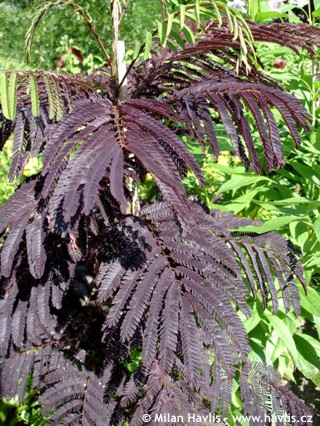


Albizia julibrissin 'SUMMER CHOCOLATE'® silk tree, false acacia


 Symbivit Tric (arbuscular)
 Symbivit (arbuscular)
Albizia
Mimosaceae plants are common and popular mainly in southern Europe for their high drought tolerance as well as attractive and long-lasting flowering. Even though they come from subtropical parts of the world there is one species hardy enough to be grown in our climate – silk tree. It originates in Iran and is renowned for its dome-shaped canopy and pink flowers over a long period in summer.
Summer Chocolate® is a spectacular silk tree variety from Japan where it was discovered in 1990 as a seedling in a controlled planting of Albizia julibrissin in 1990. It was granted a US patent No. PP13,822 in 2003. Still today it is considered a rarity for lovers of exotic-looking plants in milder climates.
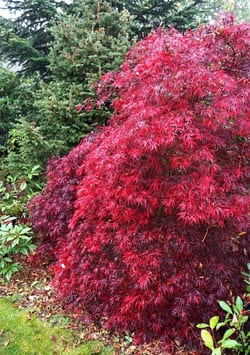
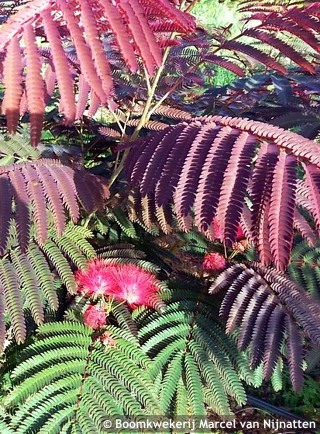
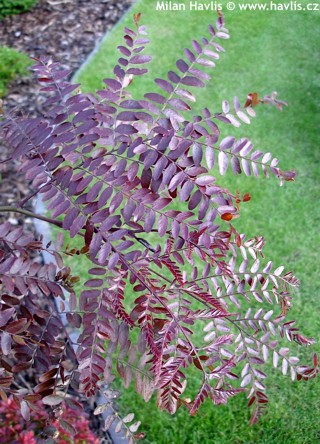
Named Summer Chocolate® it offers a stunning feature – deep maroon to almost chocolate brown foliage. The alternate leaves are bi-pinnate, delicate and persistent in the colour shade. This is what differs this albizia from other plants with maroon foliage: Summer Chocolate® leaves emerge almost green and turn maroon only when mature, whereas in case of most other plants it is the other way round. Albiza leaves close for night and during rains.
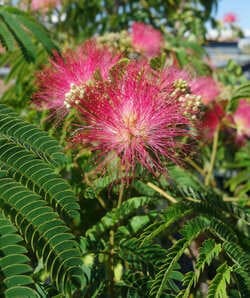
Flowering, however, is much scarcer here. The flowers are corymbs, or in simple words, hairy spheres with creamy white bottom and bright pink top. They are smaller than on the species and their presence and quantity is directly proportional to the amount of heat and sunlight it gets during summer. In zone 6 there are only a few flowers here and there, but the leaves are what we cultivate it for.
Silk tree makes a multistemmed shrub or a small tree with spreading, dome-shaped canopy. It grow rather fast and to ensure that new growths will ripen well we do not recommend fertilizing (unless selective flower-encouraging solution used). If you need to prune it do so after the danger of all frost in spring. Albizia will not flower if you cut off more than a third of last year's growth but will make long shoots.
Last update 11-12-2008; 31-01-2023
Give it a good mixture of semi-fertile, well-drained soil. It must never stand in water. It likes full blasting sun and the more heat it can take the more it will flower. Find it a position sheltered from wind. Mulch well for winter but let the sun warm up the soil above its roots in summer. It can take long periods of drought once established, however, sufficient moisture in summer months will ensure denser and healthier foliage. But excess wet may increase chances of soil diseases. Summer Chocolate® is hardy to min. -23 °C (USDA zone 6) and can withstand short spells of lower temperatures in protected locations. If the branches are injured after an unusually cold winter the plant readily regenerates from lower framework with older, more mature wood.


Goods are shipped all over Europe. For Russia and U.K. and for further details please read about SHIPPING OPTIONS HERE.
Are you interested in a serious discount for orders NOV-FEB? Check your options here.
THE PRICES INCLUDE VAT of 15%. For quick conversion you can use 1 CZK = approx. 0.04 EUR
- STANDARD QUALITY - Plants of this group are 1st class quality with number of branches and overall density adequate to their size and age, considering they were container grown.
- DE LUXE QUALITY - This label guarantees a luxurious quality of manually selected plants that, compared to their height and age, are exceptionally dense and beautiful.
- EXTRA - These plants are usually mature and bigger specimens with exceptional overall appearance.
- STANDARD (as described in the plant form) means a tree with a trunk of 190-210 cm and a crown at the top, unless specified differently. The commercial size for trees is their girth measured in the height of 1m from ground.
- HOBBY - These plants are of the same quality as our standard-quality plants but younger and therefore cheaper.
- SHRUB - a woody plant with branches growing bushy from the ground level.
- HALF-STANDARD or MINI-STANDARD - a small tree with shorter trunk, its size is usually specified.
- FEATHERED - These are trees with branches growing already from the base of the trunk and up along the stem.
- GRASSES and PERENNIALS - Sizes given usually read the diameter of the pot or the clump, as specified.
