Acer japonicum 'ACONITIFOLIUM' fullmoon maple, Japanese maple


 Symbivit Tric (arbuscular)
 Symbivit (arbuscular)
Acer
Acer japonicum, the Japanese maple, is native to the mountainous regions of northern and central Honshu and to the island of Hokkaido, where it grows in cooler, humid forests as an understorey tree or multi‑stemmed shrub. It favours humus‑rich, well‑drained soils and a stable montane climate with high air humidity. It belongs to the same taxonomic group as Acer palmatum, A. shirasawanum and A. sieboldianum, but differs from A. palmatum in its more robust habit, larger and softer leaves, and the pronounced pubescence on young shoots and petioles. Compared with A. shirasawanum, its leaves are less symmetrical, with deeper sinuses and broader lobes, and its inflorescences are not upright but gently pendulous. The leaves usually have 9–11 broad, softly tipped lobes and turn vivid shades of red, orange and purple in autumn. The species was described in the 19th century by European botanists during a period of intense interest in the Japanese flora, and it soon entered collection gardens thanks to its robustness and striking autumn colour.
Acer japonicum is one of the traditional symbols of the Japanese autumn and stands alongside Acer palmatum in cultural awareness, even though in the wild it is more typical of the cooler regions of northern Japan. Its large, softly divided leaves with deep lobes are a prominent motif of momijigari (紅葉狩り) — the “hunt for red leaves”, when people travel to temple gardens, mountains and parks in search of the finest autumn colours. Compared with the finer palmatums, japonicum appears more robust, and its autumn palette — rich reds, oranges and purples — is perceived as a more dramatic, “northern” expression of Japanese autumn aesthetics. It appears in literature and art as early as the Man'yōshū, where maple leaves symbolise transience, beauty and the melancholy of the turning year. In painting, woodblock prints and textiles, japonicum is often depicted with emphasis on its broad lobes and intense autumn colours, which have become part of the visual identity of northern Japanese landscapes. The leaves are traditionally used in ikebana and seasonal decorations, appear in the tea ceremony as a motif of late autumn, and in some regions feature in culinary specialities associated with autumn festivals. Acer japonicum thus represents a distinct, northern and dramatically coloured branch of the Japanese maple tradition, deeply rooted in cultural memory and the aesthetics of the autumn season.
The modern era of Japanese maples is shaped by several key figures and institutions that define the direction of breeding and scholarly documentation. In the Western world, a pivotal role was played by the American dendrologist J. D. Vertrees (1920–1993), author of the first comprehensive monograph Japanese Maples, followed by the British specialist Peter Gregory, long‑time curator of the collection at Westonbirt Arboretum. In Europe, one of the most important centres is the Dutch arboretum and nursery Esveld, run by the van Gelderen family (est. 1865), while in Japan traditional nurseries such as Tsukasa Maple and Kobayashi Momiji‑en preserve old regional clones and introduce new cultivars. Among the world’s leading collections are Westonbirt Arboretum in the United Kingdom, the Arnold Arboretum of Harvard University (est. 1872), which has long studied the genus Acer, and the Portland Japanese Garden, where Japanese maples have become an iconic feature and the focus of expert care. In Japan, key institutions include the Kyoto Botanical Garden (est. 1924) and the Koishikawa Botanical Garden in Tokyo (est. 1684), both of which maintain the genetic diversity of native forms.
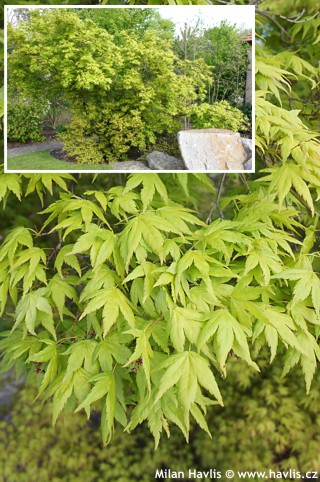
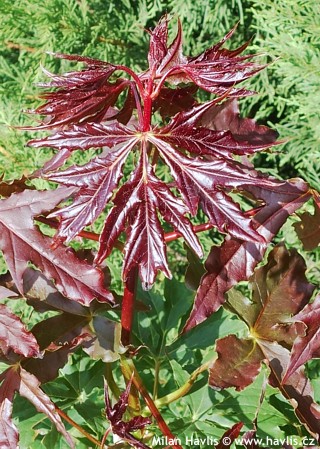
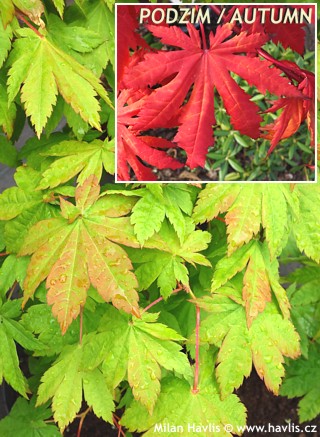
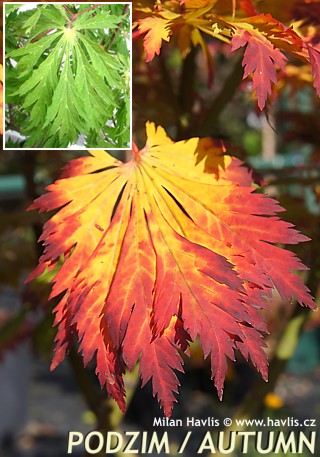
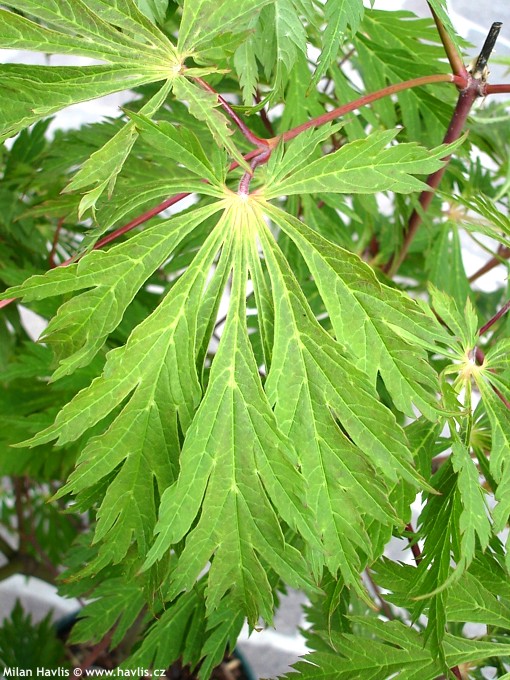
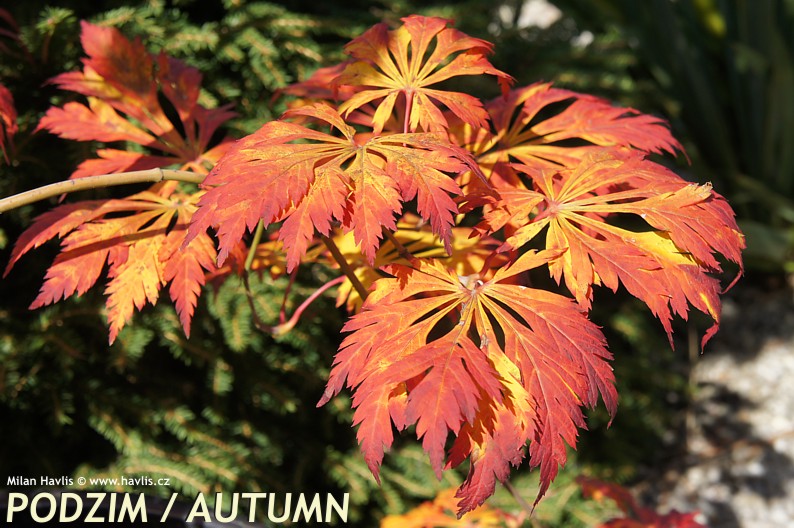
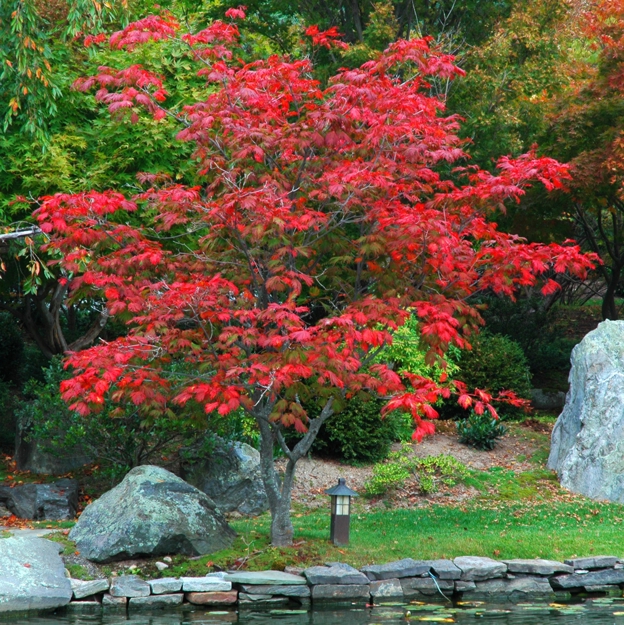
Aconitifolium is one of the oldest and best‑known cultivars of Acer japonicum, valued for its deeply divided leaves whose shape recalls those of monkshood (Aconitum), hence the name. It forms a wide‑spreading, elegant tree with a naturally airy habit, typically reaching 2–4 metres in height and similar width at maturity. The leaves are large, with 7–11 deeply cut lobes, fresh green in spring and rich green in summer with a fine texture. In autumn they turn exceptionally intense shades of gold, orange, scarlet and purple, making this one of the most spectacular autumn maples. The flowers appear early in spring, small and purplish red, borne in pendulous clusters that complement the unfolding foliage.
The cultivar originates from Japan and, according to available sources, was introduced to Europe in the 19th century, where it quickly became popular for its distinctive texture and autumn colour. The exact originator and date of selection are unknown — a common situation with old Japanese cultivars — but its long history in European gardens and repeated mention in specialist literature confirm its established place in the assortment. ‘Aconitifolium’ retains a natural, slightly wild character and is best left to develop without shaping, allowing its layered, spreading crown and fine leaf structure to stand out. Thanks to its robustness, steady growth and exceptional autumn display, it is considered one of the most reliable and impressive cultivars of Acer japonicum.
Last update 08-01-2009; 23-04-2026
The Japanese maple requires a sheltered position with dappled light or light partial shade, avoiding prolonged midday sun, which can scorch the large, soft leaves and dull their colour. It thrives in humus‑rich, slightly moist but well‑drained soil that does not dry out; compared with A. palmatum, it tolerates somewhat higher moisture and responds better to cooler, montane conditions. It does not, however, tolerate prolonged waterlogging or heavy, compacted soils. In hot summers it benefits from mulch, which stabilises soil temperature and moisture. Feeding is not recommended, as it encourages excessive growth and the formation of soft shoots prone to damage. Pruning should be light — limited to the removal of dead, damaged or crossing branches, ideally in late summer or during frost‑free periods in winter, when the risk of bleeding is lower. In denser plantings, good air circulation helps reduce fungal diseases, especially in wet years when the large leaves remain moist for longer. Acer japonicum is generally more cold‑hardy than A. palmatum, but sensitive to drought and hot winds, so it benefits from stable moisture and a calm, partially shaded site. Plants older than three to four years are fully hardy to around –29 °C (USDA zone 5).