












New in assortment - Hakone grass (Hakonechloa macra 'ALL GOLD')30.9.2026
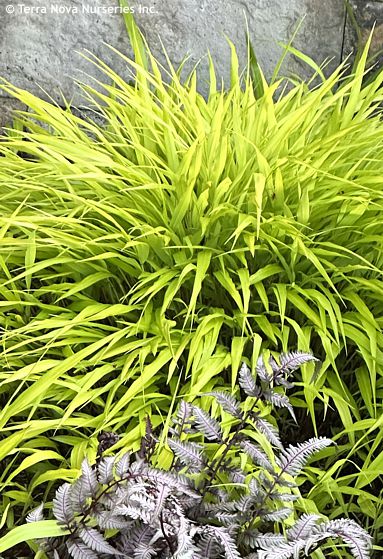
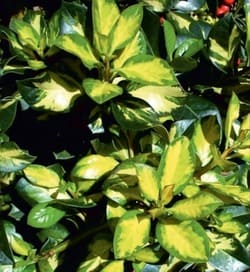
All Gold is a brightly coloured selection of Japanese forest grass, forming soft, cascading mounds with a characteristic, water‑like movement of its foliage. The leaves are narrow and silky, with a vivid lemon‑yellow to chartreuse colour that shifts gently through the season: brightest in spring, deepening into a warmer gold in summer, and turning a soft straw shade in autumn. In partial shade it keeps its cleanest colour, while full sun may lighten it slightly or bring a faint lime tint. It typically reaches 35–45 cm in height and 50–60 cm in width. Growth is slow but steady; the clump gradually expands into an elegant, low cushion that acts as a source of light and colour in darker planting schemes. The flowers are discreet, appearing in late summer as small, lightly drooping panicles that add texture rather than altering the plant’s overall expression.
It is used mainly as a colourful underplanting beneath larger shrubs, such as Japanese maples, multi‑stem birches, smoke bushes or other species with an open lower branch structure. Its bamboo‑like appearance makes it a welcome companion in Japanese gardens, where it complements tightly clipped box and Japanese azaleas, and near stone “streams” it evokes the effect of falling water. It also performs beautifully in containers, where its arching foliage creates a soft, trailing edge. It looks natural on slopes or among rocks, and thanks to its slow spread it requires very little intervention.
Last update: 30-09-2026
New in assortment - perennial phlox (Phlox 'Dophlflawhim' FLAME PRO WHITE)24.9.2026
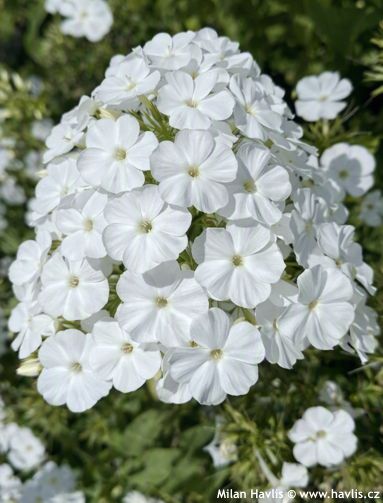
FLAME PRO WHITE perennial phlox is as pure as first snow or a bride’s dress. Its flowers are truly snow‑white, with a gentle, barely perceptible creamy tint at the centre that disappears in full sun and reappears in the evening. It flowers reliably from July to late August and belongs among cultivars capable of producing a second flush: new, smaller panicles form along the stem beneath the main one – which is best removed once spent – giving the plant a lively appearance even in late summer. The stems reach approximately 50 to 60 cm, are firm and upright, and hold their shape even after rain, a key improvement over older cultivars that often bent or broke. The leaves are healthy, fresh green, without a tendency to yellow prematurely, and the plant is self‑cleaning – spent flowers disappear on their own rather than remaining brown and withered on the panicle. FLAME PRO WHITE boasts high resistance to powdery mildew, so in normal summers its foliage remains attractive and healthy until the end of the season.
The Flame series was initiated by Dutch breeder Gosen Bartels around 2006. At that time most garden phloxes were tall, had softer stems and often suffered from powdery mildew in warm summers. Bartels therefore created the Flame series with seven recognised cultivars, each only about 40–45 cm tall, with firm stems, regular panicles and markedly lower susceptibility to mildew than older garden phloxes. And, as appetite grows with eating, he did not rest on his laurels but continued breeding. His goal was larger panicles, cleaner colours and above all stable health even in highly variable summers, when Flame cultivars began to lose resistance. His new follow‑up series was named Flame Pro and differs from the original line in three essential traits:
• even stronger stems that hold their shape even in heavy rain,
• larger and denser panicles, visibly fuller than in Flame,
• reliable resistance to powdery mildew even under more demanding conditions.
Flame Pro has “only” four cultivars – Cerise, Lilac, Soft Pink and White – because it was a targeted selection of specific traits rather than a broad colour palette. All cultivars can flower into September, as after the main flush they produce numerous smaller, secondary panicles along the stem.
Last revision 24‑09‑2026
New in assortment - coneflower (Echinacea PRINCESS™ 'Citrus')24.9.2026
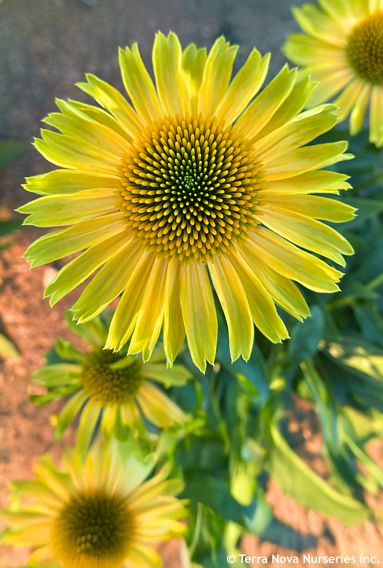
American breeder Harini Korlipara has outdone herself once again. Her coneflower PRINCESS™ CITRUS is fantastic. It carries medium‑sized blooms, 6–8 cm across, opening in a warm yellow tone, and at the height of flowering the tips of the petals shift into a soft greenish shade reminiscent of the flesh of a nearly ripe galia melon. And much like that melon, this coneflower is fragrant – fresh, sweet and full. The domed centre, a blend of orange and green, hides plenty of nectar for bumblebees and butterflies, though honeybees will also find their way in. Individual blooms last for two to three weeks, and the cultivar flowers from July until the end of September, sometimes into early October. The leaves are mid‑green, slightly glossy, broadly lanceolate and rough to the touch. The stems reach 40–50 cm and branch well – one stem can carry up to five blooms.
Terra Nova Nurseries of Oregon is one of the most influential contemporary breeders of coneflowers, and behind their work stands my favourite breeder, Harini Korlipara, who in recent years has created a series of distinct lines that have shaped the modern form of the genus. Her work is defined by compact growth, long flowering, stable colour and high uniformity achieved through precise tissue culture. The series PRIMA™, KISMET®, CARA MIA™, DELIGHTFUL™, FRESCO™, REVELATION® and SUNDIAL™ regularly receive top awards in American university trials – from Penn State and Colorado State University to UGA Trial Gardens – and many of them have achieved a perfect score of 5.0. Korlipara has established a clear, recognisable style: plants are early, firm, heat‑tolerant, abundantly flowering, rich in colour and able to hold it even in difficult conditions. Thanks to this, Terra Nova’s coneflowers enjoy immense popularity across the United States and, whenever possible, steadily make their way into European gardens as well.
Last update 23-09-2026
New in assortment - coneflower (Echinacea purpurea 'Bullechi 11' SUNMAGIC VINTAGE ORANGE)24.9.2026
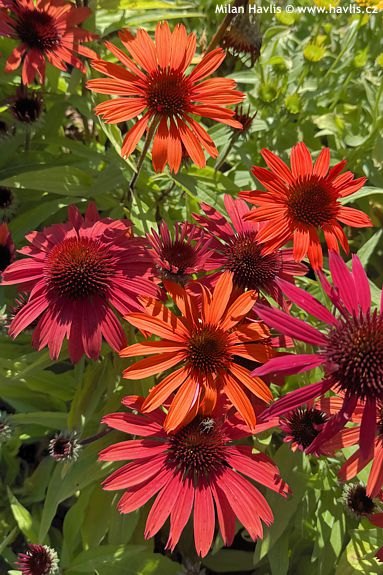
SUNMAGIC VINTAGE ORANGE coneflower comes into flower in early July and produces large blooms whose colour recalls the rind of blood oranges – a blend of deep orange and crimson red sometimes described as burnt orange. The flowers are single, measuring 10–12 cm across, and carry a sweet fragrance. Each bloom has a dark red, domed centre rich in nectar, most easily reached by bumblebees and butterflies, though honeybees will also find their way to the outer edge of the cone. Individual flowers last for two to three weeks and the plant blooms until early October. The stems are dark, firm and reach 40–60 cm, branching well even on young plants, which results in a generous number of blooms at one time. The leaves are elongated, narrowly lanceolate, fresh green, slightly rough to the touch and healthy. The plant forms dense, compact clumps. The cultivar is protected by European PBR rights no. 70085 from 2025.
The SunMagic series of coneflowers was created by Hartwig Bull of Germany at Bull Plant Genetics. Bull has long focused on developing varieties with a firm structure, stable colour and reliable growth, a philosophy reflected in his approach breed from a grower point of view. Every new series must be compact, stable, resilient, well‑branching, able to hold its colour even in extreme weather and simply grow well. SunMagic is one of his most successful projects and I believe that its strength lies partly in the fact that Bull breeds exclusively from the botanical species Echinacea purpurea, which is naturally the most robust, rather than from hybrids that can sometimes lose their perennial reliability. Hartwig Bull is also responsible for other internationally successful series: Sunbeckia, which introduced exceptionally large blooms and firm stems in rudbeckias, and SunCatcher, focused on compact sunflowers in intense colours – both regarded as annuals. Thanks to these series, plants from Bull Plant Genetics have performed well in trials from Europe and the United States to Australia, New Zealand, South Korea and Japan, and with established representation in North America they have become a steady part of the nursery trade on both sides of the Atlantic.
Last update 23-09-2026
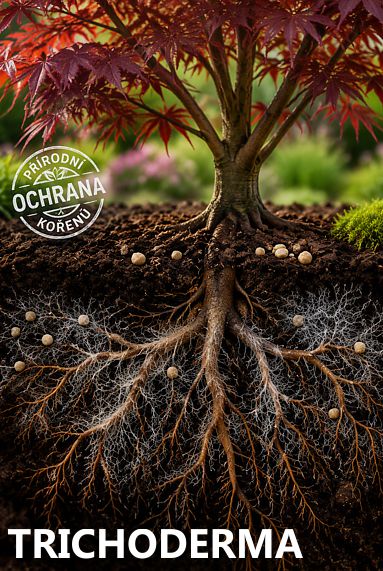
New in assortment - Soil biostimulant with antifungal activity ( TRICHODERMA)22.9.2026
New in assortment - meadow rue (Thalictrum 'Little Pinkie' CENSATION LITTLE PINKIE)20.9.2026
.jpg)
CENSATION LITTLE PINKIE breaks the long-held notion that meadow rues belong exclusively in partial shade. This one certainly does not, and its modest stature is likely part of the reason. Given adequate moisture, it performs remarkably well in full sun, where its compact habit is displayed to best effect and it rewards the gardener with an even greater abundance of brilliantly coloured flowers. The plant forms a genuinely small clump, rarely exceeding 40 cm in height. Dense and tidy, it produces attractively divided foliage that creates an elegant base for the clouds of small, richly lilac-pink to purplish flowers appearing in early summer. These shaggy little flowerheads hover just above the foliage on short stems, allowing them to remain in close visual contact with the softly matt leaves that carry a subtle blue-green tint. The flowers attract bees, hoverflies and other pollinating insects, making the plant not only charming to look at but also a meaningful contributor to the garden ecosystem. Thanks to its compact habit, it is equally at home in herbaceous borders, larger containers, smaller gardens and naturalistic plantings where soil moisture is consistently available.
The designation CENSATION™ is a trademark of CNB New Plants, a Dutch company specialising in the discovery, introduction and licensing of new perennial cultivars. Under this label, selected introductions from a wide range of genera are brought together based on their outstanding health, floriferousness, garden performance and commercial potential. Alongside meadow-rues, the portfolio currently includes cultivars of Astilbe, Astrantia, Geranium and Trollium, although the largest representation can be found among Geum and Sedum.
New in assortment - shrub rose - hybrid Persian rose (Rosa 'Korreform 500' SEE YOU IN PURPLE)18.9.2026
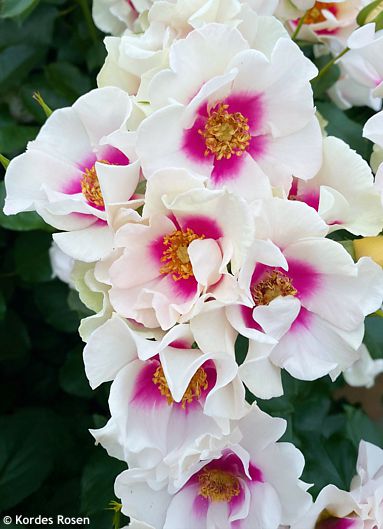
SEE YOU IN PURPLE is a hybrid of the Persian rose (Hulthemia persica) bred by W. Kordes’ Söhne in 2018. It carries the typical traits of this group: open, shallow cups with a pronounced purple centre, yellow buds and a gentle colour transition that creates a striking play of tones. The flowers measure 5–6 cm across, are semi‑double, almost white, with firmly arranged petals, and appear in medium‑sized clusters on a compact, upright plant reaching about 70 cm in height and around 50 cm in width. The colour remains stable even in hot weather and the blooms stay open for a long time. The rose flowers repeatedly from June until autumn, and thanks to its strong resistance to black spot and mildew it ranks among the most reliable Persian hybrids today. The foliage is dark green, semi‑glossy and very healthy, and the plant carries few thorns, giving it an elegant appearance even outside the flowering period.
Fragrance – ★★☆☆☆ weaker
Disease resistance – ★★★★★ excellent
Care – standard for floribundas
Flowering – repeat; throughout the season
Hardiness – very good, down to –24 °C
Pruning – standard spring pruning for floribundas
Size – height 0.7 m, width 0.5 m
Breeder – W. Kordes’ Söhne, Germany
Awards – ADR (2020)
Legal protection – EU PBR 58436 (2021)
Shrub roses form self-supporting bushes that do not require staking and naturally maintain a balanced shape. In spring they are pruned to three to five buds according to the strength of each stem, which encourages vigorous young growth and prevents congestion. During flowering, regular deadheading is essential: individual faded blooms are removed just below the flower stalk, and once an entire cluster has finished, the whole truss is cut back to the first five‑leaflet leaf; feeding afterwards stimulates a rapid flush of new shoots and buds. Shrub roses need enough space around them for even growth and good air circulation, which keeps foliage healthy and flowering steady. In mass plantings, however, they tolerate close spacing according to the recommendation for each cultivar (three to five plants per square metre).
Last update 18-09-2026
New in assortment - standard rose - floribunda (Rosa 'Korcharblo' NAUTICA)16.9.2026
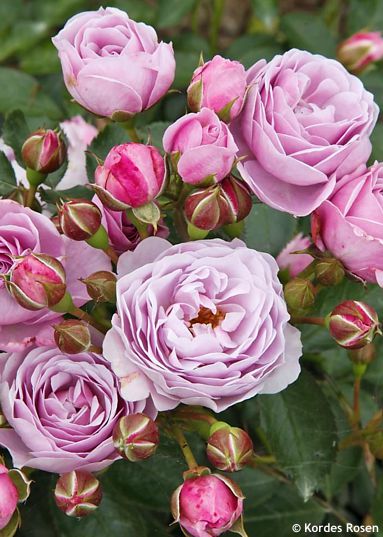
NAUTICA is a floribunda rose from W. Kordes’ Söhne, introduced in 2019, carrying an appealing light lilac‑purple, velvety bloom colour and exceptionally healthy foliage. The flowers measure 6–7 cm across, are fully double with firmly arranged petals, and appear in medium‑sized clusters on a compact, upright plant reaching about 70 cm in height and around 50 cm in width. The colour remains stable even in hot weather and keeps its rich tone throughout the season. The rose flowers repeatedly from June until autumn, and thanks to its strong resistance to black spot and mildew it ranks among the most reliable purple floribundas today. The foliage is dark green, semi‑glossy and very healthy. Nautica fits beautifully into modern plantings, smaller gardens and urban front yards, where its colour creates a striking contrast to pale and pastel cultivars.
Fragrance – ★★☆☆☆ weaker
Disease resistance – ★★★★★ excellent
Care – standard for floribundas
Flowering – repeat; throughout the season
Hardiness – very good, down to –24 °C
Pruning – standard spring pruning for floribundas
Size – height 0.7 m, width 0.5 m
Breeder – W. Kordes’ Söhne, Germany
Awards – ADR (2020)
Legal protection – EU PBR 51578 (2019)
Standard roses bring a touch of aristocratic elegance to the garden and serve as a clear sign of care, attention and a cultivated gardening style. Their richly flowering crowns, raised on a slender stem, create an airy layer of blooms above the planting, combining beautifully with perennials, lower shrubs and modern architectural elements. They excel in containers on terraces and at entrances, in front gardens, along paths and in formal compositions, where they help establish rhythm, height and clean lines. They require a little more care: in addition to regular dead‑heading and feeding, they need a firm yet as discreet as possible support to keep the stem stable in the wind without spoiling the appearance. In harsh winters, both the crown and the graft union must be protected — before winter, the branches are shortened by roughly half and the entire crown is wrapped in two layers of white fleece, tightened just below the graft. In spring, the fleece is removed and the branches are pruned back to 3–5 buds.
Last update 21-06-2026
New in assortment - shrub rose - floribunda (Rosa 'KORfloci23' MOIN MOIN® (‚Pink Flower Circus‘))16.9.2026
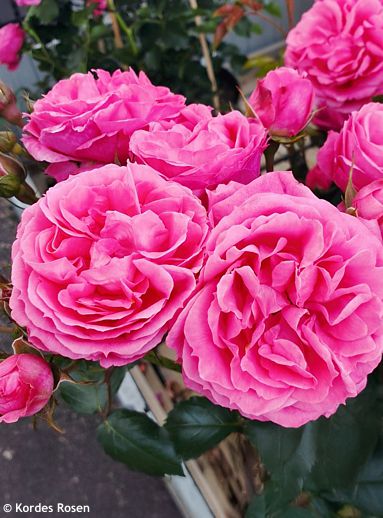
MOIN MOIN® is a modern floribunda rose bred by W. Kordes’ Söhne and introduced in 2011. It stands out for its exceptionally abundant flowering, compact growth and stable pink colour that holds well even in hot weather. Its name comes from the northern German greeting “moin moin”, common in Hamburg, Frisia and the coastal regions, expressing a friendly, playful and informal way of saying hello. The rose reflects exactly this character – fresh, cheerful and light. The blooms measure 5–6 cm across, are rounded, fully double to very full, and gradually open into shallow cups. They appear in large clusters on a dense, upright plant reaching about 60 cm in height and around 50 cm in width. The medium to raspberry pink colour remains stable throughout the season. It flowers repeatedly from June until frost, and the blooms tolerate rain and wind very well. The foliage is dark green, glossy and highly resistant to black spot and mildew, confirmed by the ADR award from 2015. Thanks to its compact habit, it is ideal for smaller gardens, urban front yards, terraces and containers.
Fragrance – ★★☆☆☆ weaker
Disease resistance – ★★★★★ excellent
Care – standard for floribundas
Flowering – repeat; throughout the season
Hardiness – very good, down to –24 °C
Pruning – standard spring pruning for floribundas
Size – height 0.6 m, width 0.5 m
Breeder – W. Kordes’ Söhne, Germany
Awards – ADR (2015)
Legal protection – EU PBR 34979 (2013), USA PP23558 (2013)
Shrub roses form self-supporting bushes that do not require staking and naturally maintain a balanced shape. In spring they are pruned to three to five buds according to the strength of each stem, which encourages vigorous young growth and prevents congestion. During flowering, regular deadheading is essential: individual faded blooms are removed just below the flower stalk, and once an entire cluster has finished, the whole truss is cut back to the first five‑leaflet leaf; feeding afterwards stimulates a rapid flush of new shoots and buds. Shrub roses need enough space around them for even growth and good air circulation, which keeps foliage healthy and flowering steady. In mass plantings, however, they tolerate close spacing according to the recommendation for each cultivar (three to five plants per square metre).
Last update 16-09-2026
New in assortment - shrub rose (Rosa 'KORcoptru' ROSENSTADT FREISING)16.9.2026
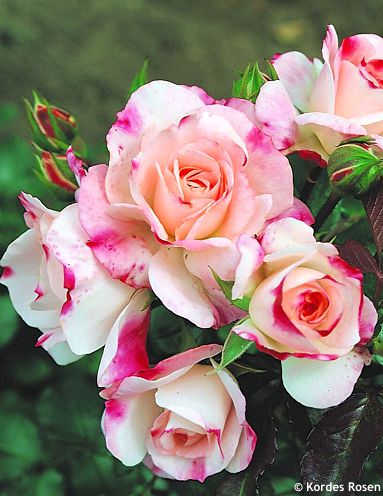
ROSENSTADT FREISING is a robust and striking shrub rose from the Heckenzauber® collection, introduced by W. Kordes’ Söhne in 2003. It is valued for its distinctive three‑coloured blooms combining a pure white base with a carmine red edge and fine pink speckling. The flowers measure 6–7 cm across, are semi‑double to double, and appear in large clusters on an upright, naturally compact plant reaching about 120 cm in height and around 80 cm in width. It flowers repeatedly throughout the season and, thanks to its stable growth, forms a long‑lasting decorative feature in borders, parks and urban plantings. The foliage is glossy, healthy and highly resistant to fungal diseases, confirmed by the prestigious ADR award from 1996 and several international medals (Kortrijk, Monza, Rome). Its vigour and resilience make it suitable even for warmer sites, and it tolerates short periods of drought.
Fragrance – ★★☆☆☆ weaker
Disease resistance – ★★★★★ excellent
Care – standard for shrub roses
Flowering – repeat; throughout the season
Hardiness – very good, down to –24 °C
Pruning – standard spring pruning for shrub roses
Size – height 1.2 m, width 0.8 m
Breeder – W. Kordes’ Söhne, Germany
Awards – ADR (1996), silver medals Kortrijk, Monza, Rome
Legal protection – EU PBR 14514 (2003)
Shrub roses form self-supporting bushes that do not require staking and naturally maintain a balanced shape. In spring they are pruned to three to five buds according to the strength of each stem, which encourages vigorous young growth and prevents congestion. During flowering, regular deadheading is essential: individual faded blooms are removed just below the flower stalk, and once an entire cluster has finished, the whole truss is cut back to the first five‑leaflet leaf; feeding afterwards stimulates a rapid flush of new shoots and buds. Shrub roses need enough space around them for even growth and good air circulation, which keeps foliage healthy and flowering steady. In mass plantings, however, they tolerate close spacing according to the recommendation for each cultivar (three to five plants per square metre).
Last update 16-09-2026
New in assortment - standard rose - floribunda (Rosa 'Korploban' CREMOSA)16.9.2026
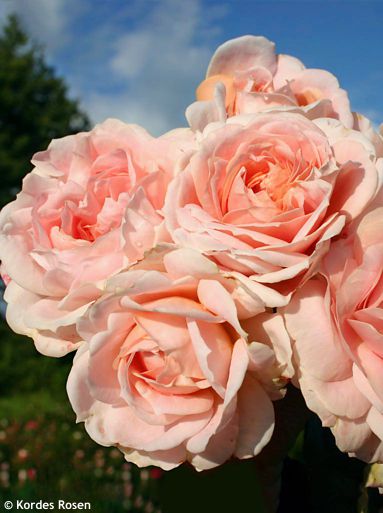
CREMOSA is a modern floribunda rose bred by Wilhelm‑Alexander Kordes and introduced by W. Kordes’ Söhne in 2018. It combines nostalgically full blooms with outstanding health and reliable repeat flowering. The flowers measure 6–7 cm across, carry a high petal count and appear in smaller clusters on a firm, compact plant reaching about 70 cm in height and around 50 cm in width. The soft apricot colour gives the rose a calm, elegant presence, fitting both romantic borders and contemporary plantings. The fragrance is clearly noticeable and complements the appearance of the blooms. Cremosa shows excellent resistance to fungal diseases, confirmed by the prestigious ADR award in 2016, and thanks to its stable performance it belongs among floribundas that look refined yet remain easy to grow.
Fragrance – ★★★★☆ strong
Disease resistance – ★★★★★ excellent
Care – standard for floribundas
Flowering – repeat; throughout the season
Hardiness – excellent, down to –28 °C
Pruning – standard spring pruning for floribundas
Size – height 0.7 m, width 0.5 m
Breeder – W. Kordes’ Söhne, Germany
Awards – ADR (2016)
Legal protection – EU PBR 58396 (2021)
Standard roses bring a touch of aristocratic elegance to the garden and serve as a clear sign of care, attention and a cultivated gardening style. Their richly flowering crowns, raised on a slender stem, create an airy layer of blooms above the planting, combining beautifully with perennials, lower shrubs and modern architectural elements. They excel in containers on terraces and at entrances, in front gardens, along paths and in formal compositions, where they help establish rhythm, height and clean lines. They require a little more care: in addition to regular dead‑heading and feeding, they need a firm yet as discreet as possible support to keep the stem stable in the wind without spoiling the appearance. In harsh winters, both the crown and the graft union must be protected — before winter, the branches are shortened by roughly half and the entire crown is wrapped in two layers of white fleece, tightened just below the graft. In spring, the fleece is removed and the branches are pruned back to 3–5 buds.
Last update 16-09-2026
New in assortment - stonecrop (Sedum 'Pldaz2018' SUNSPARKLER® PLUM DAZZLED)15.9.2026
.jpg)
PLUM DAZZLED stonecrop from the SUNSPARKLER® series, bred by Chris Hansen in Michigan, belongs among the most colour‑attractive varieties. Its young spring foliage emerges in a deep plum shade with a matte finish, as each leaf is covered with a fine waxy layer that gives it a lightly frosted appearance. In late summer it produces dense clusters of small pink flowers, creating a gentle yet unmistakable contrast with the dark foliage. The flower colour is striking, but unlike some other cultivars – such as the neon‑bright FIRECRACKER from the same series – it remains calm and refined, like pink pearls set against dark velvet. The inflorescences are firm, abundant and highly attractive to bees and bumblebees. The leaves are small and fleshy, and during flowering they show a blend of deep maroon tones and dark olive‑green. The habit of the plant reflect one of its parents, Sedum cauticola, a low, slightly mat-forming species with small leaves, while the second parent, Hylotelephium telephium, contributes generous flowering and stronger stems.
In the garden, the SUNSPARKLER® PLUM DAZZLED stonecrop works well as a low groundcover for sunny, dry sites, where it forms a dense carpet of colour with late summer flowering. It performs reliably in gravel borders and prairie plantings, where its dark foliage highlights lighter perennials such as catmint, yarrow, sage or ornamental grasses. It also combines well with other succulents, including sempervivums, delospermas or low thymes, which appreciate the same soil conditions. Next to plants with silvery foliage, such as wormwood, helichrysum or senecio, it acts as a strong contrasting element. In containers it keeps its shape and colour throughout summer and forms an attractive spill, making it suitable for terraces and balconies. Thanks to its late flowering it provides bees and bumblebees with a valuable source of nectar at the end of the season. The cultivar is protected by European PBR No. 55351 from 2016.
American plant breeder Christopher M. Hansen is the kind of person who can ignite not just a spark but a whole firework of enthusiasm for plants even in people who previously thought that “succulents are just pebbles with leaves”. That’s why his friends and colleagues call him Sparky. His passion began at the age of five, when he collected his first houseleeks, and he hasn’t stopped since: he went through the Missouri Botanical Garden, Longwood Gardens, and Wayside Gardens, where he learned the craft in depth. Today he leads his own company and team at Garden Solutions and introduces series that carry exactly his kind of energy – SunSparkler® sedums, Chick Charms® sempervivums, Gnome Domes® orostachys, and even the Winter Thriller® hellebores, which were in fact his first major success. Sparky is a breeder who tests plants under extreme conditions, loves colour, contrast, and playfulness, and aims to bring joy back into gardens. His projects are not just about genetics – they are about helping people fall in love with plants as spontaneously as he once did, and that resonates with me deeply.
Last update 16-09-2026
New in assortment - stonecrop (Sedum SUNSPARKLER® FIRECRACKER)10.9.2026
.jpg)
FIRECRACKER is another remarkable low‑growing stonecrop from the SUNSPARKLER® series bred by Chris Hansen in Michigan, USA. In late summer it produces dense clusters of small pink flowers that create a soft yet striking contrast to the dark foliage. The flower heads are firm and abundant, attracting bees and bumblebees, so in high summer they appear like a gentle pink shimmer above a maroon carpet. The leaves are fleshy, deep purple to chocolate burgundy, and in spring they emerge olive green with only reddish margins. Its habit is low, compact and wide‑spreading, with no tendency to flop even in rain, which is the main difference from the original species. The name ‘Firecracker’ refers to the sparkling effect of the dark leaves and pale pink flowers, which in midsummer truly resemble a small garden firework.
In the garden, the SUNSPARKLER® FIRECRACKER stonecrop works well as a low groundcover for sunny, dry sites, where it forms a dense carpet of colour with late summer flowering. It performs reliably in gravel borders and prairie plantings, where its dark foliage highlights lighter perennials such as catmint, yarrow, sage or ornamental grasses. It also combines well with other succulents, including sempervivums, delospermas or low thymes, which appreciate the same soil conditions. Next to plants with silvery foliage, such as wormwood, helichrysum or senecio, it acts as a strong contrasting element. In containers it keeps its shape and colour throughout summer and forms an attractive spill, making it suitable for terraces and balconies. Thanks to its late flowering it provides bees and bumblebees with a valuable source of nectar at the end of the season. The cultivar is protected by patents no. 43679 (EU, 2016) and PP26595 (USA, 2016).
American plant breeder Christopher M. Hansen is the kind of person who can ignite not just a spark but a whole firework of enthusiasm for plants even in people who previously thought that “succulents are just pebbles with leaves”. That’s why his friends and colleagues call him Sparky. His passion began at the age of five, when he collected his first houseleeks, and he hasn’t stopped since: he went through the Missouri Botanical Garden, Longwood Gardens, and Wayside Gardens, where he learned the craft in depth. Today he leads his own company and team at Garden Solutions and introduces series that carry exactly his kind of energy – SunSparkler® sedums, Chick Charms® sempervivums, Gnome Domes® orostachys, and even the Winter Thriller® hellebores, which were in fact his first major success. Sparky is a breeder who tests plants under extreme conditions, loves colour, contrast, and playfulness, and aims to bring joy back into gardens. His projects are not just about genetics – they are about helping people fall in love with plants as spontaneously as he once did, and that resonates with me deeply.
Last update 09-09-2026
New in assortment - coneflower (Echinacea 'Balsomselo' SOMBRERO SANDY YELLOW)6.9.2026
.jpg)
SOMBRERO™ SANDY YELLOW coneflower wins you over with its understated elegance, which may at first seem almost reserved. But after two to three years, when the clump in the border thickens and begins to flower truly abundantly, you realise that this reserve was only a lure for shyer suitors, much like in courtship. Only in a larger clump does its original beauty fully appear: soft pastel yellow blooms that rightly bear the name SANDY YELLOW. And that sand is certainly not meant as building material, but as sunlit sand on an enchanting beach. You fall for this coneflower just as you fall for that beach you want to return to again and again.
The flowers are single, lightly scented, about 8 cm across, and their centre is adorned with the typical raised, bristly cone offering plenty of nectar for bumblebees and honeybees. They appear from July to September and although their colour softens as they mature, each bloom remains attractive for a good 10–14 days. The leaves are dark green, firm, ovate‑lanceolate, slightly rough to the touch, with pronounced veining that keeps the clump fresh and healthy throughout the growing season. They form a dense basal rosette that gives rise to sturdy stems reaching about 60 cm. The whole clump is dense and fairly compact. The variety is protected by these patents: PP23104 (USA, 2012) and EU 37680 (Europe, 2014).
New in assortment - clasping knotweed (Persicaria amplexicaulis 'EARLY PINK LADY')29.8.2026
.jpg)
Early Pink Lady knotweed will delight those who do not like waiting for summer perennials. It is one of the few exceptional cultivars that can start blooming as early as mid-July if the season starts well. Its slender, spike‑like inflorescences carry deep pink to rosy red buds and soft pink flowers, giving the flowering clump an elegant colour without looking pale. The spikes are usually 12–14 cm long, sometimes a little more, and the flowering stems reach around 70 cm. They remain straight and narrow even in rain, so the plant never looks tousled, even in a dense planting. The clump is compact, firm and quick to knit into the border. The leaves are medium‑sized, usually 10–15 cm long, dark green with a purplish flush when emerging and on the uppermost leaves in full sun. They are matte, which contrasts well with the pink spikes. The shape is broadly lanceolate, with a clearly clasping base that curves gently around the stem, the feature that gives the species its name amplexicaulis = embracing. In the border they soon create and even, attractive surface. It spreads as a tight clump and is not invasive.
Last update 29-08-2026
New in assortment - Tibetan cherry, Birchbark cherry (Prunus serrula)27.8.2026
.jpg)
The Tibetan cherry is an exceptionally beautiful deciduous tree with a subtle, almost understated aesthetic. Unlike most flowering cherries, it does not offer a mass of blossom in spring, but draws attention through its bark, whose detail is so compelling that one naturally steps closer to appreciate both sight and touch. It is strikingly glossy, mahogany to deep amber brown, and on young trees it peels horizontally in thin ribbons like delicate shavings. Over time it develops irregular pale markings that resemble the striping of an okapi, the African relative of the giraffe. This highly attractive bark earned the species considerable recognition in horticulture, and in 1944 it received the Award of Merit from the Royal Horticultural Society.
The leaves are deciduous, narrowly lanceolate, long and finely pointed, with regular, delicate serration along the margin. They measure 5 to 10 cm in length and 1.5 to 3 cm in width and do not resemble typical cherry leaves; because they are slightly pendulous, they are often compared to willow leaves. The flowers are white, about 1.5 to 2 cm across, usually produced in twos or threes, sometimes singly or in fours, and appear in April without creating a dramatic display. The fruits are small, oval, about 1.2 cm long, red and glossy, and ripen in summer. They are edible but not palatable and are not eaten.
The Tibetan cherry is a medium-sized tree reaching 10 to 15 metres in height with a moderate growth rate of 30 to 40 cm per year. Young shoots are softly downy and grow upright, giving the tree a distinctly ascending crown. In gardens it is used mainly as a specimen tree, because its winter effect is strongest when it has enough space and direct winter light. In parks it performs well in small groups, where the repeated pattern of trunks becomes a strong compositional element. It is often combined with spring bulbs, which benefit from the stable structure, and later with Japanese anemones, which in dense single-species plantings create long-flowering clumps in late summer and autumn. The tree looks best where its bark can be fully appreciated, such as in winter sun, near paths, terraces, water features or light-coloured walls that reflect light.
Last revision 26–08–2026
New in assortment - New York ironweed (Vernonia noveboracensis)25.8.2026
.jpg)
The first thing you notice about New York ironweed is its unusually strong and tall structure: the stems feel as if they were made of flexible metal, and the plant keeps its upright shape even after heavy rain or wind. The main show, however, arrives from early to mid‑August – small purple flowers in a shade so vivid it almost dazzles the eye. They glow from a distance, and because ironweed is still relatively unknown, many plant lovers wonder what those bright flowers, unlike anything familiar, actually belong to. Their structure reflects the plant’s membership in the Asteraceae family: they resemble tiny asters, only smaller, denser and arranged in generous, open clusters. Flowering lasts almost two months, depending on the age of the plant, atop strong stems that reach up to 2 metres in good conditions. The habit is tall, slender and naturally architectural, with 10–20 cm long, lanceolate, mid‑green leaves with a finely serrated margin, forming a firm, continuous column of healthy foliage even at a time when other perennials may show signs of late‑season fatigue. It is hardy to abt. -34 °C (USDA zone 4).
New York ironweed is a quintessential late‑summer plant that brings the atmosphere of American wetlands and mid‑Atlantic wet meadows into garden borders, where it grows among tall grasses, Eupatorium, Eutrochium, Hibiscus moscheutos and other moisture‑loving species – and it is with these plants that it creates the most natural compositions in gardens. Its upright, architectural form works beautifully in modern naturalistic plantings, and it is no surprise that it has become popular in Great Britain, where gardeners traditionally love tall perennials that give borders dramatic height and late‑season impact. It pairs well with plants that share a similar rhythm: Eutrochium maculatum, Sanguisorba officinalis, Thalictrum rochebrunianum, Veronicastrum virginicum and dark‑leaved Actaea simplex, while the front of the border can be filled with lighter species such as Gillenia trifoliata, Helenium autumnale, Persicaria amplexicaulis or Eutrochium dubium, which complement its height and create a layered, natural picture.
Last revision 25‑08‑2026
New in assortment - Cooper's ice plant (Delosperma cooperi 'John Proffitt' TABLE MOUNTAIN)17.8.2026
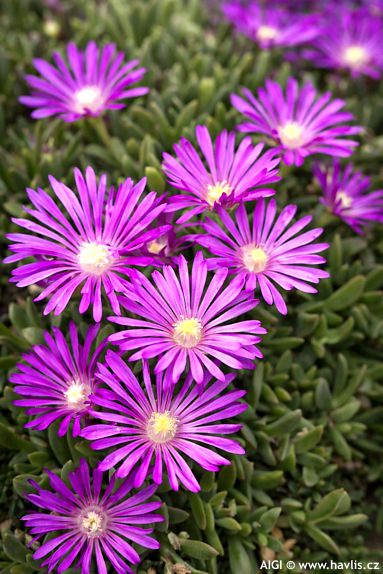
‘John Proffitt’ TABLE MOUNTAIN belongs to the Cooper’s ice plant group and, in this case, boasts a mass of bright purple flowers with a pale-yellow centre that glow like tiny glass lenses in full sun. The plant forms low, firm mats about 10 to 12 cm high and 45 to 60 cm wide, capable of extending by 20 to 25 cm in a single season. The leaves are grey‑green, fleshy and filled with a characteristic gel‑like substance which, when punctured, produces tiny sparkling droplets – the very feature that gave ice plants their English name. The flowers, 3.5 to 5 cm across, appear from late May and continue in abundant bloom until mid or late July, after which the plant produces occasional flowers into autumn, a markedly longer season than that of the original species, D. cooperi.
‘John Proffitt’ TABLE MOUNTAIN is an excellent choice for a long season of colour with minimal maintenance. It performs best in rock gardens, gravel plantings, among stones or in the crevices of dry walls, where its trailing growth quickly forms a continuous, low carpet up to 60 cm wide. Its vivid flower colour combines well with perennials of similar requirements but different structure – such as sempervivums, sedums, lewisias or low fescues, which add contrast in both colour and texture. To extend the flowering season, low pinks or creeping thymes can be added to fill the brief pauses when the ice plant rests. Thanks to its tolerance of heat, drought and wind, it is an excellent choice for xeric plantings and exposed sites where other perennials fail to thrive.
The cultivar was developed through a collaborative project between Denver Botanic Gardens and Colorado State University, aiming to produce a markedly cold‑hardy form capable of withstanding the extreme temperature fluctuations of high‑altitude Colorado. It entered the market in 2002, and the original cultivar name ‘John Proffitt’ honours a former director of Denver Botanic Gardens. The later commercial name TABLE MOUNTAIN refers to the Table Mountain of Cape Town, a smaller yet iconic landmark of South Africa with its almost perfectly level summit plateau. By the way, did you know that beneath Table Mountain meet 2 oceans? The Atlantic and the Indian Oceans create a fascinating view because of their different temperatures, salinity and currents, their waters often maintain a surprisingly sharp boundary that can even be seen in the colour. This ice plant doesn’t give a damn though. What matters is that compared with the original species, it has a more compact habit, a longer flowering period, greater tolerance of winter moisture and a more stable performance in temperate climates far from the Table Mountain itself. As a member of the Plant Select® programme, it ranks among the most reliable hardy ice plants available, with a proven cold tolerance of –28 to –30 °C (USDA zone 5) when good drainage is ensured.
Last update 15-02-2026
New in assortment - hardy ice plant (Delosperma 'SUNDELLA RED')15.8.2026
.jpg)
Sundella Red ice plant stands out with its unusually deep, almost ruby‑coloured flowers that shine like small pieces of glass in full sun. The plant forms low, firm cushions with dense, fleshy leaves slightly broader than those of wild species, creating a compact base for a generous display of blooms. Its habit is even and stable, with no tendency to split apart, suggesting the influence of species with naturally tight growth such as D. congestum. The flowers measure about 2.5 to 3 cm across, with narrow, highly glossy petals that open only in full sun and create a striking colour effect even on a small area. Flowering begins in late May and is at its strongest until mid‑July, after which the plant continues to produce occasional blooms until September.
Ice plants are most often grown in rock gardens and similar plantings – among stones, in ornamental gravel or in the crevices of dry walls – and combine well with perennials that share the same requirements but flower at different times, extending the interest of the whole composition. They look particularly good among sempervivums and lewisias, and can be paired with low, compact grasses such as fescues. Sedums offer a contrasting palette of foliage colours, while low pinks provide a different flower form. For herb lovers, the smallest species such as thyme, wild thyme or savoury make excellent companions.
Last revised 15‑08‑2026
New in assortment - cup plant (Silphium perfoliatum)14.8.2026
.jpg)
Cup plant is one of those prairie species you notice immediately. It is a very tall perennial that reaches between 2 and 2 metres in height, flowers included, depending on conditions, and it never disappears in the background. You recognise it by its massive, four‑angled stems wrapped in large, coarse leaves 30 to 40 cm long, clasping the stem so tightly that they form the characteristic little cups. These leaf “cups” are not just a curiosity. They catch water running down the stem and provide moisture for the plant and for birds and small animals in locations where water is scarce.
The flowers are typical for the Asteraceae family, like oversized bright yellow daisies 5 to 6 cm across, occasionally up to 8 cm, arranged in terminal panicles. A single panicle usually carries around 15 flower heads, but in fertile soil and a long summer it can produce up to 50, so the whole structure bends slightly under their weight like a heavy raceme. Flowering begins in early or mid-August and continues until the end of September.
Cup plant is a substantial perennial, whether in tall or shorter cultivars and species. It performs best when planted in groups, where it creates a visible mass of foliage and later a long season of bright flowers. As a moisture‑loving perennial it pairs well with heleniums, joe‑pye weeds and swamp mallows. Dark‑leaved bugbanes provide contrast in colour and texture, ligularias offer a different flower form and leaf shape, trollius brings earlier flowering and the front of the border can be filled with astilbes, marsh marigolds or heucheras.
Last update: 14-08-2026
