Acer negundo 'VARIEGATUM' ash-leaved maple, box-elder

 Symbivit Tric (arbuscular)
 Symbivit (arbuscular)
Acer
The genus Acer belongs among woody plants that appeared very early in the Northern Hemisphere, and whose basic form has changed remarkably little since then, unlike many other tree groups. Tertiary fossils from Europe, Asia and North America already show leaves and fruits that would be instantly recognisable today, including the characteristic paired samaras. In Czechia, one of the best known fossil sites is Bílina, where petrified maple leaves and fruits from the late Tertiary period testify that these trees were part of the local landscape long before the arrival of humans. Scientifically, the genus was described by Carl Linnaeus (1707–1778) in his seminal work Species Plantarum in 1753, although its internal classification has been repeatedly revised since then. Today, botanists regard East Asia, particularly China, Japan and the Himalayan region, as the true centre of species diversity within the genus. Maples occupy an exceptionally wide range of habitats, from subtropical mountain forests to the cold regions of the temperate zone. They are among the trees that have accompanied human landscapes and cultures for a very long time.
Acer negundo, ash-leaved maple or boxelder, originates from North America, where it formed part of the everyday life of Indigenous peoples as well as later European settlers for centuries. It naturally grows along rivers, in floodplains and in open woodlands, where it functions as a fast growing and highly adaptable tree. At times when sugar maple was not readily available, sugar was commonly produced from its sap, albeit with lower yields and a milder flavour. The species was introduced to Europe in 1688, when it was cultivated in the gardens at Fulham near London by Henry Compton (1632–1713), one of the most important introducers of North American woody plants of his time. From there, boxelder gradually spread into botanical gardens and parks throughout Europe. In what is now the Czech Republic, it has been documented since 1835, when it appeared in the Royal Game Reserve in Prague’s Stromovka, from where it quickly spread into castle parks, urban greenery and the open landscape. Often this spread was not intentional. Based on long term scientific studies, boxelder has been shown to possess a high degree of invasiveness, which has led to the botanical species being excluded from recommended plantings and actively removed in many locations. In horticultural practice, therefore, only selected, predominantly sterile cultivars are used, as they do not pose a comparable risk to surrounding vegetation.
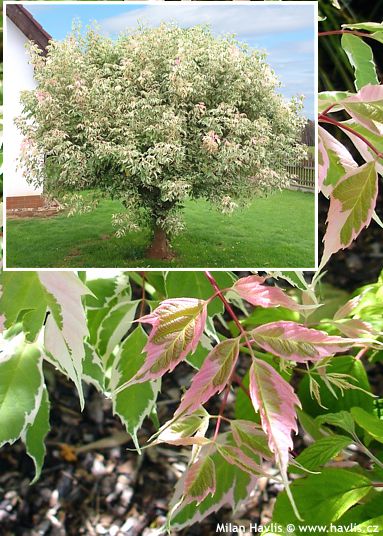
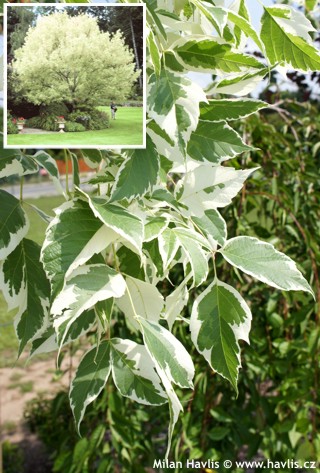
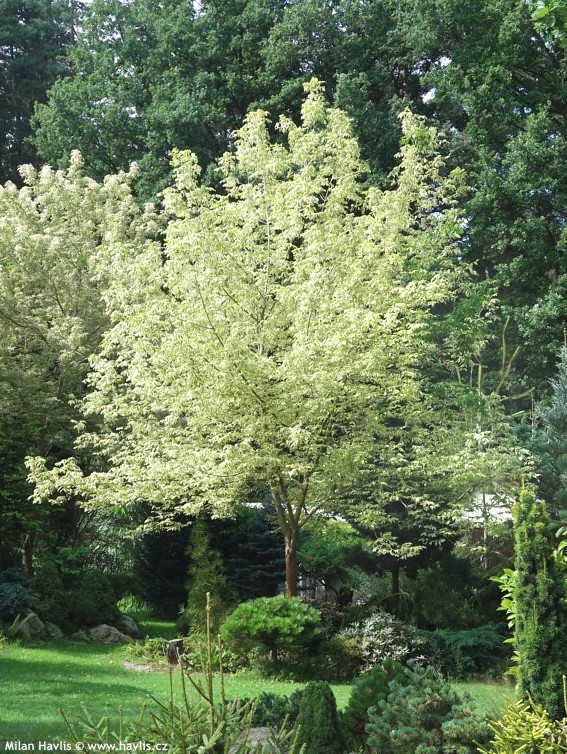
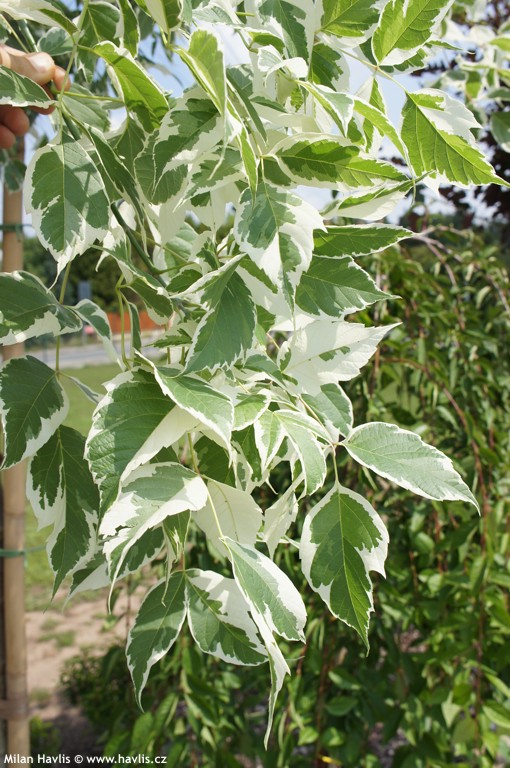
Variegatum boxelder has long ranked among the most popular variegated maples, apart from the Japanese species, and its appeal dates back to the nineteenth century. Its deciduous foliage is attractively pinnate, usually composed of three to seven leaflets, each with a conspicuous, irregular creamy to white‑green margin, and some leaves may be almost entirely white, giving the tree a luminous presence in the garden. Young plants grow quickly to vigorously, typically forming a tree of roughly 5-7 metres with a similar spread; exceptionally up to 10 meters under ideal growing conditions. The fruits may also be variegated, but the seeds are sterile, so the cultivar does not produce abundant seedlings and is not invasive. Together with its decorative leaves, this makes 'Variegatum' a popular specimen and a choice for smaller park plantings. Important note: as with other variegated woody plants, reversion to the original green form can occur, meaning whole green shoots may appear and should be removed promptly at the base of the branch, otherwise they will eventually overgrow the variegated crown. Variegated leaves are not prone to sunscald.
According to available specialist sources, 'Variegatum' first appeared as a mutation on a green‑leaved individual in a nursery at Toulouse in 1845 and has since been recorded under numerous names, for example 'Albo‑variegatum', 'Argenteo‑cinctum', 'Argenteo‑limbatum', 'Argenteo‑notatum', 'Argenteo‑variegatum Robustum', 'Foliis Albo‑variegatis' or simply 'Silverleaf'. The cultivar received the Award of Garden Merit (AGM) from the Royal Horticultural Society in 1973 and was described in the literature as once being one of the commonest variegated trees, widely used in town gardens and even grown in pots for interior decoration. Because many variegated selections now exist, distinguish 'Variegatum' by its characteristic creamy to white leaflet margins and the occasional wholly white leaflets, and by any variegation of the samaras; persistent green shoots or loss of variegation indicate reversion or a different, less stable selection.
Last update 28-07-2011; 22-02-2026
Boxelder maple requires virtually no maintenance. It is resistant to severe frost, wind, drought and temporary waterlogging. It is not prone to diseases and thrives in full sun as well as partial shade. It performs best in deeper, moist but well drained soils, yet it also tolerates drier sites and urban conditions. During the first three years after planting, the tree must be firmly staked to ensure proper anchorage and straight trunk development. During this period, grass and other plants should not be allowed to grow above the root zone. Pruning is not necessary, but it is possible, ideally in late winter before sap flow begins. Trees or shrubs subjected to regular renewal pruning develop dense branching with large leaves, enhancing their ornamental value. Frost hardiness is excellent, tolerating temperatures down to approximately −45 °C (USDA zone 2).