












.jpg)

Chrysanthemum 'COUSIN JOAN' chrysanthemum

 Symbivit Tric (arbuscular)
 Symbivit (arbuscular)
Chrysanthemum
Genus Chrysanthemum comprises dozens of species originally widespread in Asia, especially in China and Japan. The scientific name derives from Greek: chrysos = gold, anthemon = flower. Fossil records show that the genus is millions of years old, but the first botanical descriptions appeared in Europe in the 18th century, when plants were brought by travelers and missionaries. Chrysanthemums reached North America in 1790 thanks to the French botanist André Michaux. The cornerstone of most garden cultivars is Chrysanthemum indicum, first scientifically described by Carl Linnaeus in 1753 in his Species Plantarum. Modern breeding often focuses on short‑term decorative effect – plants are sold as potted ornaments for a single season and behave like annuals. They are easily recognized by their dense, globular shape and striking colours. Garden cultivars intended for permanent planting have a loose habit, flower gradually, and are labeled as hardy.
From preserved works and records it is clear that chrysanthemum ranks among the oldest cultivated plants – it was grown as early as the Shang dynasty (China, c. 15th century BC). In the 11th century AD, it was included in China among the “Four Noble Plants” (together with bamboo, plum, and orchid), symbolizing the seasons, with chrysanthemum representing autumn. Beyond ornamental use, the flowers were brewed into teas, young leaves eaten as a vegetable, and flower heads sometimes pickled in vinegar. Between the 5th and 8th centuries AD chrysanthemum was introduced to Japan, where it quickly became a symbol of the imperial family – already in the Nara period (710–794) it appears in literature and on seals. In the 14th century it was officially recognized as the emblem of the imperial house, and the national “Festival of Chrysanthemums” (Kiku no Sekku) was established as a celebration of longevity and renewal. Chrysanthemums reached Europe via trade routes from China and Japan in the 17th–18th centuries, first in the Netherlands and then in England, where systematic breeding began.
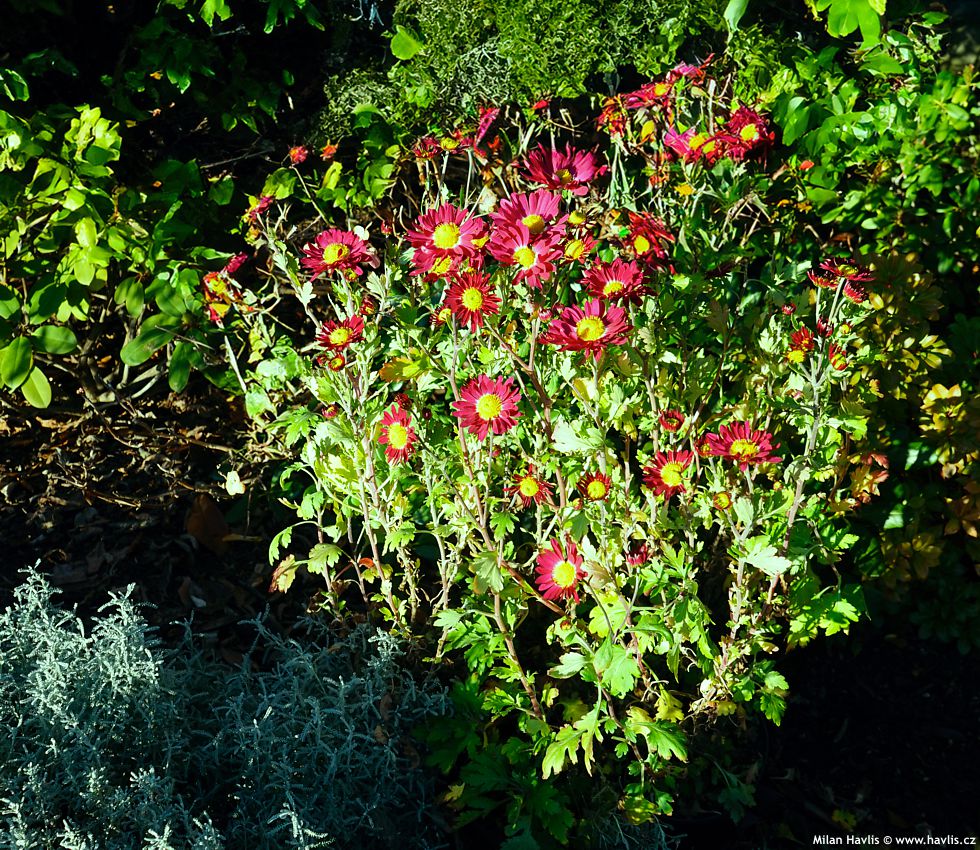
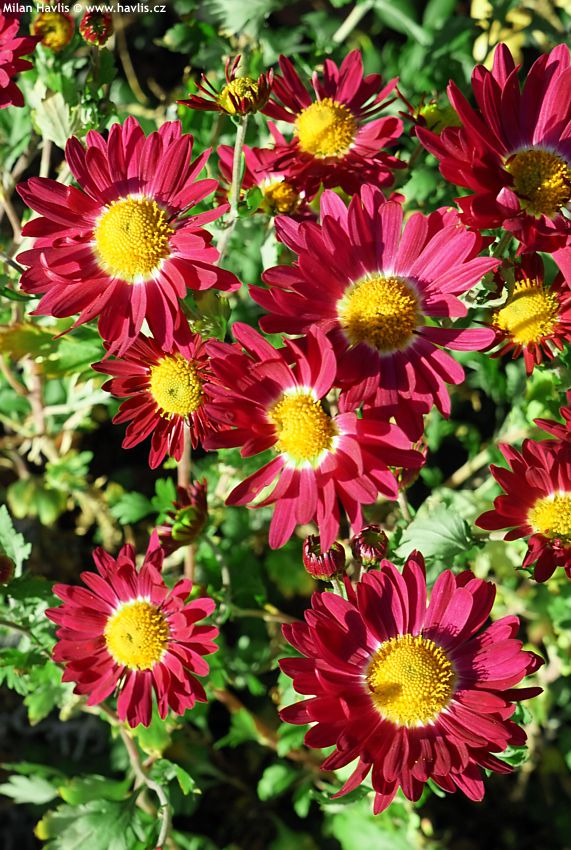
Cousin Joan chrysanthemum belongs among very late cultivars, offering its richly coloured blooms even with the arrival of the first frosts. The flowers are simple and delicately fragrant; the petals are deep fuchsia with a narrow, almost white inner ring that contrasts cheerfully with the yellow disc. The plant is compact, densely branched, and grows to about 70 cm in height. The cultivar belongs to the group of “single Korean” chrysanthemums with simple flowers. Its origin is linked to British breeding, where it entered the horticultural trade and received the RHS Award of Garden Merit, confirming its reliability and ornamental value.
Its late flowering from October into November makes it valuable for extending the season of perennial borders, especially in places still frequented at that time of year – beds near house entrances, by parking areas, or outside French windows. In all these settings, ‘Cousin Joan’ acts like a burst of colour, best accompanied by contrasting companions – either medium‑sized evergreen shrubs to preserve freshness with their evergreen foliage, or fine grasses such as Pennisetum that evoke the garden’s transition into winter while retaining structure (they need neither tying nor cutting).
Last update 30-11-2025
Chrysanthemums are not very demanding to grow: they require a sunny site, humus‑rich, well‑drained soil, and regular watering during dry spells. Feeding during the growing season supports abundant flowering. Pruning is unnecessary, apart from removing spent blooms. In containers, roots should be protected from frost. The plant is hardy to about –29 °C (USDA zone 5). When handling, gloves are advisable, as sensitive individuals may react allergically to sesquiterpene lactones present in the leaves – if you have ever been allergic to daisies, sunflowers, artichokes, or dandelions, chrysanthemums may affect you as well.

Goods are shipped all over Europe. For Russia and U.K. and for further details please read about SHIPPING OPTIONS HERE.
Are you interested in a serious discount for orders NOV-FEB? Check your options here.
THE PRICES INCLUDE VAT of 15%. For quick conversion you can use 1 CZK = approx. 0.04 EUR
- STANDARD QUALITY - Plants of this group are 1st class quality with number of branches and overall density adequate to their size and age, considering they were container grown.
- DE LUXE QUALITY - This label guarantees a luxurious quality of manually selected plants that, compared to their height and age, are exceptionally dense and beautiful.
- EXTRA - These plants are usually mature and bigger specimens with exceptional overall appearance.
- STANDARD (as described in the plant form) means a tree with a trunk of 190-210 cm and a crown at the top, unless specified differently. The commercial size for trees is their girth measured in the height of 1m from ground.
- HOBBY - These plants are of the same quality as our standard-quality plants but younger and therefore cheaper.
- SHRUB - a woody plant with branches growing bushy from the ground level.
- HALF-STANDARD or MINI-STANDARD - a small tree with shorter trunk, its size is usually specified.
- FEATHERED - These are trees with branches growing already from the base of the trunk and up along the stem.
- GRASSES and PERENNIALS - Sizes given usually read the diameter of the pot or the clump, as specified.
