












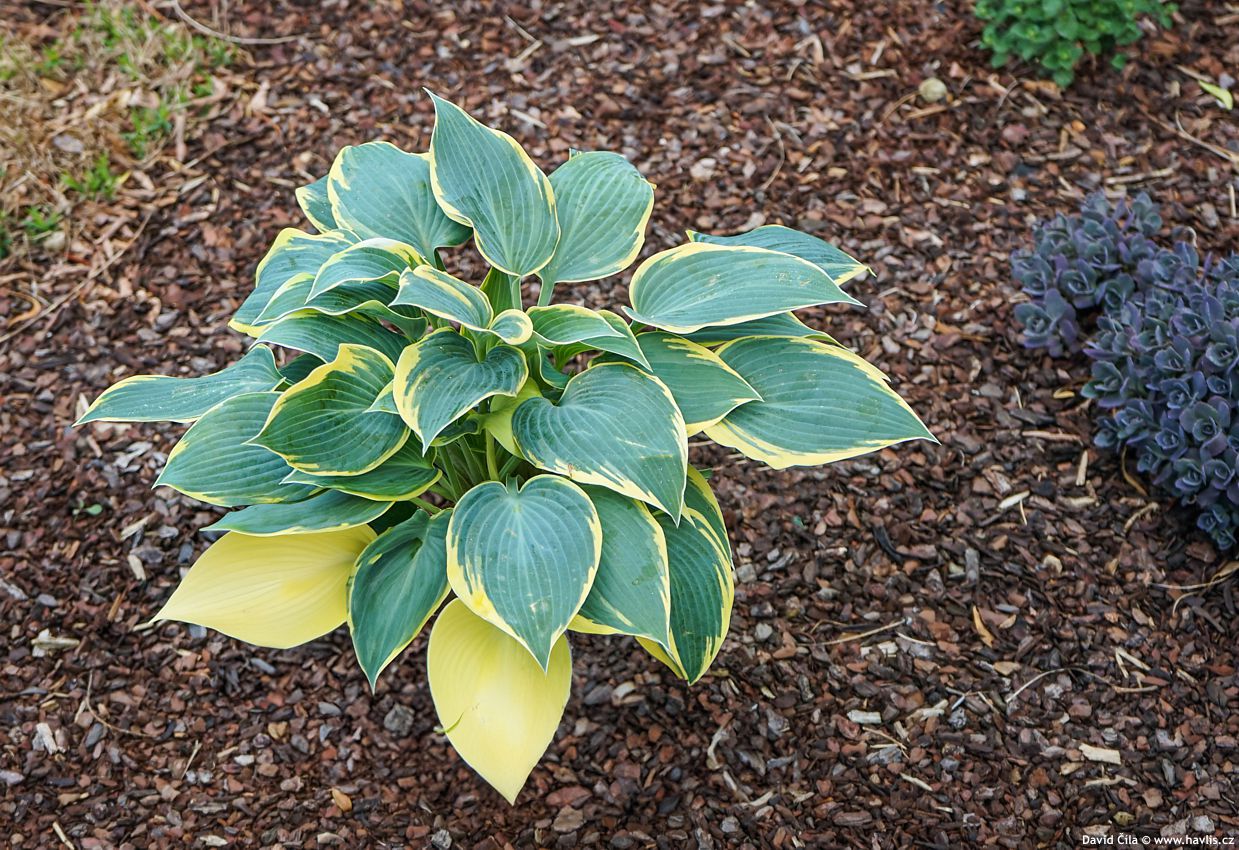
Hosta 'QUEEN JOSEPHINE' plantain lily

Hosta
The genus Hosta comprises a group of perennial herbs native to East Asia — chiefly Japan, the Korean Peninsula, northeastern China and the Russian Far East — and in the wild they are typically found in woodland understoreys, on moist slopes and in stream valleys, in partial to full shade. The number of recognised taxa varies in the specialist literature depending on species concept; common estimates fall around 40–50 species. Hostas were first recorded by the European traveller Engelbert Kaempfer (1651–1716), significant early botanical work from Japan was contributed by Carl Peter Thunberg (1743–1828), and the generic name Hosta was formally established by Leopold Trattinnick (1764–1849) in honour of the Austrian physician and botanist Nicolaus Thomas Host (1761–1834), who played a notable role in developing the imperial botanical collections in Vienna. The historical synonym Funkia, referring to Heinrich Christian Funck (1771–1839), appears in older sources but today Hosta is the internationally accepted name. The genus has undergone several taxonomic revisions because of its high variability, and modern systematics place it in the family Asparagaceae (subfamily Agavoideae).
The historical use of hostas in their native lands was markedly more utilitarian than is sometimes suggested. In Japan some species were cultivated primarily as food — young shoots and leaves are known locally as urui and are still consumed regionally — while ornamental use developed more slowly. Hostas reached Europe and North America mainly as botanical specimens in the nineteenth century, with notable collectors and introducers such as Philipp Franz von Siebold (1796–1866), who systematically documented Japanese flora, sent extensive collections to Europe and co‑published the important Flora Japonica. Ornamental use in gardens expanded gradually; in the twentieth century a strong collector culture emerged around hostas, institutionalised in part by the American Hosta Society (founded 1968). The AHS organises cultivar registration, publishes specialist literature and supports regional and national shows and competitions; awards such as “Hosta of the Year” and local exhibition prizes have a measurable effect on the popularity and distribution of cultivars. Alongside the AHS, university arboreta and specialist horticultural institutions maintain collections, perform evaluations and act as hubs for knowledge exchange between collectors and breeders.
Breeding of hostas concentrates primarily on the leaf — its size, shape, patterning and colour — as well as on overall plant habit and, in some lines, on flower number and fragrance; historically they were long associated with the Liliaceae because of their floral traits. The species most frequently used as parents in hybridisation are Hosta sieboldiana, Hosta fortunei and Hosta plantaginea (the latter prized for its fragrant flowers), which have provided the genetic foundation for many modern cultivars. The result is thousands of registered cultivars exhibiting a wide spectrum of leaf textures and colours. Collectors’ enthusiasm stems from the slow, “characterful” development of hostas — each plant matures into a distinctive form, leaves alter texture and hue with light and age — and from the pleasure of comparing subtle differences between varieties. Active participants in the contemporary scene include long‑standing registrars and experts associated with the AHS as well as commercial growers and specialist nurseries (for example Plant Delights and Tony Avent), who combine scientific methods with collector demand and thus keep breeding and the exchange of new cultivars alive.
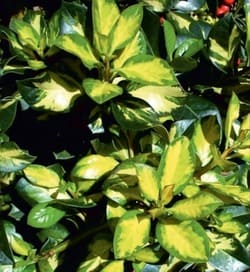
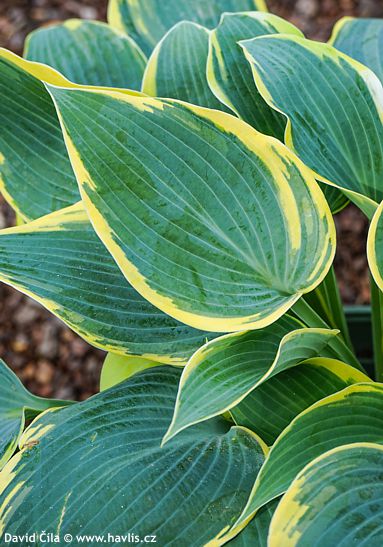
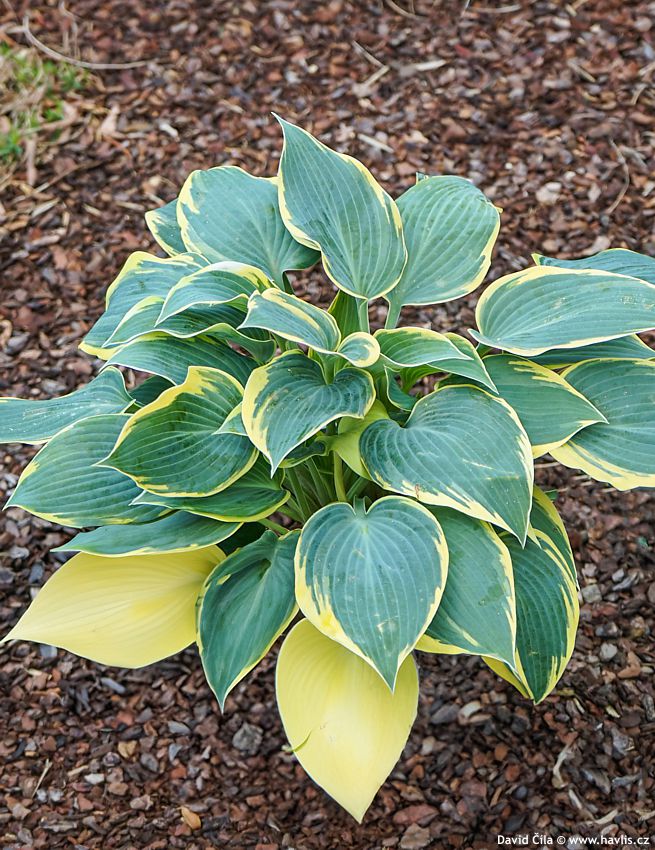
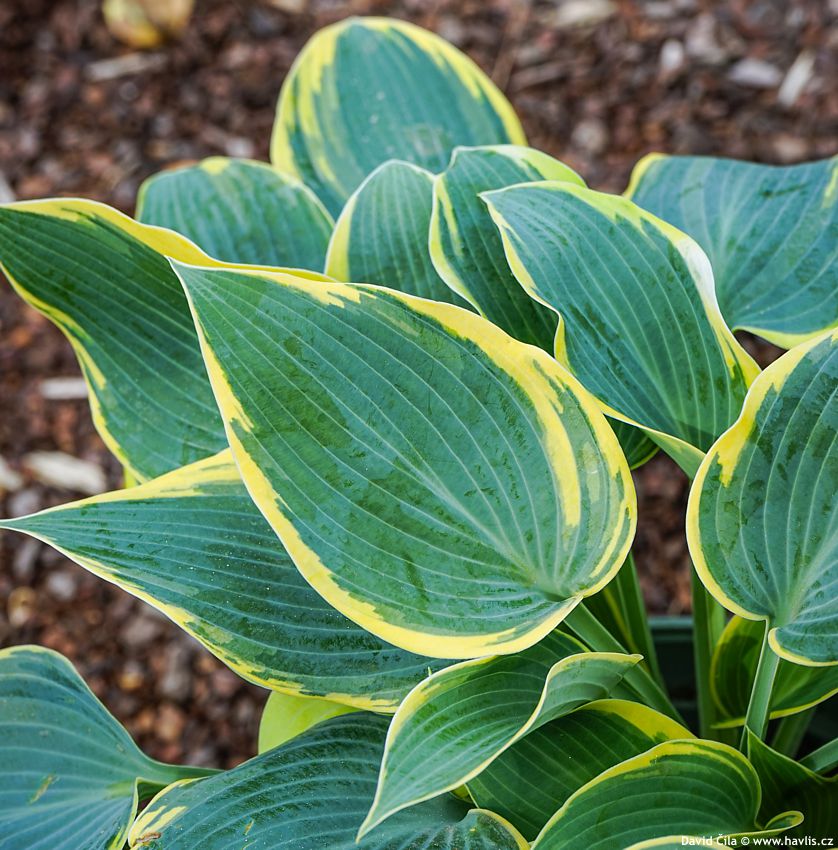
Queen Josephine is a large‑leaved hosta cultivar whose foliage looks as if it were cut from thick parchment – firm, weighty and strongly sculpted.
The base colour is a deep green, at the beginning of the season often carrying a faint bluish‑grey bloom reminiscent of blueberry skins, which gradually fades as summer approaches and the leaves become glossy. The margin is attractively light buttery yellow to creamy, and occasionally some leaves may appear entirely creamy. The contrast is not loud but rather refined, and that is precisely where its strength lies. The clump grows slowly yet very steadily, with leaves arranged in a regular, gently domed rosette that in summer provides a luxurious backdrop for the flowers. It blooms from July to August, producing tubular to bell‑shaped flowers in pale lavender to light violet, borne on upright stems rising roughly 20–60 cm above the foliage. The more shade it receives, the fewer flowers it produces, but with sufficient light (half a day of sun or bright, filtered light throughout the day) and adequate moisture, flowering is abundant and conspicuous.
The cultivar ‘Queen Josephine’ is more tolerant of sun than variegated hostas, and thanks to its firmer leaves it is less attractive to slugs. It arose as a spontaneous mutation of the cultivar ‘Josephine’ and was registered by the breeder Bob Kuk (Ohio) in 1991. It bears the name of Empress Joséphine, wife of Napoleon Bonaparte, which is no coincidence – she too was a symbol of elegance and cultivated taste.
Hostas bring both drama and calm to the garden at once: dramatically large, often richly coloured leaves, yet through their stillness and slow growth into substantial clumps they also introduce a sense of quiet and the need for patience. Their architectural structure is hard to find among other perennials and naturally invites bold contrasts. Do not hesitate to create dense combinations of differing textures – for example the grass‑like, elongated leaves of liriope, the palmately divided forms of hardy geraniums, the showy fans of ferns, or, conversely, small‑leaved and delicate perennials that act as the smallest companions within this almost rainforest‑like setting. Hostas can be grown as isolated clumps, or young plants can be moved a little further each year to form ground cover or attractive bands along paths or used as an understorey edging beneath taller perennials or shrubs.
Hostas need constantly moist, fertile soil that never dries out – keep it always mulched. They respond well to fertilizing and produce stronger foliage and denser tufts. Ideal location is partial shade, or full sun with some shade during the day. Full shade is fine but plants may not flower as freely or at all. Drought can result in weakened plants that will be prone to diseases, and combination of drought and full sun will damage most variegated cultivars. Beware of slugs and snails who come to feast on their leaves without an invitation. Being deciduous, remove all wilted foliage from previous year in early spring and make sure not too damage emerging bourgeons. They cope well with polluted city environment. Hardy to about -40 °C (USDA zone 3).
Last update 03-04-2026

Goods are shipped all over Europe. For Russia and U.K. and for further details please read about SHIPPING OPTIONS HERE.
Are you interested in a serious discount for orders NOV-FEB? Check your options here.
THE PRICES INCLUDE VAT of 15%. For quick conversion you can use 1 CZK = approx. 0.04 EUR
- STANDARD QUALITY - Plants of this group are 1st class quality with number of branches and overall density adequate to their size and age, considering they were container grown.
- DE LUXE QUALITY - This label guarantees a luxurious quality of manually selected plants that, compared to their height and age, are exceptionally dense and beautiful.
- EXTRA - These plants are usually mature and bigger specimens with exceptional overall appearance.
- STANDARD (as described in the plant form) means a tree with a trunk of 190-210 cm and a crown at the top, unless specified differently. The commercial size for trees is their girth measured in the height of 1m from ground.
- HOBBY - These plants are of the same quality as our standard-quality plants but younger and therefore cheaper.
- SHRUB - a woody plant with branches growing bushy from the ground level.
- HALF-STANDARD or MINI-STANDARD - a small tree with shorter trunk, its size is usually specified.
- FEATHERED - These are trees with branches growing already from the base of the trunk and up along the stem.
- GRASSES and PERENNIALS - Sizes given usually read the diameter of the pot or the clump, as specified.
