

































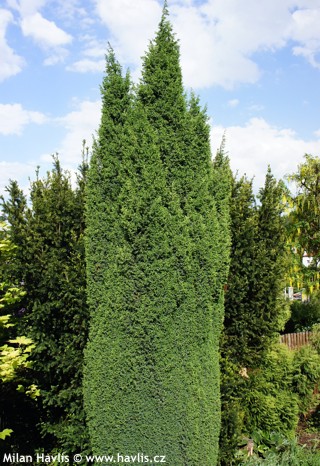
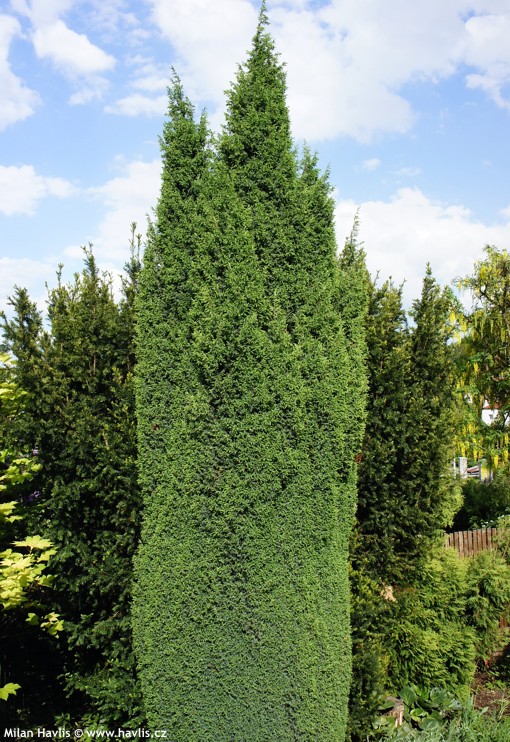
Juniperus communis 'HIBERNICA' common juniper

 Symbivit Tric (arbuscular)
 Symbivit (arbuscular)
Juniperus
The genus Juniperus belongs among the oldest woody plants of the Northern Hemisphere, with a history reaching deep into the Tertiary period. Junipers shaped the landscape long before the first gardens were created, and their fossils have been found across Europe, Asia and North America. Besides Carl Linnaeus (1707–1778), who formally described the common juniper in 1753 and placed it within the botanical system, the genus was also studied by the Swiss botanist Albrecht von Haller (1708–1777). He paid close attention to the remarkable variability of woody plants, including junipers, in relation to altitude and climate, and pointed out that a single species may appear almost as several different plants across mountains, pastures and lowlands. Junipers thus became among the first woody plants that botanists struggled to fit neatly into a single category, and perhaps this is why they have retained a reputation for being somewhat wilful individualists to this day.
The common juniper is a native European species with an exceptionally wide ecological range. It grows from lowlands up to alpine zones, where it becomes a prostrate, wind‑sculpted shrub, while in open landscapes it forms upright silhouettes. For centuries it was part of everyday life – its wood scented rural houses, twigs were used to fumigate stables and dwellings, and the blue, glaucous cones ripening in their second year belonged both in the kitchen and in the medicine chest. Juniper still flavours game, rich and fat meats and spirits, the best known of which is gin. It is precisely the common juniper whose fruits are edible and safe to use; with other junipers one could not be so certain. In the landscape, juniper was regarded as a protective plant and a point of orientation. Today it is slowly disappearing from the wild, yet it is returning to gardens in the form of cultivars that transform its wild character into cultivated elegance.
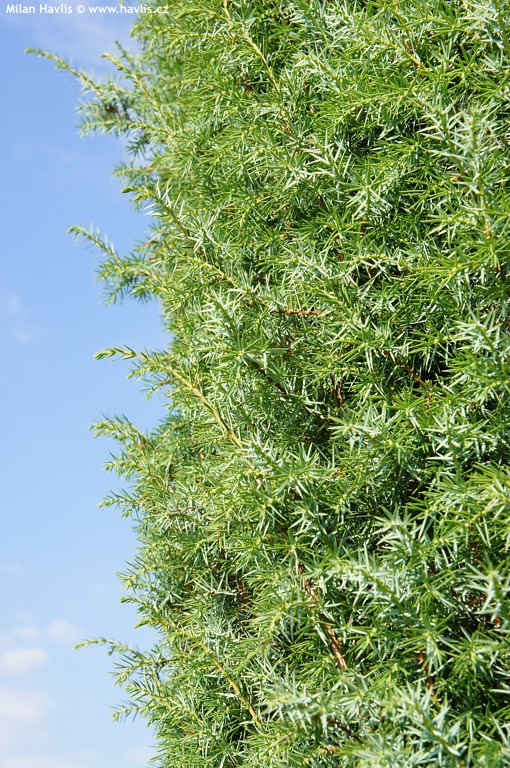
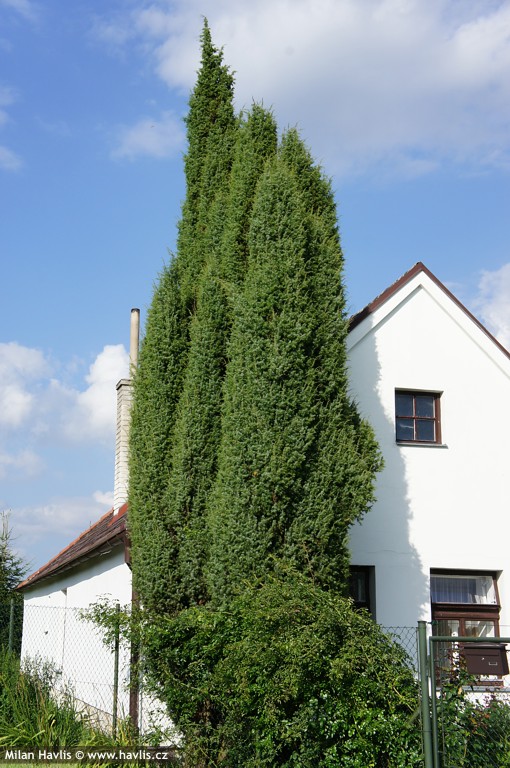
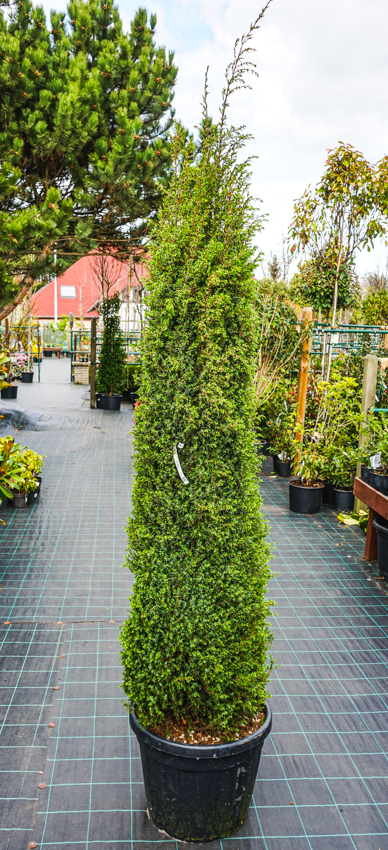
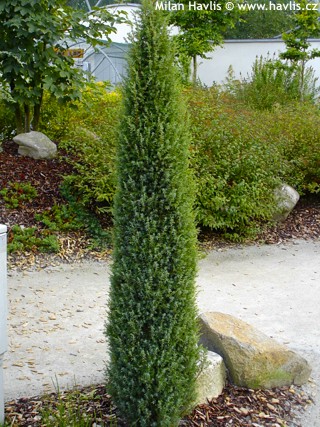
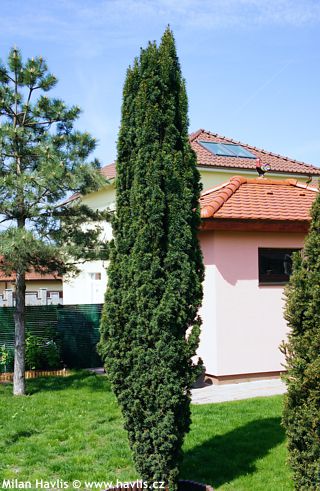
Hibernica juniper belongs among the oldest cultivated columnar forms of common juniper, and its origin is traditionally associated with Ireland (Hibernia), from which its name is derived. It is not the result of deliberate breeding, but rather a selection of a naturally upright form from the wild, introduced into gardens as early as the 19th century; the year 1858 is most often cited. It is characterised by a columnar habit that is slender and regularly conical when young, gradually broadening with age into a relatively massive, wide column. The plant forms an exceptionally unified outer surface, almost cylindrical in shape, and the crown may be topped by several leading shoots. The needles are fine, blue‑green to grey‑blue, with a characteristic glaucous bloom that gives the plant a calm, slightly cool tone. They are prickly to the touch, though less aggressive than in wild forms of common juniper.
For many decades, ‘Hibernica’ was virtually the only relatively narrow‑growing juniper available in cultivation and became the archetype of a columnar conifer in the cooler regions of Europe. In the garden, its substantial presence gives an impression of strength and stability, offering a pronounced vertical element with a calm, almost monumental silhouette. Compared with the cultivar ‘Arnold’, ‘Hibernica’ is broader and more robust, while ‘Arnold’ appears more slender, technical and architectural. This contrast gives both cultivars a clear purpose: ‘Hibernica’ excels where plantings are meant to feel solid, traditional and natural, whereas ‘Arnold’ is better suited to modern, precisely structured compositions.
Last update 04-03-2013; 20-01-2026
Junipers are generally undemanding plants, and the common juniper as a species shares these modest requirements. It prefers a sunny position, where it maintains compact growth and good colour; in partial shade it may survive but loses density and character. It is not particular about soil type – it will grow in ordinary garden soil as well as in poorer, stony or sandy soils – but good drainage is essential, and permanently waterlogged sites should always be avoided. It tolerates drought very well and requires watering only after planting. Fertilisation is unnecessary, or at most very light. Pruning is not required for the plant’s survival and is carried out exceptionally, in cultivars that either grow rapidly or tend to spread (for example under the weight of snow), ideally in late winter. The common juniper is fully hardy and easily withstands temperatures down to around –40 °C (USDA zone 3).
Goods are shipped all over Europe. For Russia and U.K. and for further details please read about SHIPPING OPTIONS HERE.
Are you interested in a serious discount for orders NOV-FEB? Check your options here.
THE PRICES INCLUDE VAT of 15%. For quick conversion you can use 1 CZK = approx. 0.04 EUR
- STANDARD QUALITY - Plants of this group are 1st class quality with number of branches and overall density adequate to their size and age, considering they were container grown.
- DE LUXE QUALITY - This label guarantees a luxurious quality of manually selected plants that, compared to their height and age, are exceptionally dense and beautiful.
- EXTRA - These plants are usually mature and bigger specimens with exceptional overall appearance.
- STANDARD (as described in the plant form) means a tree with a trunk of 190-210 cm and a crown at the top, unless specified differently. The commercial size for trees is their girth measured in the height of 1m from ground.
- HOBBY - These plants are of the same quality as our standard-quality plants but younger and therefore cheaper.
- SHRUB - a woody plant with branches growing bushy from the ground level.
- HALF-STANDARD or MINI-STANDARD - a small tree with shorter trunk, its size is usually specified.
- FEATHERED - These are trees with branches growing already from the base of the trunk and up along the stem.
- GRASSES and PERENNIALS - Sizes given usually read the diameter of the pot or the clump, as specified.
