











Lavandula angustifolia BÍLÉ ODRŮDY / WHITE lavender

 Symbivit Tric (arbuscular)
 Symbivit (arbuscular)
Lavandula
The genus Lavandula originates from a broad belt stretching across the western and southern Mediterranean, the Canary Islands, Madeira, North Africa and the Middle East. In these regions it grows on dry, stony slopes, limestone outcrops, and in garigue and maquis vegetation, where the soil is poor, free‑draining and exposed to intense sunlight. This environment shaped its characteristic adaptations – narrow, silvery leaves with dense pubescence that reduces water loss, and a high concentration of aromatic oils that protect the plant from herbivores and extreme drought. The genus comprises three main evolutionary lineages: subgenus Lavandula with the classic “true” lavenders (L. angustifolia, L. latifolia and their hybrid L. × intermedia), subgenus Fabricia including species such as L. stoechas and L. dentata, and subgenus Sabaudia with the Canary and Macaronesian species. The chemical composition of their essential oils varies markedly between these groups – from the gentle, linalool‑rich profile of true lavender to the camphoraceous and cineole tones typical of species from warmer regions. Natural overlap between L. angustifolia and L. latifolia in France and Spain led to the emergence of the hybrid L. × intermedia, which later became central to modern lavender oil production. Lavender has been cultivated since antiquity, but its true expansion came in the 19th and 20th centuries, when Provence became the heart of European perfumery and lavender a symbol of the Mediterranean landscape.
Lavender has accompanied people since ancient times and became part of everyday life as well as the cultural symbolism of Europe. The Greeks used it in medicine and to perfume baths; the Romans added it to their baths, oils and linens, believing it purified both body and mind – hence its name, derived from the Latin lavare, “to wash”. In the Middle Ages it was a staple of monastic gardens, valued for its calming effects, its ability to repel insects and its supposed protection against “bad air”. In Renaissance Italy it was used to perfume gloves and fabrics, and in 17th‑century England it became a familiar element of domestic hygiene and garden culture. During plague epidemics it formed part of the so‑called Four Thieves’ Vinegar and was long believed to offer protection against infection. In modern times lavender became a symbol of Provence, even though most of the iconic purple fields are in fact lavandin rather than true lavender. Nevertheless, it remains a plant that bridges traditional crafts, perfumery, herbal medicine and everyday practice – from lavender sachets in linen cupboards to modern aromatherapy. Across many cultures it is associated with cleanliness, calm, femininity and the protection of the home. Its fragrance has become one of the most recognisable scents in the world, allowing lavender to transcend the boundaries of its Mediterranean origins.
Lavandula angustifolia forms compact, dense shrubs with finely branched, woody stems that, with age, develop into low to medium‑sized cushions. The leaves are narrow, linear and silvery green to grey‑green, sometimes even green, with fine pubescence that reduces water loss and protects the plant from drought and intense sunlight. The flowers, in shades of purple, pink and white, have a gentle, sweet and clean fragrance with a high content of linalool and linalyl acetate, which distinguishes true lavender from species with a sharper, camphoraceous aroma. The species was first described scientifically by Carl Linnaeus in 1753, but the currently accepted name, Lavandula angustifolia Mill., was established by the British botanist Philip Miller, who later defined it precisely while working at the Chelsea Physic Garden in London. It is among the hardiest lavenders and, in well‑drained soil, tolerates the cooler climate of Central Europe reliably. It differs from its relative L. latifolia by its finer habit, shorter flower spikes and markedly higher‑quality oil; and from the hybrid lavandin (L. × intermedia) by its smaller stature, shorter flowering stems, softer fragrance and superior winter hardiness.
Exalting the beauty of lavender is like carrying coals to Newcastle. So let' concentrate on something special: white varieties.
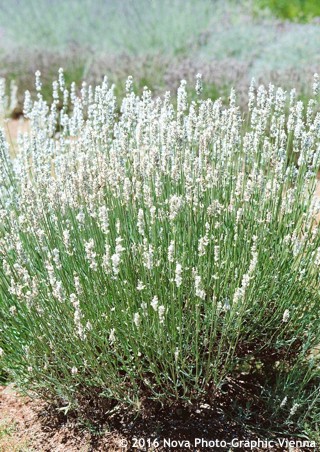
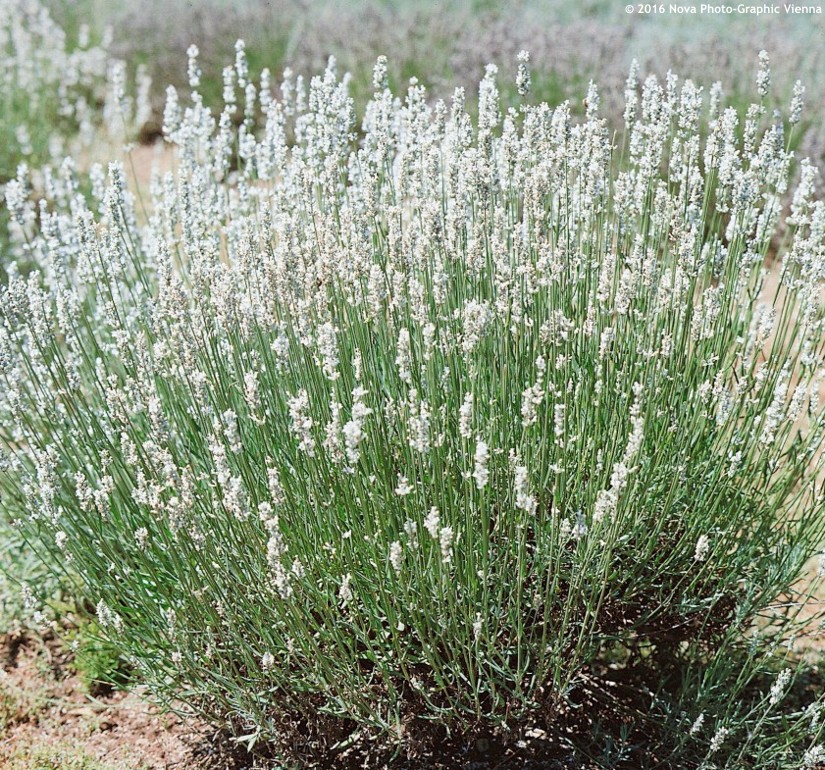
White flowering varieties of lavender are still a bit unusual yet very handsome. They are fast growing subshrubs, sometimes also classified as woody perennials, with 40-60 cm tall stems producing short, scented spikes of white flowers from early until late summer. Evergreen, linear leaves are grey-green to blue-green in cold months, and light green in warm months.
Last update 01-03-2016; 06-05-2019
Lavandula angustifolia requires full sun and a light, very well‑drained soil; in heavy or waterlogged ground it declines quickly. After planting it needs regular watering until established, then becomes drought‑tolerant and is watered only during prolonged heatwaves. Feeding is not recommended, as it encourages lush, soft growth and shortens the lifespan of the plants. To maintain a compact shape, an annual post‑flowering trim in late summer is essential: remove the spent flower spikes and reduce the plant by roughly one third, always cutting only into green growth. In colder regions it is better to leave the main pruning until spring. Spent stems can be removed at any time after flowering to tidy the plant, and many gardeners harvest the blooms in summer for drying (hang in an airy room, heads down; some florists even fix them lightly with hairspray). The plant is very hardy but dislikes winter moisture, so good drainage or a slightly raised site is beneficial. In denser plantings, adequate air movement helps reduce fungal diseases. Fully hardy to min. -27°C (USDA 5b)