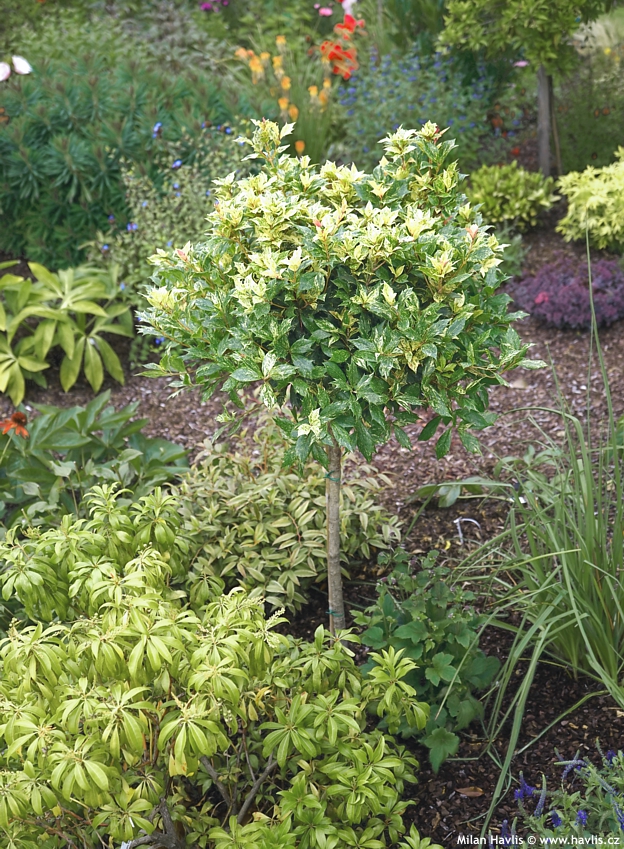
Osmanthus heterophyllus 'GOSHIKI' (var. tricolor) holly osmanthus, false holly - STANDARD TREE


 Symbivit Tric (arbuscular)
 Symbivit (arbuscular)
Osmanthus
Osmanthus, called sweet olive in English, takes its name from Greek words osme (fragrance) and anthos (flower). The genus comprises roughly 25–30 species, along with numerous cultivated forms, many of which are often mistaken for hollies because of the shape and firmness of their leaves. Osmanthus reached Europe during the 18th century, when botanical gardens and plant collectors began to focus intensively on woody plants from East Asia. The genus was first scientifically described by Carl Linnaeus (1707–1778) in 1753, but the detailed classification of individual species as we know it today is largely the work of later botanists, particularly Japanese and European taxonomists of the 19th century, who were able to study living plants in their native habitats.
Osmanthus plants caught my attention at first sight in 2004, and I became a collector long before I had read about their supposed sensitivity to our climate. You know the saying, “Never say something can’t be done, because someone may come along who doesn’t know that and does it”? I simply planted one after another in my garden and observed how they behaved. They were tested most severely during the harsh winter of 2006/2007, yet not a single plant died. Scorched leaves grew back, frost‑damaged twigs were pruned away, and some specimens are now taller than I am. I have also noticed a remarkable genetic tolerance to drought, although I still need more time to distinguish those that cope well with both summer and winter dryness from those that require watering during winter.
Osmanthus heterophyllus, the holly osmanthus, originates from central and southern Japan (Honshu, Shikoku and Kyushu) as well as Taiwan, where it has been regarded as an integral part of everyday life for centuries. It was botanically described by Carl Peter Thunberg (1743–1828), a Swedish botanist who was among the very few Europeans allowed to study Japanese flora on site, and thanks to him the species entered European collections at the turn of the 18th and 19th centuries. In Japan it was planted near houses, temples and in traditional gardens as a quiet form of protection and a valued evergreen backdrop. Its twigs were used in New Year arrangements and rituals as symbols of strength and endurance, the wood served for small‑scale crafts, and the plant was appreciated for its reliability close to human dwellings.
If you like spiny leaves and colours, this variety of holly osmanthus is a must have in your collection. Its name is Goshiki and you are right to assume that it comes from Japan where its name means 'Five Colors'. It was chosen not only for its spectacular colour, but also for its excellent tolerance to weather conditions, especially its hardiness. In 2012 it was awarded AGM (Ward of Garden Merit) by the Royal Horticultural Society (RHS) in England. It was first imported from Japan to the USA by the American collector of Asian plants Barry Yinger in 1970, from where it spread around the world as slowly as it grows. Despite its age it is still a bestseller.
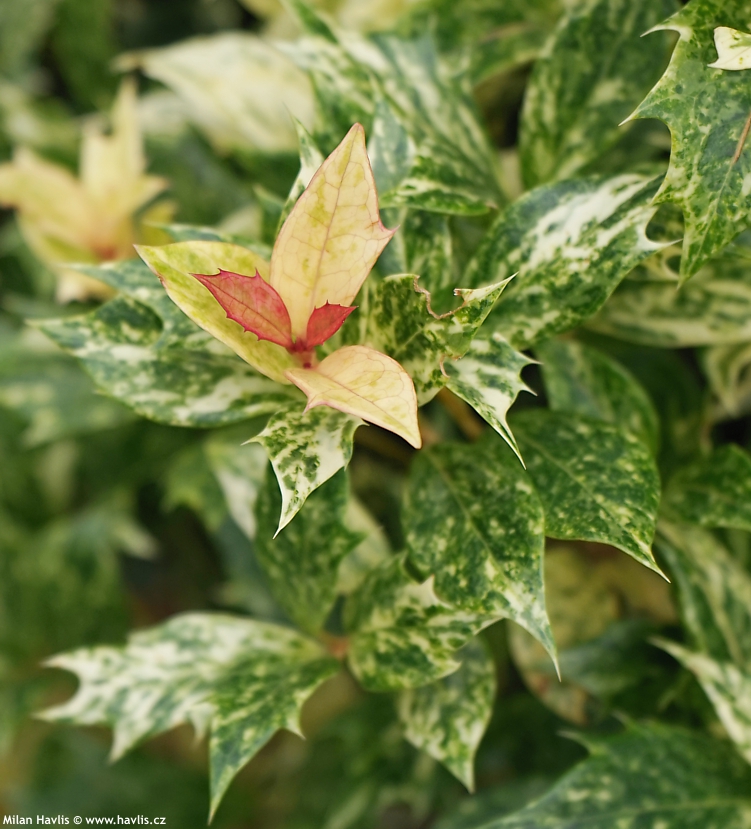
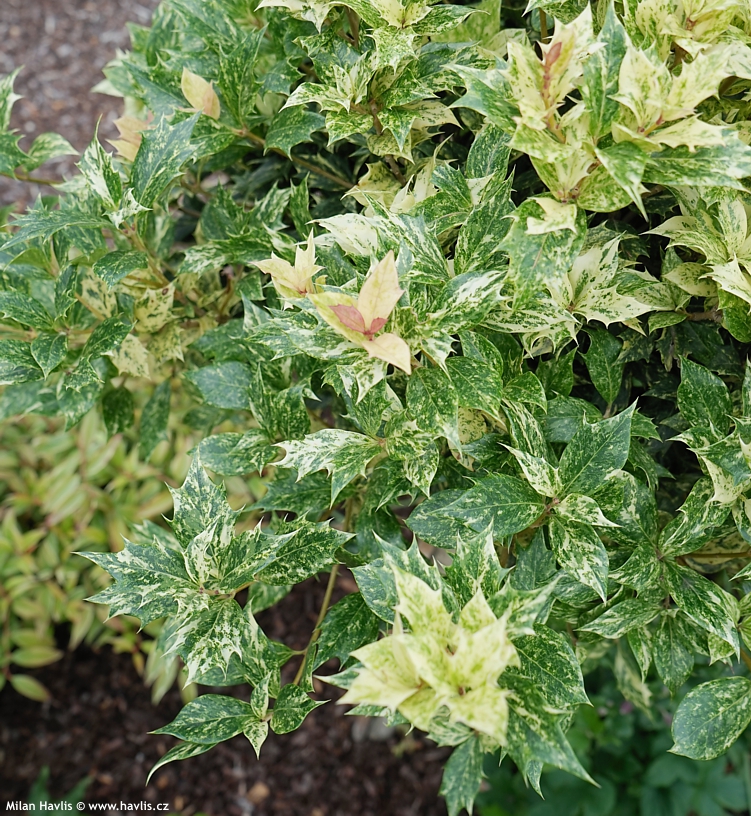
Goshiki osmanthus bears evergreen, conspicuously mottled, spiny foliage. Newly emerging leaves are bronze to purple, young leaves are light vanilla yellow with a fine green pattern, and mature leaves show dark green and creamy yellow marbling from summer onwards. The more sun it gets in the summer the more distinctly coloured it will be. The twigs and bark are light gray and smooth. We haven't seen any flowers on it yet.
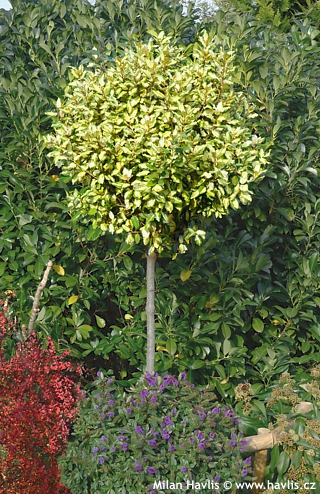
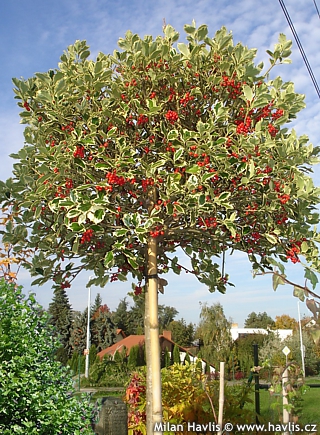
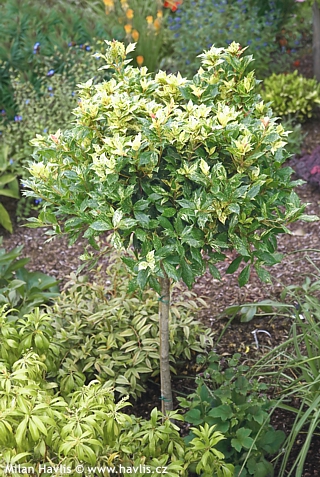
Standard trees – tree forms of evergreen woody plants are becoming more and more popular. They can offer good screening at a desirable height blocking views from neighbouring windows if privacy is why you look for an evergreen tree. And they make a desirable display of foliage in a different horizon, plus allowing other smaller plants live under their canopies. Every standard tree needs a good support to protect the stem from moving, especially in wind. It can be removed after 3 years if the tree is established well. There is usually a bamboo stick attached to the tree trunk when you buy the plant. It needs to be removed before you tie the stem into your new support.
Although it can grow up to 3 meters in its natural habitat, it grows very slowly and its common size in Central European conditions is around 1.5 m in height and spread as a shrub. But if you want to know how tall your plant will get as a standard tree you have to add the stem height. It does not require pruning but it tolerates it very well, even in old wood, so you can shape it as you like. Spring pruning enhances branching, summer trimming is great for shaping.
Spiny-leaved osmanthus have long been used as a natural barrier against wild animals and cattle. Another important advantage is that they are long-lived shrubs or trees, and we are not talking about decades but hundreds of years. There are records of specimens whose age was estimated to 950 or more years. In other words, if located in an ideal spot it can be a plant that will be passed on by one generation to another. It looks great as an attractive evergreen specimen shrub or small tree, and does a good job as a hedge, too.
Last update 01-09-2022
Provide holly osmanthus with a high‑quality soil, ideally slightly acidic, that remains evenly moist but never waterlogged and is rich in nutrients. Generous mulching is recommended to protect the roots from rapid freezing. It can be grown in full sun or partial shade; in cooler regions it benefits from a position sheltered from winter sun, while ample light in summer is advantageous. Planting well‑established, robust specimens is advisable. If leaves are scorched by sun after the first winters, the shrub reliably regenerates in spring and produces fresh foliage. Frost hardiness is very good, down to around −24 °C (USDA zone 6), especially on a sheltered site. It is generally disease-free, but may be attacked by vine weevils, so keep an eye out for them.