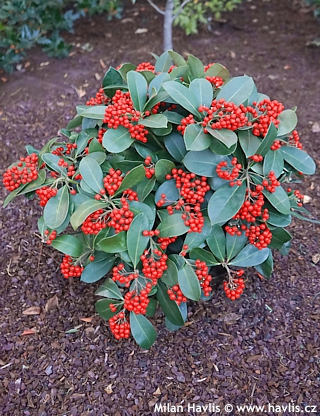
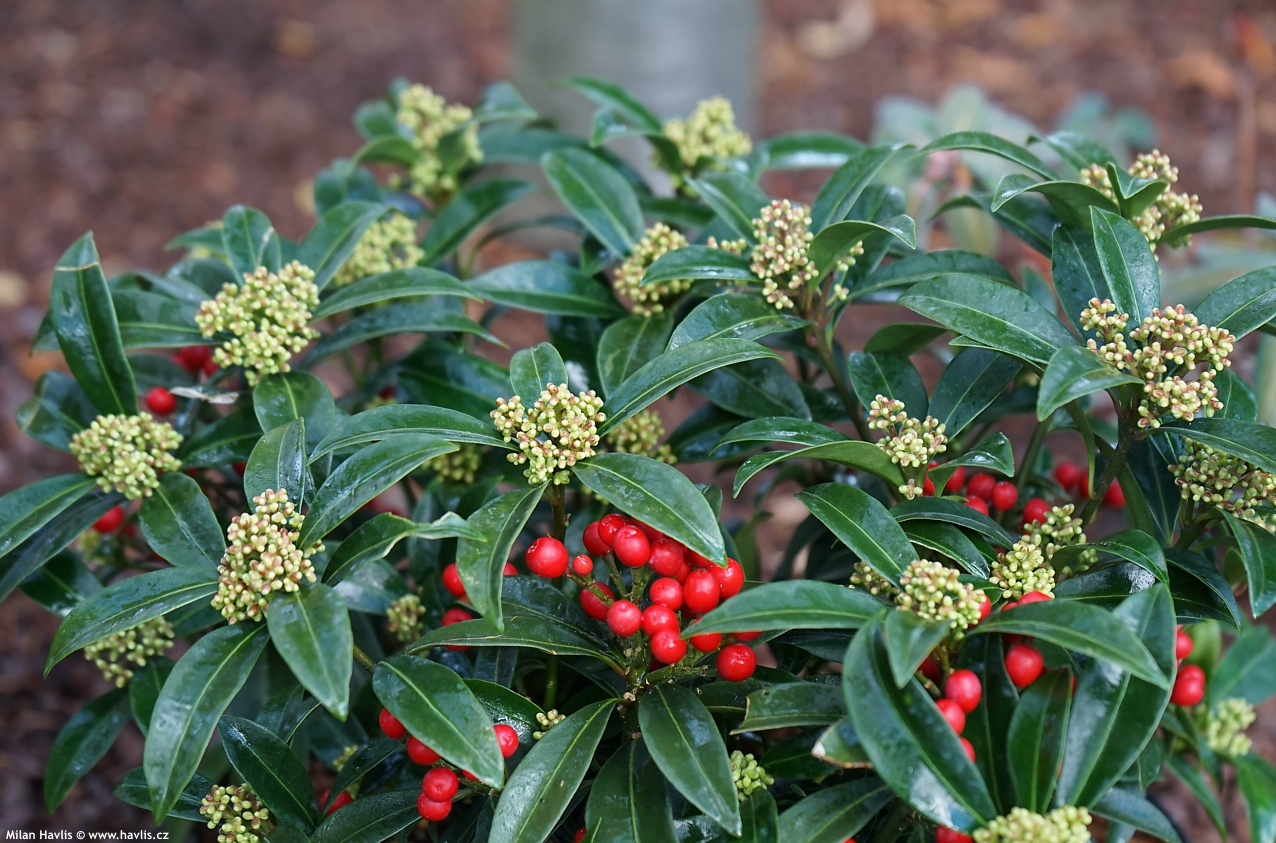
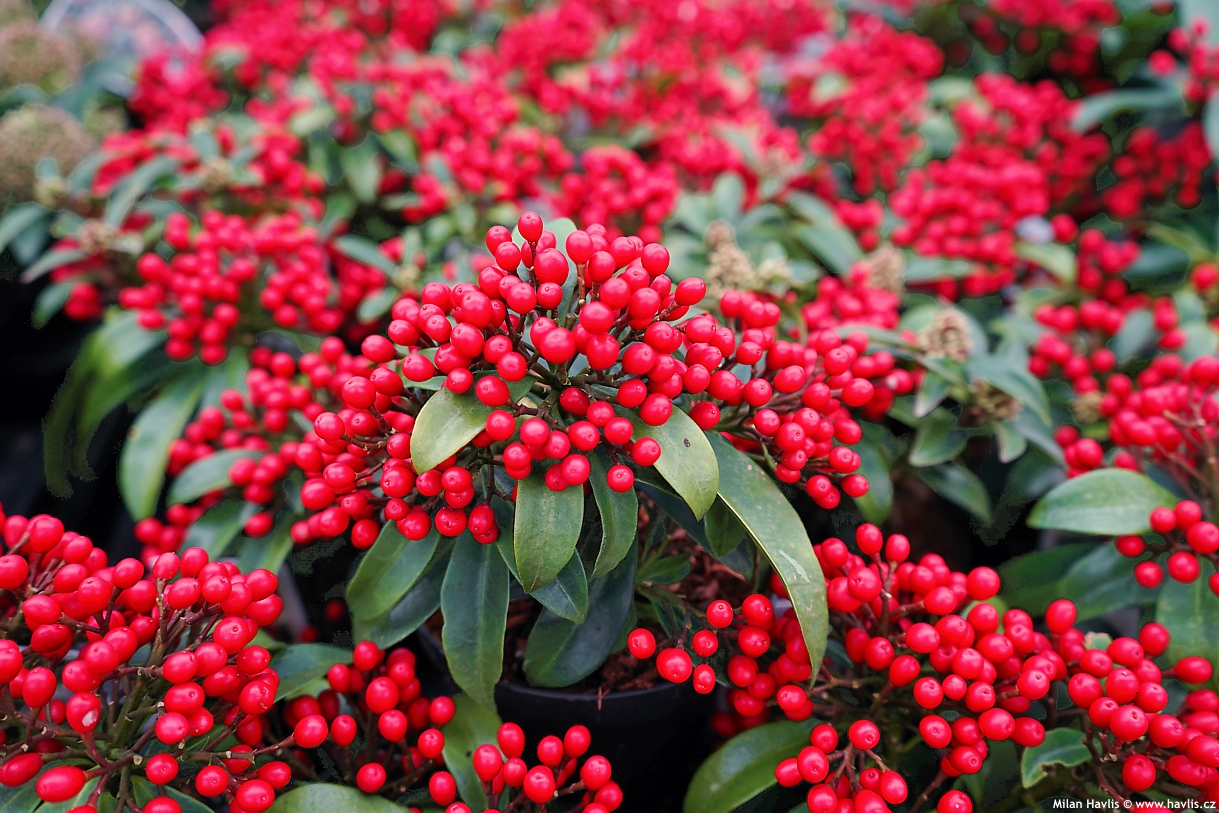
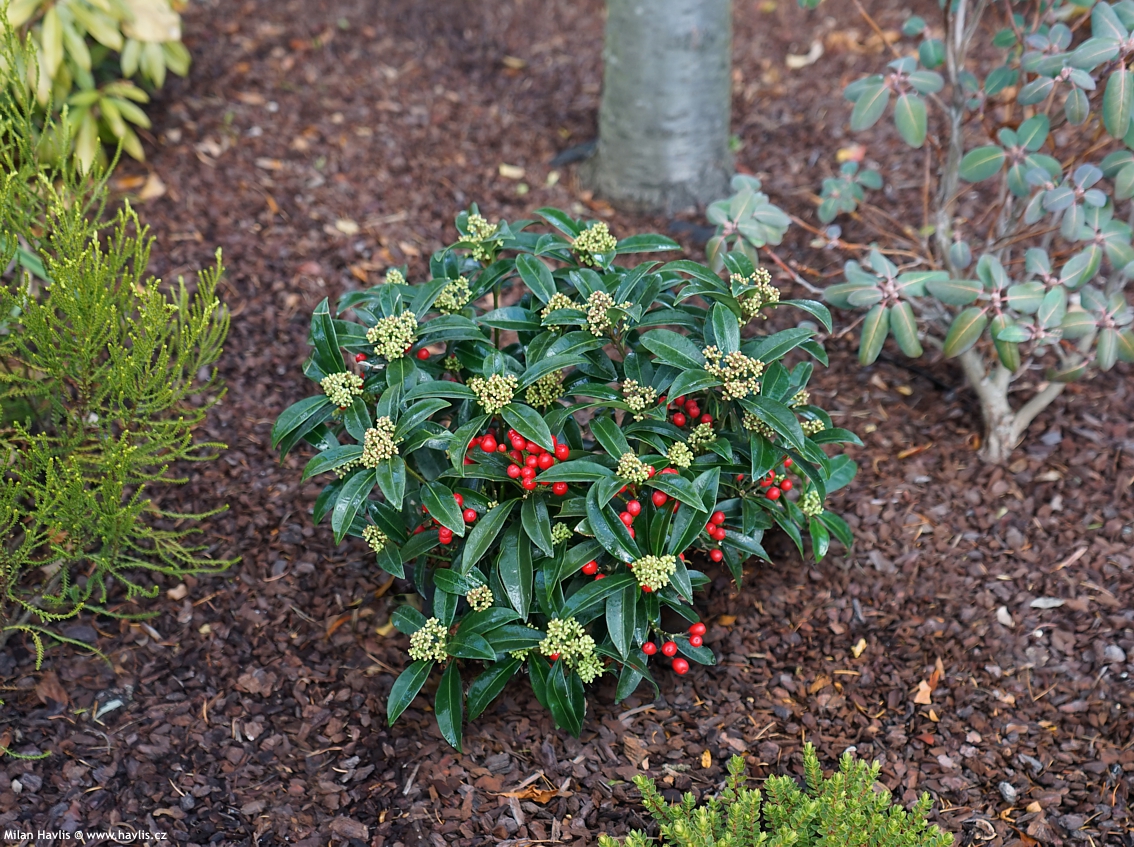
Skimmia japonica 'GODRIE'S LITTLE RUBY' Japanese skimmia


Skimmia
The genus Skimmia comprises a small number of evergreen shrubs native to East Asia, particularly Japan, Korea, China and the Himalayan region. It belongs to the rue family (Rutaceae), which also includes, perhaps unexpectedly, citrus fruits, a relationship reflected in the structure of the flowers and the gently aromatic foliage. In Europe, skimmias have been known since the late eighteenth century thanks to the Swedish naturalist Carl Peter Thunberg (1743–1828), a pupil of Carl Linnaeus and one of the key figures in the early study of Japanese flora. Thunberg stayed in Japan in 1775–1776 as a physician to the Dutch East India Company and, based on the material he collected there, published his seminal work Flora Japonica in 1784, in which the genus Skimmia and the species Skimmia japonica were scientifically described for the first time. In their natural habitat, skimmias form part of the understorey of mountain forests, growing in partial shade in humus-rich, acidic soils with evenly balanced moisture. These ecological requirements later shaped their use in gardens as evergreen shrubs suited to shaded situations.
The generic name Skimmia is derived from the Japanese vernacular name miyama-shikimi (深山樒), meaning “mountain” or “wild shikimi”. In Japanese usage, the word shikimi on its own refers primarily to Illicium religiosum, an aromatic shrub traditionally associated with Buddhist rituals. The name reflects not only the similarity in leaf shape and scent between the two plants, but also cultural associations with purification, protection and calm that are linked to these aromatic shrubs in Japanese tradition. By adopting this name into scientific nomenclature, Thunberg preserved a direct connection between local usage and botanical description.
Japanese skimmia (Skimmia japonica) represents the key species that first found its way into European gardens. Its natural range includes Japan, the Ryukyu Islands and the Philippines, with forms extending as far north as Sakhalin and the southern Kuriles, and probably also parts of China and Taiwan. In Europe it was already being cultivated in the first half of the nineteenth century, as evidenced by records from the Royal Botanic Gardens, Kew, dating from 1838. Wider horticultural interest, however, followed only after a further introduction from Japan in 1861 by Robert Fortune for the nursery of Standish & Co. An initial wave of enthusiasm culminated in an award for fruiting plants exhibited in 1864, but disappointment soon followed when many distributed plants failed to produce the expected decorative berries. The reason lay not in cultivation errors, but in the biology of the species itself, its dioecious nature, which at the time was understood by very few gardeners. This fact became generally accepted only after Maxwell T. Masters published his study of skimmias in 1889. As a result, skimmia found its place in European gardens less as a showy specimen and more as a bearer of calm. It acts as a quiet, permanent backdrop beneath the canopies of trees and large shrubs, evoking an atmosphere close to the zen concept of the garden, where harmony, balance and endurance matter more than immediate effect.
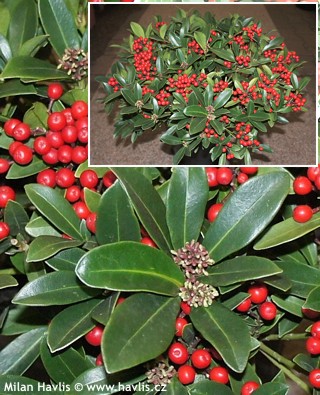
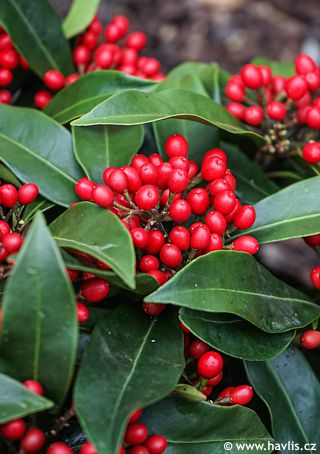
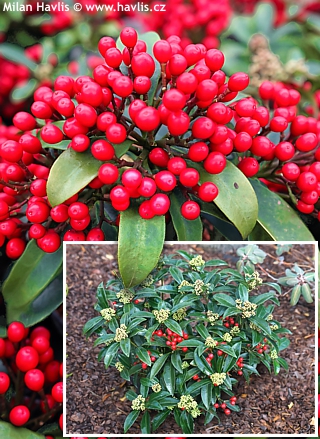
I suppose that there’s never enough skimmia varieties when it comes to dwarf as well as female plants with berries. Just like Godrie’s Little Ruby. Johan Godrie from his nursery in Dutch town Achtmaal bred 2 siblings, the male variety Godries Dwarf Green (pollinator) and the female Godries Little Ruby, which if pollinated by any male variety bears attractive, glossy, bright red fruits in autumn. It makes upright panicles composed of tine, cream white, strongly sweetly scented flowers whose buds form already in late summer and bloom in early spring. The evergreen leaves are dark green, narrowly elliptic, and very glossy. The breeder classifies them as a subspecies of skimmia reevesiana, which means that they are slow-growing, mound-forming shrubs, which make beautiful, densely branched cushions. European Patent No. EU 21194 was issued in 2008.
Nowadays in garden centres you can often find beautiful plants with berries all over the plant without any branches above them blocking the view. It is not natural, though. Those “blocking branches” were removed by the nurserymen who wanted to enhance the fruit display. But those branches would have carried flower buds to produce berries again the following year, so don’t be surprised not to arrive in flowers or berries in the coming year but the year after.
Skimmia is an undemanding shrub that requires little routine maintenance, provided it is correctly sited and well planted. It needs consistently moist but very well-drained soil rich in nutrients, particularly iron and magnesium. The substrate should be light, humus-rich and acidic, ideally improved with leaf mould and peat to maintain suitable structure and pH. It thrives best in partial shade to deep shade, for example on the north side of a building or beneath broad-canopied trees that provide summer shade and diffuse strong winter sunlight. Pale or yellowing leaves usually indicate unsuitable conditions, too much direct sun, waterlogging, or poor, insufficiently acidic soil lacking iron. Skimmia tolerates urban conditions and air pollution well. It is fully hardy to at least −27 °C (USDA zone 5) and, in sheltered, non-sunny positions, also performs well in wider, relatively shallow outdoor containers with good drainage. If small pale speckles appear on the leaves, check the undersides, as they may indicate infestation by rhododendron lace bug, particularly on weakened plants. Thanks to its calm appearance and year-round effect, skimmia is also well suited to modern containers outside cafés and restaurants. The entire plant is poisonous.
Last update 10-11-2021;27-03-2026