

































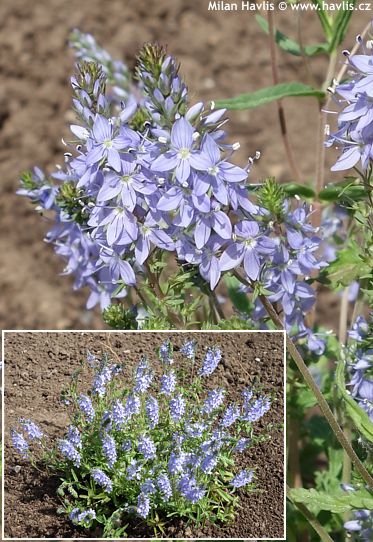
Veronica longifolia 'LILAC FANTASY' long-leaved speedwell

 Symbivit Tric (arbuscular)
 Symbivit (arbuscular)
Veronica
The genus Veronica belongs among the most numerous and the most diverse groups of flowering plants of the temperate zone. It includes several hundred species distributed almost worldwide, from alpine meadows and forest understories to dry steppes and coastal rocks. It was described in the 18th century by Carl Linnaeus, who adopted an already established name linked to the legend of Saint Veronica. The legend says that she offered Christ a piece of cloth during his arduous journey to Golgotha, with which he wiped sweat and blood off his face. His image was said to have miraculously imprinted itself on the fabric, the so‑called vera icon, or “true image”. This idea of a faithful, unembellished imprint of reality was symbolically transferred in pre‑modern botany to speedwells, whose small, clearly drawn flowers were perceived as honest and needing no adornment.
Long-leaved speedwell (Veronica longifolia) is a European perennial, first described botanically in 1753. It is a characteristic species of damp meadows and river floodplains across Central and Northern Europe, where it formed a natural part of the traditional agricultural landscape for centuries. In meadow communities it was valued as a stable, long‑lived perennial able to tolerate repeated mowing while continuing to provide forage for pollinators during high summer, when many other meadow species had already finished flowering. Its prominent spike‑like inflorescences are an important nectar source for bumblebees, solitary bees, and butterflies, and the species is still regarded as an indicator of well‑preserved, species‑rich grasslands. It reached North America unintentionally, mainly through seed and hay imported from Europe during the 19th century. Although it has locally naturalised on moist sites in parts of the north‑eastern and midwestern United States, it has never behaved invasively and remains scattered and localised. Owing to its combination of adaptability, ecological value, and non‑invasive behaviour, it has become one of the key parent species in modern breeding, particularly for the development of cultivars with longer inflorescences and an extended flowering period.
I first encountered Lilac Fantasy speedwell early in my gardening career, in full bloom, at a suburban nursery that had little left to offer after the spring season. On a single table stood a cluster of pots containing just one flowering perennial. Its spikes swayed gently in the breeze, and the colour was calm yet quietly compelling. Perhaps it was the absence of other flowers around it, perhaps its understated charm, or perhaps I was simply hot and unwilling to continue wandering through that sold‑out wasteland – in any case, I fell for it immediately and decided to give a better home. Naturally, I bought them all and gave them a fine position in full sun, alongside moisture‑loving ornamental grasses and astilbes.
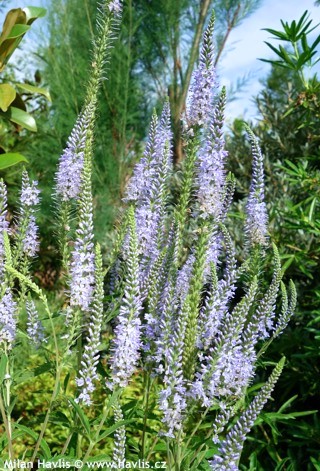
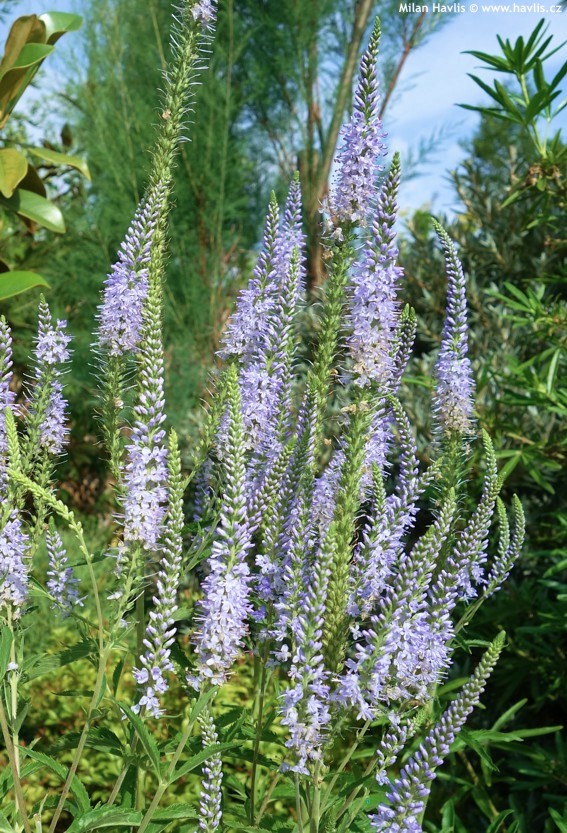
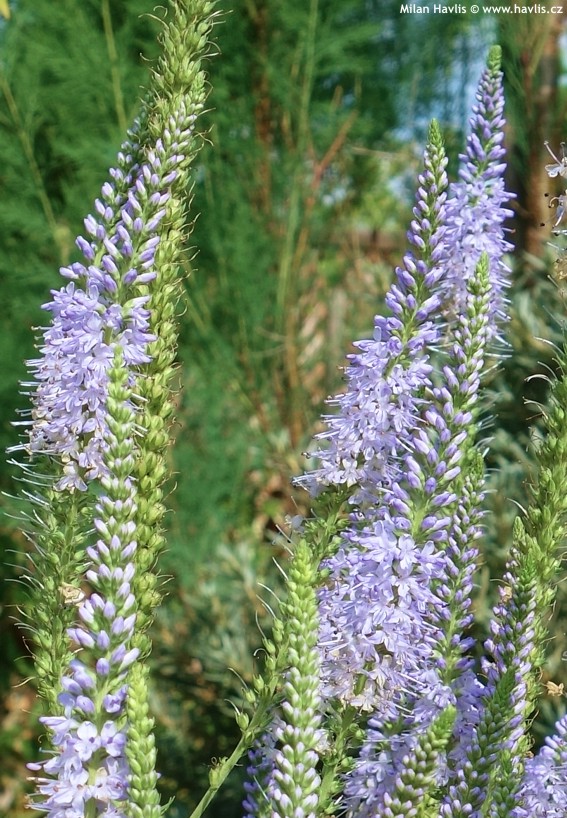
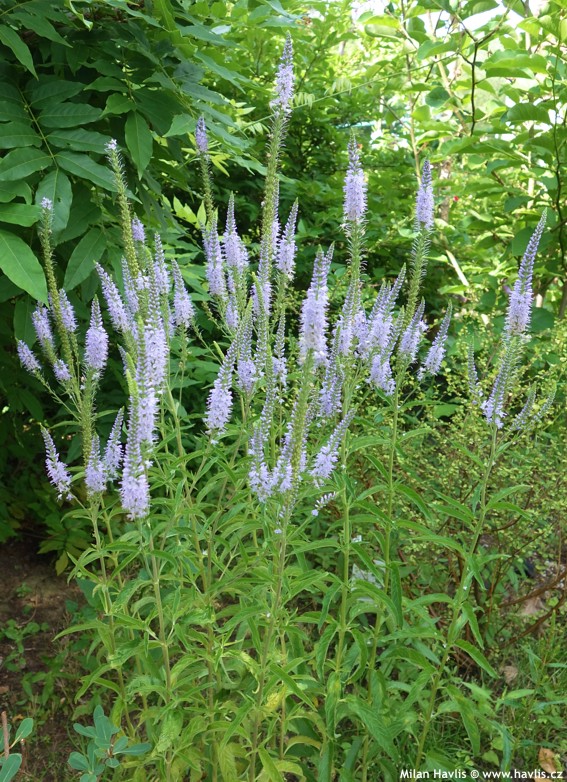
Lilac Fantasy is a less showy yet highly elegant cultivar of long‑leaved speedwell. From the second half of June, it produces richly branched inflorescences composed of spikes up to 25 cm tall – botanically more accurately described as terminal panicles – in a soft lavender‑blue shade with subtle lilac‑pink undertones. Under favourable conditions, the stems can reach up to 70 cm in height, though they are usually somewhat shorter in ordinary garden soil. The leaves are narrowly lanceolate, healthy, 7–12 cm long, with finely serrated margins. The plant forms a dense, well‑filled clump that naturally expands and gains presence with each passing year. Its calm vertical accent makes Lilac Fantasy an ideal companion for lower or horizontally growing perennials and fine‑textured grasses, where it stands out without the need for strong contrasts. It looks particularly beautiful in combination with oxeye daisies, Japanese asters, or even globeflowers, which it naturally follows thanks to its later flowering time, meeting them again during their second flush.
Last update 14-12-2016; 29-06-2017; 27-12-2025
Long‑leaved speedwell is an undemanding and reliable perennial that performs best in full sun to light partial shade, provided the soil retains sufficient moisture. It prefers deeper, humus‑rich soils that remain evenly moist, but will also tolerate ordinary garden conditions as long as the soil does not dry out completely during summer. In drier locations it benefits from occasional watering, especially during the period of bud formation. After the main flush of flowering, spent stems can be cut back to encourage the development of new shoots and often a lighter repeat bloom. The plant is fully frost‑hardy to approximately −34 °C and requires no winter protection; it can remain in the same position for many years without the need for transplanting, although older clumps benefit from rejuvenation by division after several seasons. It is also suitable for year‑round cultivation in outdoor containers, provided regular watering is maintained.

.jpg)
