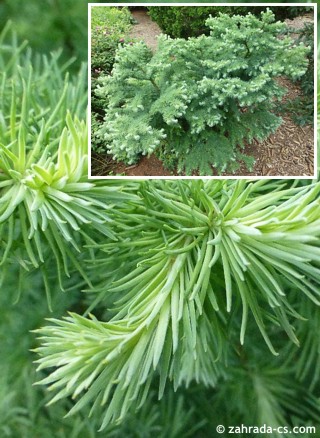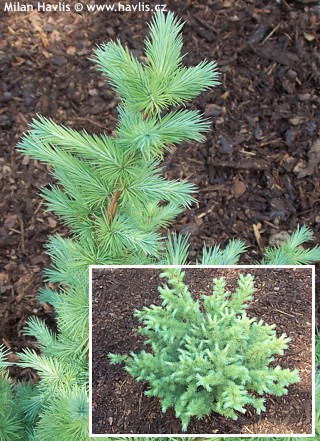













Cedrus deodara 'FEELIN' BLUE' Himalayan cedar

 Ectovit (ectomycorrhizal)
Cedrus
The genus Cedrus belongs to that small group of woody plants that have accompanied human memory for so long that they seem almost timeless. Fossilised pollen and petrified wood reveal that cedars once covered vast areas of Eurasia before their range gradually contracted during the Tertiary and Quaternary periods to the mountain systems of the eastern Mediterranean and western Asia. Even the generic name itself, derived from the Greek kedros and Latin cedrus, evokes their fragrant, resinous timber, long associated with durability, sanctity and power. One linguistic curiosity is worth mentioning: the Russian word кедр (kedr) does not refer to a true cedar, but to Siberian pine (Pinus sibirica), a completely different genus of conifer. Cedars appear in epics, biblical texts and classical mythology; their wood supported temple roofs, formed the keels of ships and furnished the thrones of kings. Standing beneath an ancient cedar, one cannot help feeling that time slows down, as though the tree understands that a human life is merely a brief episode within a story that unfolds over centuries.
Himalayan cedar originates from the western Himalayas, where it occurs from Afghanistan through northern Pakistan and India to western Nepal. Its specific name deodara derives from the Sanskrit devadāru, meaning “tree of the gods” or “wood of the gods”. The name itself hints at the exceptional status the species held in the cultures of the Himalayan highlands, where its forests were revered as sacred groves. For centuries it formed extensive mountain forests and ranked among the most economically valuable trees of the western Himalayas. Of all true cedars, it is also the only species whose natural range extends into the subtropical climatic zone. It does not occur in lowlands, however, but on mountain slopes and valley sides, typically between 1,200 and 3,500 metres above sea level. Its timber is strong, durable, aromatic and remarkably resistant to both decay and wood-boring insects, making it highly valued for temples, bridges, mountain dwellings and hydraulic structures. Cedars were traditionally planted near shrines and sacred places, where they symbolised strength, longevity and the connection between humanity and the divine order.
European botanists did not become acquainted with the species until the early 19th century. It was formally described in 1824 by the British botanist David Don (1799–1841) under the name Pinus deodara. During the second half of the 19th century, the natural forests of deodar were also studied in detail by Dietrich Brandis (1824–1907), the founder of modern Indian forestry, who played a key role in the first scientific efforts to manage and protect Himalayan forests. For European gardeners, however, the pivotal date was 1831, when William Leslie Melville, an officer of the East India Company, brought the first seeds to Scotland. From these emerged some of the earliest European specimens, and within a few decades Himalayan cedar had spread to parks and arboreta throughout Europe. In Victorian Britain it became one of the symbols of the era’s fascination with exotic conifers and ranked among the most coveted novelties in ornamental horticulture. Some of the trees planted at that time remain among the largest and most valuable examples of the species outside its native Himalayas. For nearly two centuries their monumental crowns have risen above Europe’s parks and historic estates, from Dropmore and Eastnor Castle in England to Villa Carlotta in Italy and Señorío de Bertiz in Spain, where their majesty often rivals the architecture itself.
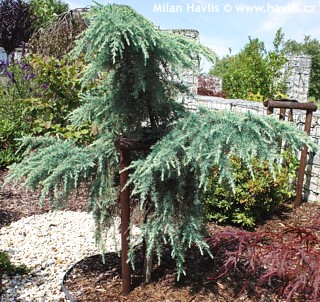
Feelin‘ Blue is a striking Dutch introduction of Himalayan cedar, which in fact turned out to be one of the most reliable cedars we ever had. Formerly a ground-covering plant is often staked up to a bamboo stick in order to form an appearance of a classic but much smaller cedar tree with picturesque arching branches. With their long, evergreen needles they look like a silvery blue waterfall.
It grows moderately about 30-40 cm per year. It natural height without staking is not much taller than 20 cm and spread could be indefinite. It grows best in full sun and almost any reasonably permeable soil. Lime tolerant. Pruning is possible in early spring. It is very hardy down to USDA zone 5 i.e. -29 °C.
Last update 04-03-2007; 08-10-2016
Himalayan cedar is a remarkably adaptable tree that performs well across most of Europe, including Czechia and Slovakia, becoming less suitable only in the colder regions of northern Europe. It thrives best in full sun and deep, well-drained soil, although its substantial root system can also cope with heavier clay soils, provided care is taken during planting to prevent waterlogging within the planting pit during the first few years (see Planting Instructions). It does not tolerate prolonged waterlogging or strongly calcareous soils, where chlorosis and reduced vigour may occur. Young plants require moderate but regular watering after planting, yet once established they tolerate summer droughts as well as many pines. The tree produces two flushes of growth each year and gradually sheds its oldest needles during these growth periods. Pruning is rarely necessary and the species is at its finest when given sufficient space to develop its natural crown. Selective thinning of overcrowded crowns and the removal of damaged branches may be carried out from spring until mid-summer. Fertilisation is not recommended, as a more natural rate of growth promotes better ripening of the shoots before winter. Himalayan cedar tolerates urban conditions and atmospheric pollution remarkably well. Although it develops an extensive root system, it is not known for causing serious damage to roads or nearby buildings. More than a century of cultivation in numerous European cities, including many smaller towns, demonstrates that it can be grown successfully near roads, pavements and buildings.
Established trees can withstand temperatures down to approximately −29 °C (USDA zone 5) for short periods. Young specimens, however, may be more susceptible to shoot damage during severe winters, particularly when exposed to late-winter or early-spring sunshine during freezing weather. Any damaged foliage is normally replaced reliably during the early months of the following growing season. For colder regions where winter temperatures regularly fall below −24 °C, or where severe frosts persist for extended periods, it is advisable to select cultivars bred specifically for enhanced cold hardiness.