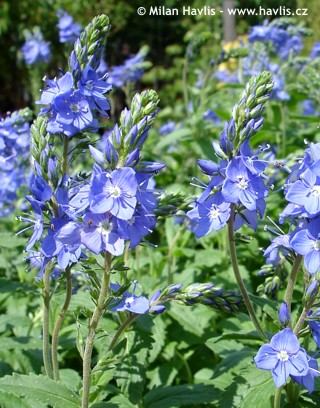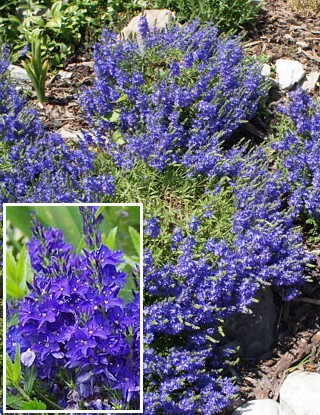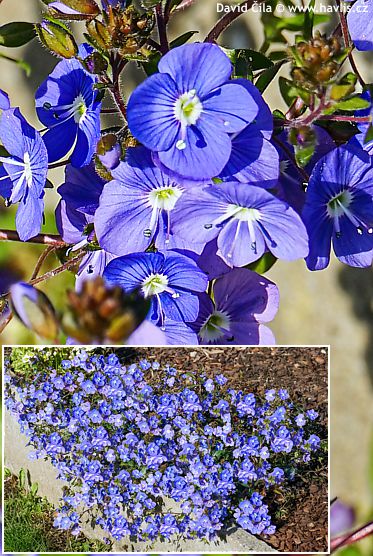











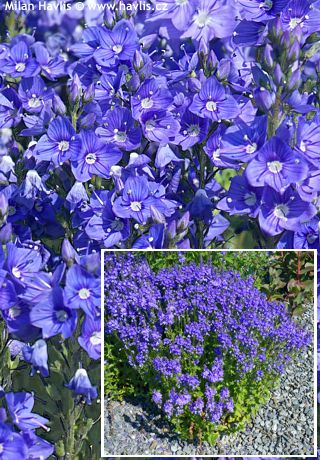
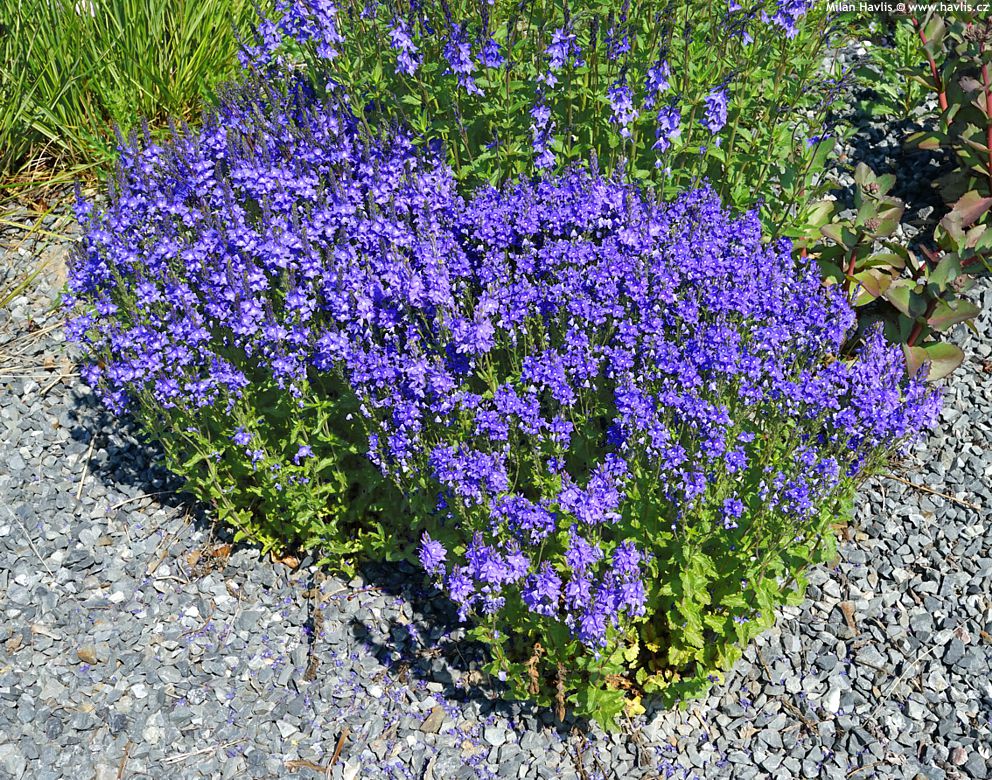
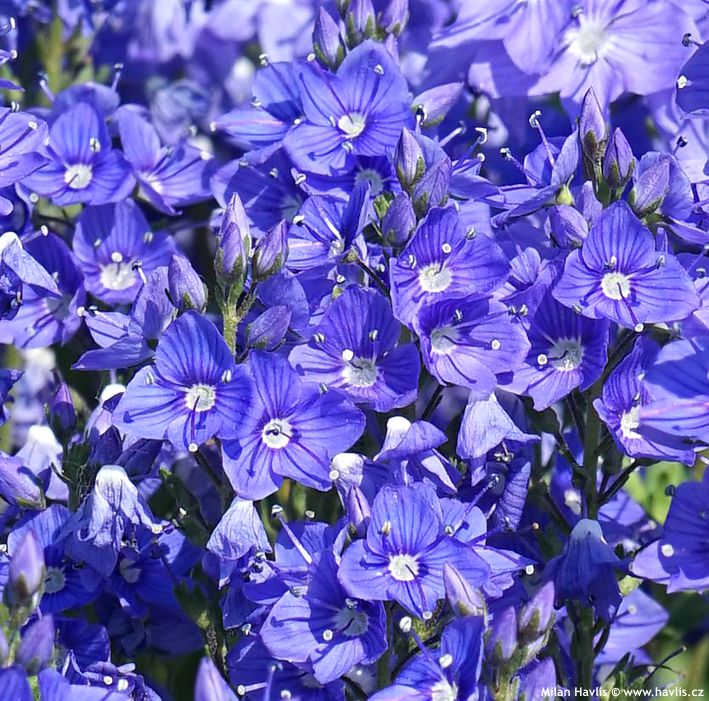
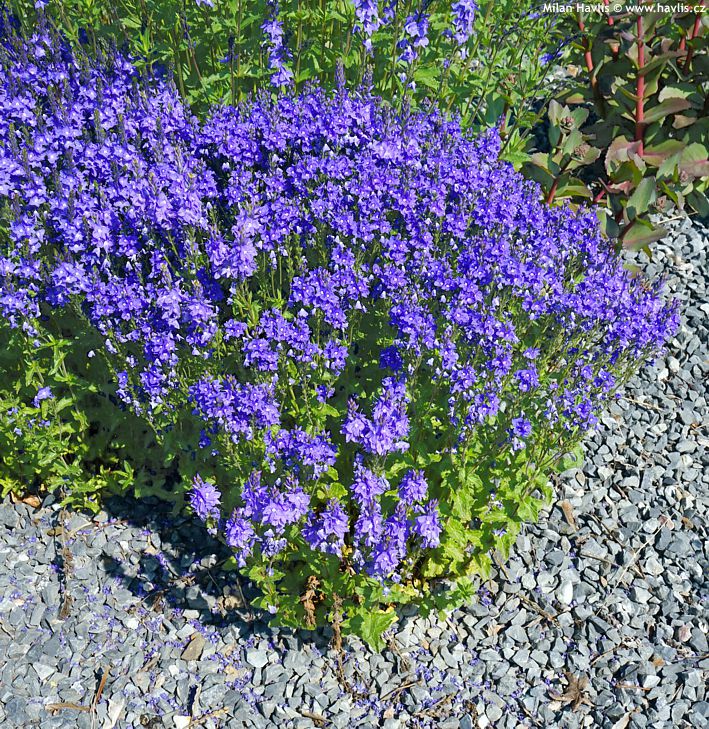
Veronica austriaca 'KNALLBLAU' Austrian speedwell

 Symbivit Tric (arbuscular)
 Symbivit (arbuscular)
Veronica
The genus Veronica belongs among the most numerous and the most diverse groups of flowering plants of the temperate zone. It includes several hundred species distributed almost worldwide, from alpine meadows and forest understories to dry steppes and coastal rocks. It was described in the 18th century by Carl Linnaeus, who adopted an already established name linked to the legend of Saint Veronica. The legend says that she offered Christ a piece of cloth during his arduous journey to Golgotha, with which he wiped sweat and blood off his face. His image was said to have miraculously imprinted itself on the fabric, the so‑called vera icon, or “true image”. This idea of a faithful, unembellished imprint of reality was symbolically transferred in pre‑modern botany to speedwells, whose small, clearly drawn flowers were perceived as honest and needing no adornment.
Austrian speedwell is a native Central European species originating from the regions of present‑day Austria, Hungary, Slovakia, Czechia, and the Balkans. Its natural habitat lies on dry, sun‑exposed slopes, rocky steppes, and forest‑steppe landscapes that were shaped for centuries by grazing, mowing, and traditional land use, giving rise to open habitats rich in steppe flora. Its origin is estimated to date back to the post‑glacial period some 10,000–12,000 years ago, and it still marks landscapes shaped over millennia, where human presence faded in and out, and care was never required. Where such landscapes disappear today, the plant vanishes from the wild, too, finding refuge instead in maintained gardens and urban plantings, where its ease of cultivation and tolerance of poorer soils, limited or no irrigation, and complete neglect are particularly valued. Although a number of attractive cultivars now exist, it has retained the character of a humble, unassuming perennial that bridges the wild nature of its original home with domestic plantings that often seek to echo these landscapes.
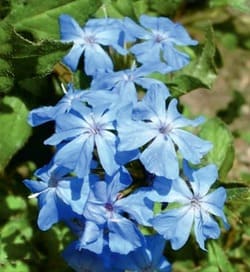
Knallblau is among the earlier‑flowering cultivars of Austrian speedwell and was introduced in 1950. It comes into bloom as early as late May, typically for a period of four to six weeks, bearing intensely storm‑blue flowers arranged in upright, spike‑like inflorescences, in which new buds continue to form progressively upwards; the overall length of flowering depends on the age and vitality of the plant. The flowers are attractive to butterflies. Both before and after flowering, the plant is ornamented by distinctive foliage whose shape loosely recalls that of caryopteris – broadly oval to heart‑shaped, conspicuously serrated along the margins, fresh green and glossy. Neither the leaves nor the flowers are scented. The plant forms dense, well‑branched clumps that draw the attention of many passers‑by when in bloom.
The cultivar Knallblau is associated with the name of Karl Foerster, one of the most influential figures in European horticulture of the twentieth century. A German breeder, gardener, and thinker of perennial plantings, he became renowned above all for selecting and developing long‑lived, resilient plants capable of thriving not only in gardens but also within the wider landscape. His work was grounded in a deep understanding of natural plant communities and in the conviction that a good garden should be sustainable, legible, and beautiful even without excessive care. It was in this spirit that Knallblau emerged in the mid‑twentieth century as a perennial firmly rooted in both place and time. To this day, it is regarded as a classic cultivar bearing Foerster’s unmistakable signature of simplicity, reliability, and lasting value.
Last update 07-06-2019; 27-12-2025
Austrian speedwell is an undemanding and long‑lived perennial. It performs best in full sun and well‑drained, rather dry soils, and reacts poorly to prolonged waterlogging, particularly in winter. The only intervention that benefits its appearance rather than its actual growth is cutting the entire clump back to ground level immediately after flowering; this rejuvenates the plant and ensures that, for the rest of the growing season, the garden is left not with a tired, spent clump but with a neat, dense mound of small, fresh green leaves. It is reliably hardy to at least −34 °C, allowing it to overwinter without difficulty even in colder parts of Central Europe. Cultivation in containers is possible, provided excellent drainage and a predominantly mineral substrate are used; containers should be placed in a sheltered, dry position to prevent the root ball from becoming waterlogged during winter.