










Acer negundo 'SENSATION' ash-leaved maple, box elder

 Symbivit Tric (arbuscular)
 Symbivit (arbuscular)
Acer
The genus Acer belongs among woody plants that appeared very early in the Northern Hemisphere, and whose basic form has changed remarkably little since then, unlike many other tree groups. Tertiary fossils from Europe, Asia and North America already show leaves and fruits that would be instantly recognisable today, including the characteristic paired samaras. In Czechia, one of the best known fossil sites is Bílina, where petrified maple leaves and fruits from the late Tertiary period testify that these trees were part of the local landscape long before the arrival of humans. Scientifically, the genus was described by Carl Linnaeus (1707–1778) in his seminal work Species Plantarum in 1753, although its internal classification has been repeatedly revised since then. Today, botanists regard East Asia, particularly China, Japan and the Himalayan region, as the true centre of species diversity within the genus. Maples occupy an exceptionally wide range of habitats, from subtropical mountain forests to the cold regions of the temperate zone. They are among the trees that have accompanied human landscapes and cultures for a very long time.
Acer negundo, ash-leaved maple or boxelder, originates from North America, where it formed part of the everyday life of Indigenous peoples as well as later European settlers for centuries. It naturally grows along rivers, in floodplains and in open woodlands, where it functions as a fast growing and highly adaptable tree. At times when sugar maple was not readily available, sugar was commonly produced from its sap, albeit with lower yields and a milder flavour. The species was introduced to Europe in 1688, when it was cultivated in the gardens at Fulham near London by Henry Compton (1632–1713), one of the most important introducers of North American woody plants of his time. From there, boxelder gradually spread into botanical gardens and parks throughout Europe. In what is now the Czech Republic, it has been documented since 1835, when it appeared in the Royal Game Reserve in Prague’s Stromovka, from where it quickly spread into castle parks, urban greenery and the open landscape. Often this spread was not intentional. Based on long term scientific studies, boxelder has been shown to possess a high degree of invasiveness, which has led to the botanical species being excluded from recommended plantings and actively removed in many locations. In horticultural practice, therefore, only selected, predominantly sterile cultivars are used, as they do not pose a comparable risk to surrounding vegetation.
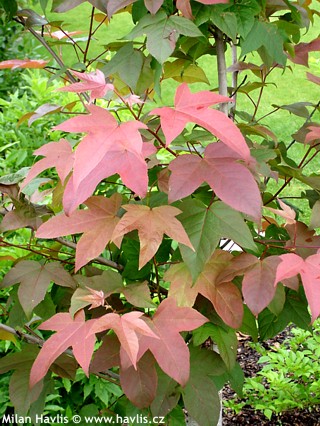
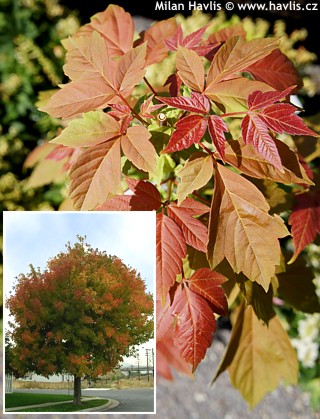
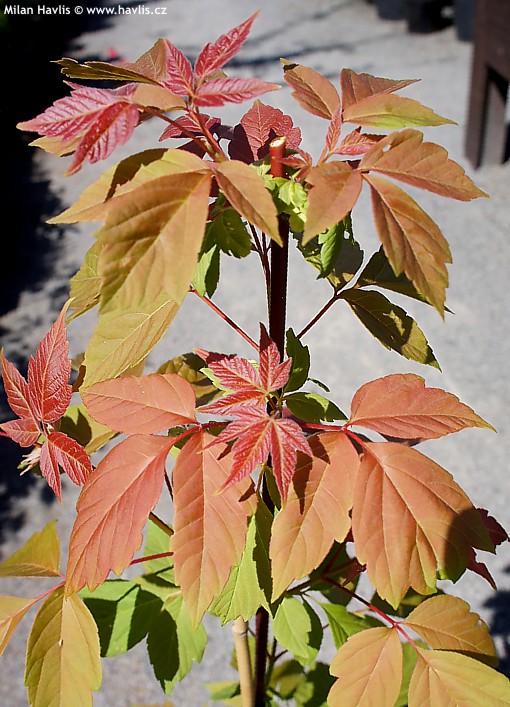
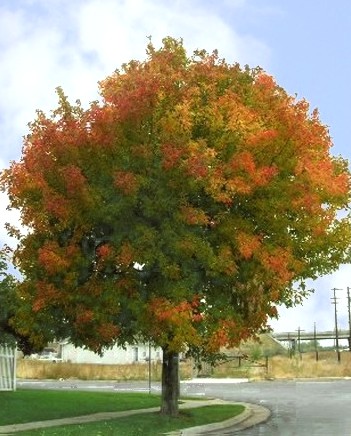
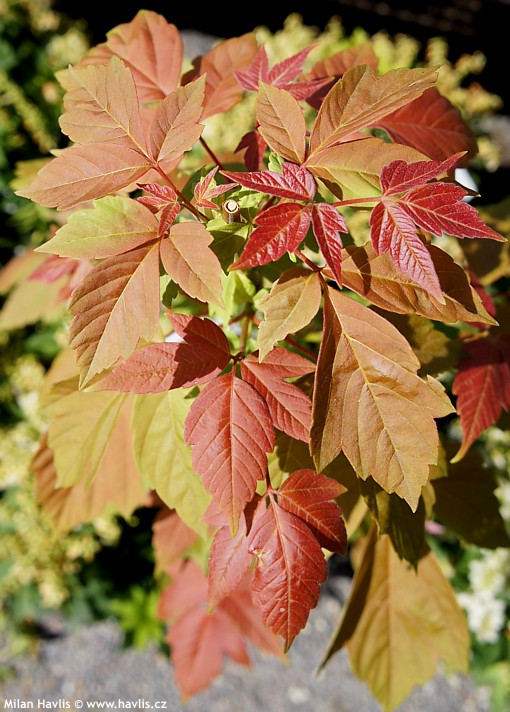
Sensation box elder is truly sensational, mostly because of its leaf colour. New foliage emerges coppery red and creates a “fiery” rim on the tree that gradually matures to deep green during the season, and the crown often turns shades of red and orange in autumn. The cultivar is a clone discovered by Warren Carnefix in the early 1980s, the original tree found in Idaho near an abandoned homestead, and it is a male clone, so it typically does not produce samara clusters, which is a practical advantage in urban plantings. In North America Sensation can develop a more robust habit and reach larger dimensions, but in European conditions it is often reported as more compact and regular, with a height of around 6–8 metres; growth is reliable, medium to fast, and the crown tends to be broadly rounded to oval. The cultivar is described as less wild yet denser and more decorative thanks to the persistent colour contrast in the crown, and in the landscape it is used where a strong colour element is desired without heavy maintenance.
Last update 07-01-2012; 22-02-2026
Boxelder maple requires virtually no maintenance. It is resistant to severe frost, wind, drought and temporary waterlogging. It is not prone to diseases and thrives in full sun as well as partial shade. It performs best in deeper, moist but well drained soils, yet it also tolerates drier sites and urban conditions. During the first three years after planting, the tree must be firmly staked to ensure proper anchorage and straight trunk development. During this period, grass and other plants should not be allowed to grow above the root zone. Pruning is not necessary, but it is possible, ideally in late winter before sap flow begins. Trees or shrubs subjected to regular renewal pruning develop dense branching with large leaves, enhancing their ornamental value. Frost hardiness is excellent, tolerating temperatures down to approximately −45 °C (USDA zone 2).