Acer shirasawanum 'JORDAN' Shirasawa maple, Japanese maple

 Symbivit Tric (arbuscular)
 Symbivit (arbuscular)
Acer
Acer shirasawanum, the Shirasawa maple, is a species native to Japan, where it grows in the mountainous regions of central and southern Honshu and on the islands of Shikoku and Kyushu. It occurs there as an understorey tree or large shrub in cooler, humid forests, often on steep slopes with humus‑rich, well‑drained soils. Unlike Acer palmatum, which occupies a wide ecological range, A. shirasawanum is more typical of higher elevations and stable montane climates, a pattern reflected in its slower growth and marked tolerance of partial shade. It belongs to the same taxonomic group as A. palmatum, A. japonicum and A. sieboldianum, and differs from the first two mainly by its smooth, hairless shoots and upright inflorescences, while in contrast to the yellow‑flowered A. sieboldianum it bears red flowers. The leaves are almost circular, deeply lobed, with 9–13 shallow, finely serrated lobes that turn vivid shades of gold, orange and red in autumn. The species was described in 1911 by the Japanese botanist Gen’ichi Koidzumi and named in honour of Homi Shirasawa, who studied the dendroflora of Japan. In cultivation it is less common than Acer palmatum, but its cultivars rank among the most valuable Japanese maples, many of them having received international awards for ornamental merit. By 2020, seventeen recognised cultivars had been registered, each with its own distinctive qualities.
The Shirasawa maple is one of the species that remained hidden for centuries in Japan’s mountain forests and entered cultural awareness later than the widely cultivated palmatum maples. In Japanese it is known as Ōitaya meigetsu, the “moon leaf”, a name referring to its almost circular, finely divided foliage, which in traditional aesthetics evokes the clear autumn moon. In its native regions of central and southern Honshu, Shikoku and Kyushu it forms part of the autumn tradition of momijigari (紅葉狩り), the “hunt for red leaves”, when people travel to temple gardens, mountains and parks in search of the finest colours. It is a celebration held in similar esteem to the spring hanami (花見), dedicated to flowering cherries. Compared with the deep reds of A. palmatum, the golden and orange tones of this species create a lighter, calmer counterpoint. Japanese maples appear throughout literature — in the Man'yōshū, the oldest surviving anthology of Japanese poetry from the 8th century, and in Chinese poetry, where they were praised by writers such as Wang Wei (699–759). For centuries they have been a constant motif in painting, woodblock prints, textiles and porcelain, symbolising beauty, elegance, tranquillity and the transience of the seasons — qualities that have become part of the aesthetic code of the entire East Asian cultural sphere. Their leaves are used in ikebana and seasonal decorations, appear in the tea ceremony as an emblem of autumn, and in the Minoo area near Osaka they are prepared as the regional speciality momiji no tenpura (もみじの天ぷら), a sweet treat made from salted and batter‑fried maple leaves.
The modern era of Japanese maples is shaped by several key figures and institutions that define the direction of breeding and scholarly documentation. In the Western world, a pivotal role was played by the American dendrologist J. D. Vertrees (1920–1993), author of the first comprehensive monograph Japanese Maples, followed by the British specialist Peter Gregory, long‑time curator of the collection at Westonbirt Arboretum. In Europe, one of the most important centres is the Dutch arboretum and nursery Esveld, run by the van Gelderen family (est. 1865), while in Japan traditional nurseries such as Tsukasa Maple and Kobayashi Momiji‑en preserve old regional clones and introduce new cultivars. Among the world’s leading collections are Westonbirt Arboretum in the United Kingdom, the Arnold Arboretum of Harvard University (est. 1872), which has long studied the genus Acer, and the Portland Japanese Garden, where Japanese maples have become an iconic feature and the focus of expert care. In Japan, key institutions include the Kyoto Botanical Garden (est. 1924) and the Koishikawa Botanical Garden in Tokyo (est. 1684), both of which maintain the genetic diversity of native forms.
Jordan is a Shirasawa maple variety from Italy where it was found in the Gilardelli Fratelli di Giordano E Nello Gilardelli nursery. If you know the area, you can easily guess where exactly. Here’s a clue: it is the Mecca of most Italian growers: Pistoia in Tuscany, of course. It was named after the owner's son Giordano and the cultivar’s name was later simplified to Jordan to make life on non-Italian speakers easier.
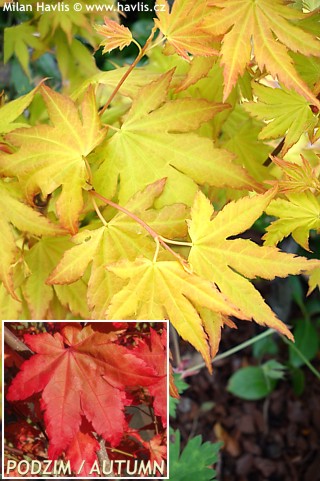
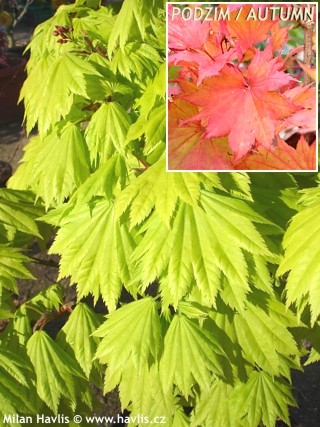
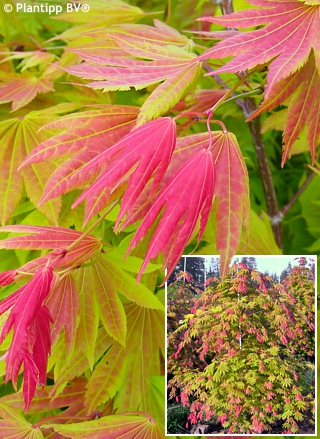
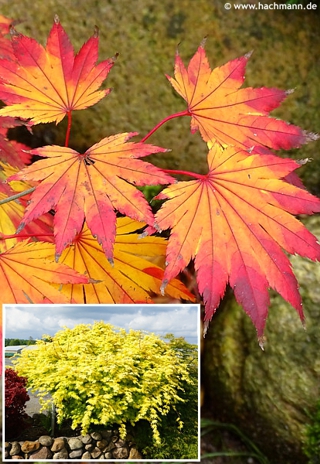
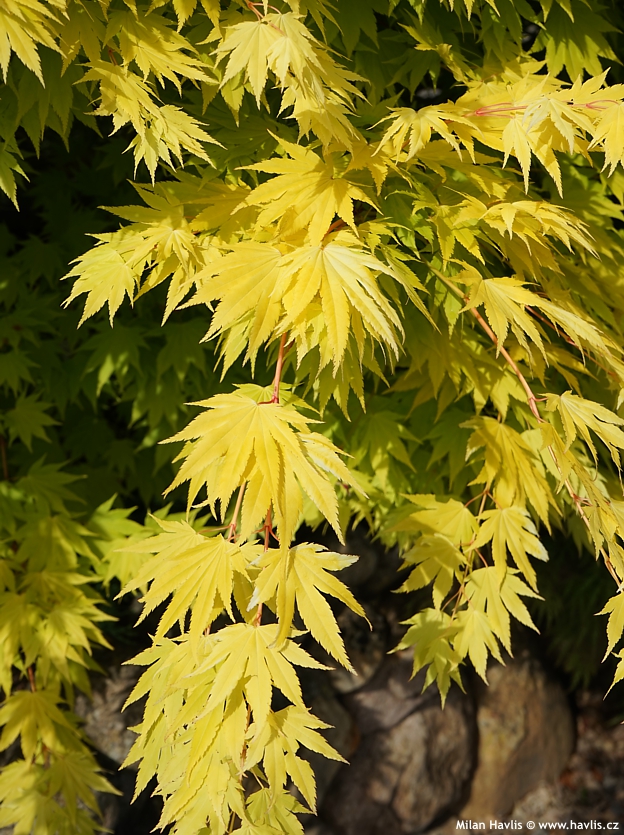
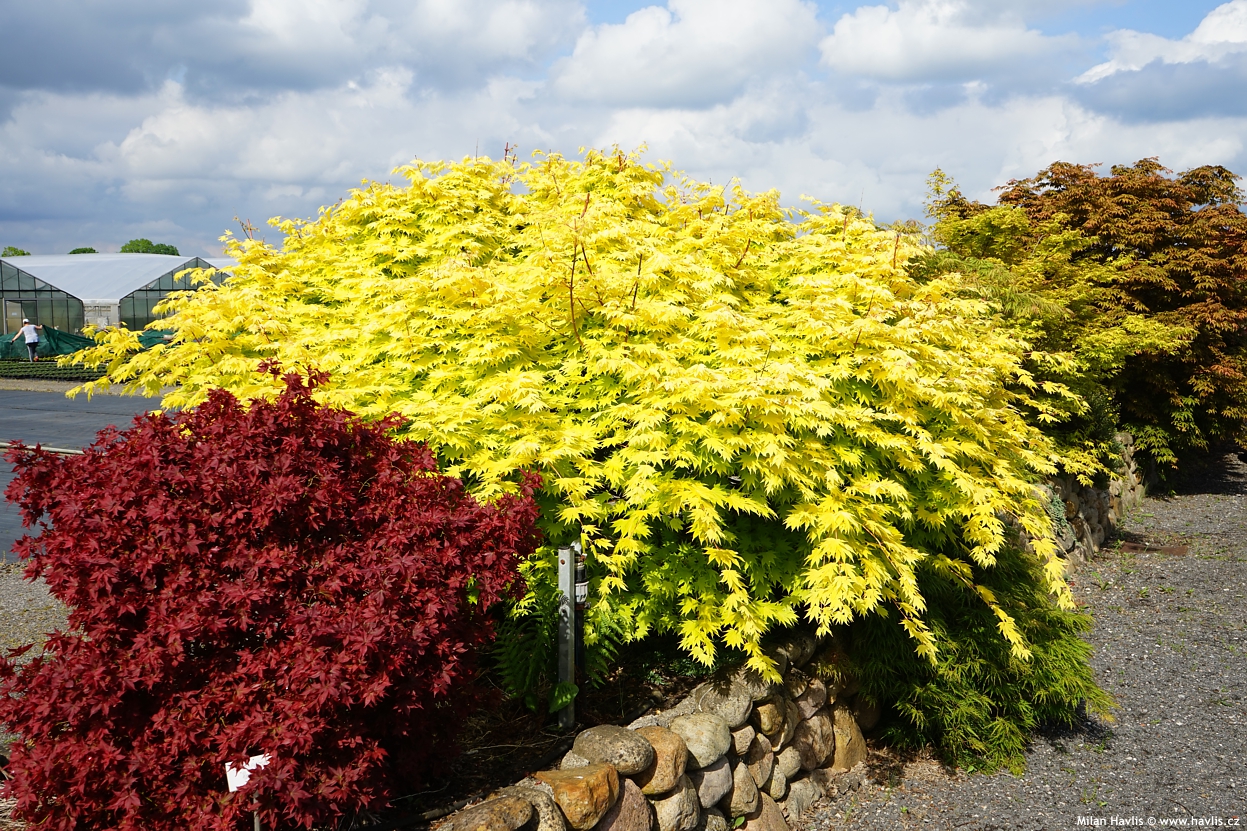
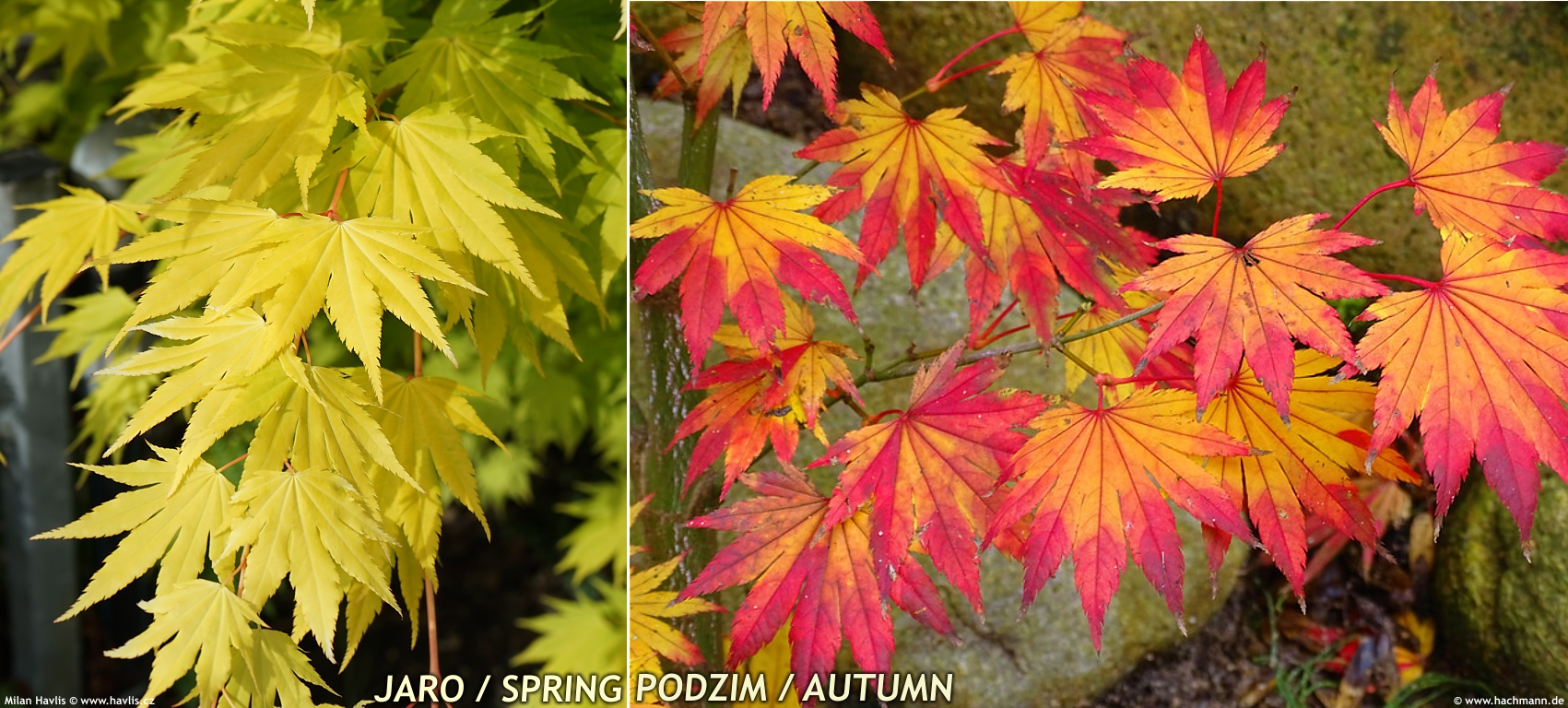
Jordan maple boasts a beautiful colour play on its leaves. They are deciduous, in spring they emerge in a dazzling shade of bright yellow colour with soft pink to orange margins and in summer they mature to rich golden yellow or chartreuse on less insolated branches. The leaves put on a final show in autumn when they turn several warm shades of orange, salmon, and scarlet. The leaf shape confirms the assumption that Jordan is most likely a spontaneous hybrid between a. shirasawanum and a. palmatum. The leaves are not as shell-shaped as on a. shirasawanum and have deep lobes corresponding to a. palmatum species. They are palmate and divided into 7-11 acuminate leaflets with delicately notched margins.
It grows moderately to a broadly vase-shaped shrub or a small multi-stemmed tree of dense habit. Branches are distinctly mahogany orange and petioles are salmon pink all through the growing season. The tips of branches often become dry after winter and are best pruned not to disfigure the appearance of a fully leaved shrub. It looks especially beautiful grown among maroon-leaved maples.
Last update 08-03-2024; 23-04-2026
Acer shirasawanum requires a sheltered position with dappled light or light partial shade, avoiding direct midday sun, which can scorch the leaves, especially in pale‑coloured cultivars. Only a few cultivars tolerate full sun. It grows best in humus‑rich, slightly moist but well‑drained soil with even watering; it does not tolerate prolonged waterlogging or the drying out of the root ball. In hot summers it benefits from mulch, which helps stabilise soil moisture and temperature. Feeding is not recommended, as it encourages overly vigorous, soft growth. Pruning should be minimal — limited to the removal of dead, damaged or crossing branches, ideally in late summer when the risk of bleeding is lower, or during frost‑free periods in winter. In denser plantings, good air circulation helps reduce fungal diseases, especially in wet years. Plants older than 3-5 years (wood maturity pending) are fully hardy to about -29 °C (USDA zone 5).