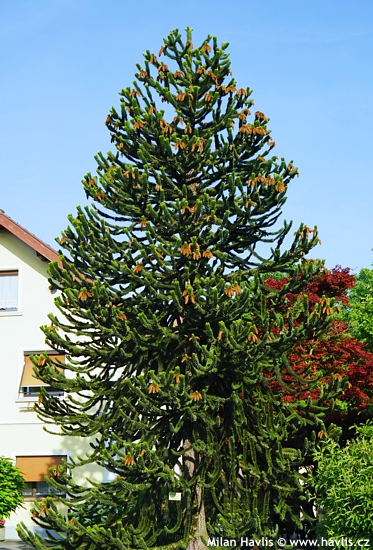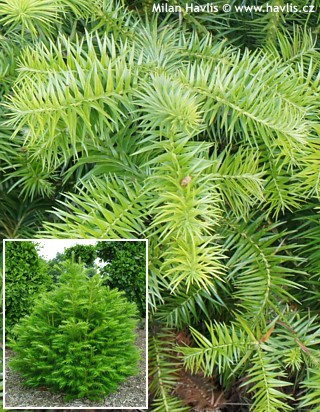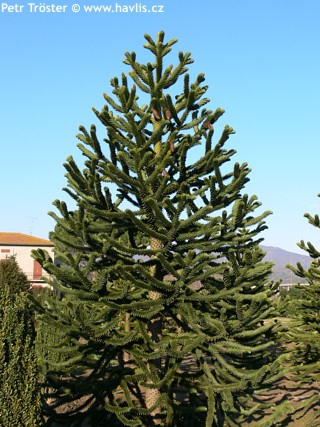
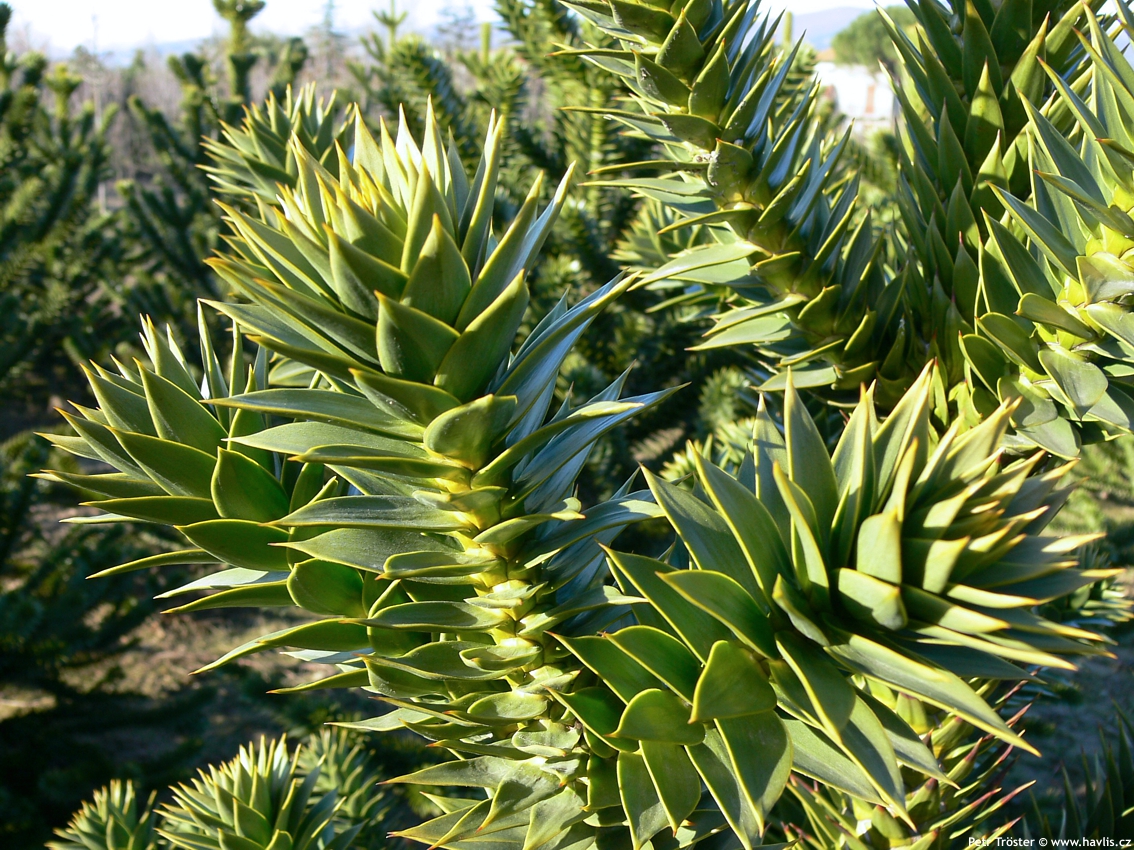
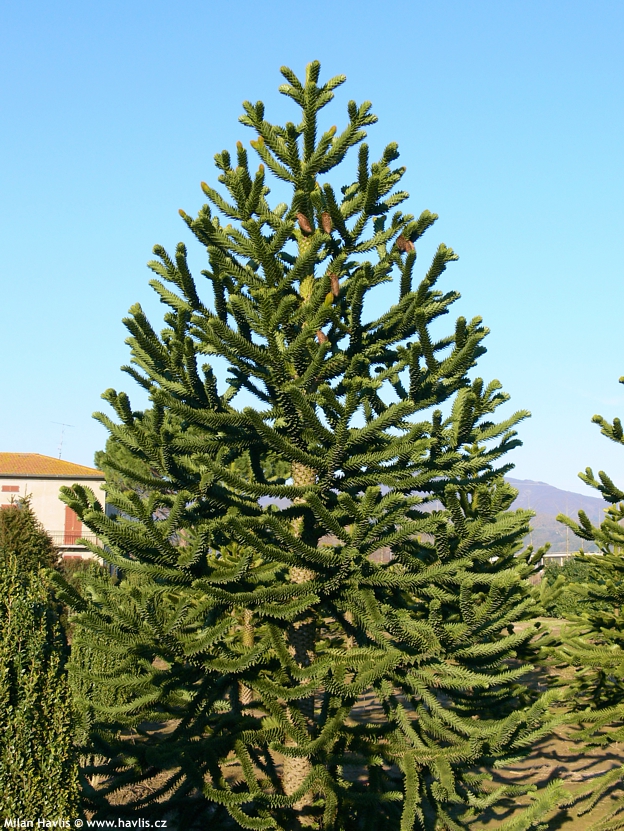
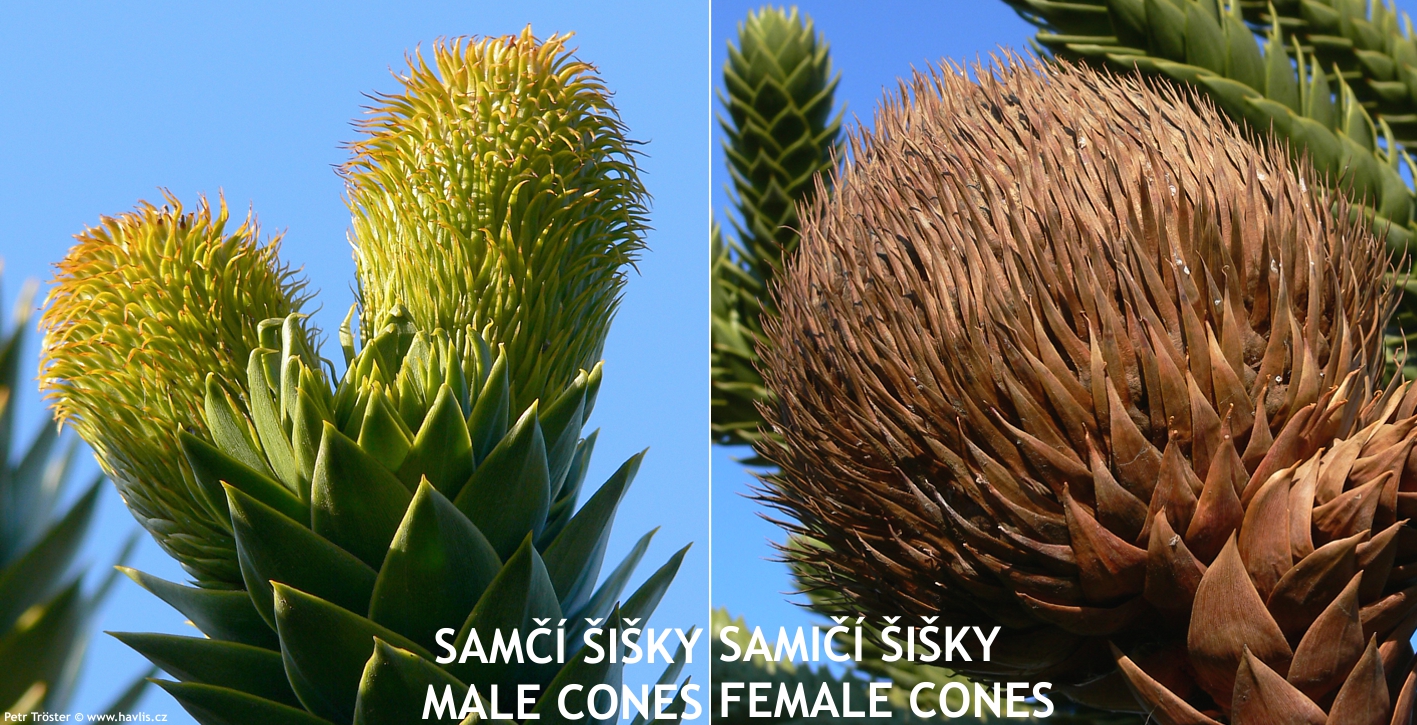
Araucaria araucana 'ROBUSTA GHERI' monkey puzzle tree, hardy araucaria


 Symbivit Tric (arbuscular)
 Symbivit (arbuscular)
Araucaria
The genus Araucaria today comprises 19 recognised species scattered across the Southern Hemisphere, from Australia through the Pacific to South America. It is a relict group of conifers that has survived since the Mesozoic era and frequently appears in the palaeobotanical record as a so‑called “living fossil”. Araucarias are characterised by massive trunks, regular tiers of branches and often an exceptionally great age. Their systematic description and introduction into European collections accompanied the travels of explorers and botanists of the eighteenth and nineteenth centuries, who brought plants back from remote regions of the Southern Hemisphere and marvelled at the fact that they were looking at trees whose structure had changed only minimally since the age of the dinosaurs.
The species Araucaria araucana – the monkey puzzle tree – originates from central and southern Chile, where it is the national tree, and from western Argentina, where it grows on volcanic, rocky slopes in mountainous regions. The first formal botanical description was published by Juan Ignacio Molina (1740–1829) under the name Pinus araucana; it was later transferred to the genus Araucaria by Karl Heinrich Koch (1809–1879). This species is sought after for its unmistakable silhouette, stiff triangular leaves and large spherical cones with edible seeds. In its native range it has strong cultural significance for the indigenous Mapuche people, who for centuries have collected and used the seeds, known as piñones, as an important food source. Araucaria araucana is now considered an endangered species due to logging, fires and grazing, which gives this tree a pronounced historical and ecological dimension.
Robusta Gheri is a sought‑after selection of the monkey puzzle tree, combining greater strength with enhanced cold tolerance. Its branches are thicker, carry denser foliage and give the whole plant a more compact, muscular look, as if the tree had a little more power stored inside. The leaves are the same dark green, rigid and sharply pointed, but their denser arrangement creates an even more pronounced armour. Growth is slow to moderate, with a regular conical outline that young plants maintain very well. Compared with the species, ‘Robusta Gheri’ appears sturdier and less prone to wind damage.
This selection originated in the Tuscan nursery Gheri Vivai Piante in the 1980s, and its main strength proved to be exceptional frost resistance. During the winter of 1985, which was extraordinary across Europe and reached even the warmest parts of Italy, it survived temperatures down to −22 °C. The nursery’s owner, Roberto Gheri, a passionate grower and collector especially of ginkgos, noticed its remarkable vitality and began propagating it; the cultivar soon became a long‑awaited dream for gardeners in colder parts of Europe. Unfortunately, the nursery suffered severe damage in autumn 2023, when it was among the worst affected during the flood of 2 November. It was buried under 60–80 cm of mud, thousands of plants were lost, including around 4,000 young monkey puzzle trees, and the future of the cultivar has since become uncertain.
Last update 09-01-2009; 26-02-2026
Its requirements and care are relatively straightforward, but with a few key principles. The monkey puzzle prefers full sun or only light partial shade and well‑drained, rather acidic to neutral soils with good drainage; it does not tolerate prolonged waterlogging. Young plants benefit from mulching and a sheltered position protected from cold winds, while mature trees are markedly more resilient. Fertilising is unnecessary and is best avoided, allowing new growth to ripen properly during the growing season. Pruning is carried out only to remove damaged branches or to ensure clearance beneath the crown; shaping is generally not required. Frost hardiness was historically considered reliable down to −22 °C, which is an exceptional value for a monkey puzzle tree, and after years of cultivation in Central Europe we can confirm that it has also endured occasional drops to −25 °C (USDA zone 6) with only minimal damage (in places scorched older leaves).