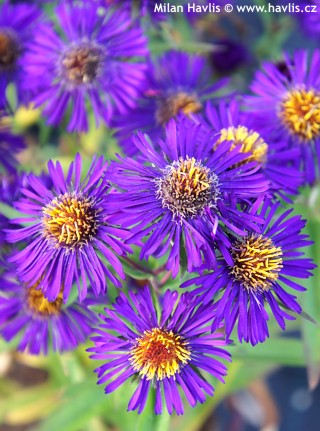











Aster novi-belgii 'Asflo' (syn. Symphyotrichum) STARLETTA New York aster

 Symbivit Tric (arbuscular)
 Symbivit (arbuscular)
Aster
Genus of asters (Symphyotrichum) is one of the largest groups of North American herbaceous perennials, comprising roughly one hundred species distributed mainly across the United States and Canada. For more than two centuries these plants were included in the broadly defined genus Aster, established by Carl Linnaeus (1707–1778) in 1753. It was not until the late 20th century that the American botanist Guy L. Nesom (*1945) demonstrated, through detailed studies of morphology and evolutionary relationships, that the North American "asters" formed a distinct group. As a result, many species were transferred to the newly circumscribed genus Symphyotrichum in 1994-1995. In botanical literature this name is now fully accepted, although in horticulture the older and, truth be told, rather more straightforward name Aster remains in widespread use.
New York aster, Symphyotrichum novi-belgii, is native to eastern North America, where it inhabits moist meadows, coastal habitats and open landscapes from the Canadian provinces south into the north-eastern United States. The species was first described by Carl Linnaeus (1707–1778) in 1753 under the name Aster novi-belgii. The epithet novi-belgii does not refer to modern Belgium but to historic New Netherland, the Dutch colony centred on what is now New York. This is also the origin of its common English name, New York aster. During the 19th and 20th centuries it became one of the most important autumn-flowering perennials in European gardens and gave rise to more than a thousand named cultivars. The species is frequently confused with New England aster (Symphyotrichum novae-angliae), which comes from the same part of North America. Interestingly, the names of both plants still commemorate two neighbouring colonial regions of the 17th century – New Netherland and New England. While New England aster is conspicuously hairy across much of the plant, New York aster has a lighter appearance, with stems and leaves that are usually smooth.
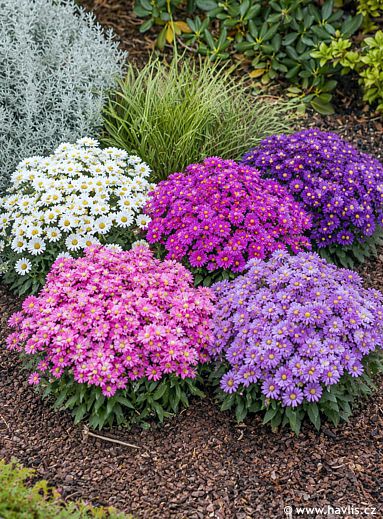
The STARLETTA series perfectly illustrates how far the breeding of autumn asters has progressed in recent decades. Gone are the tall, sometimes rather untidy plants that often lost their lower leaves to powdery mildew. In their place stand modern, carefully bred cultivars with a compact, dense habit and healthy foliage that remains attractive throughout a flowering season extending into November and, in mild years, occasionally into December. Plants typically reach only 25 to 35 cm in height, forming broad, well-branched cushions that become almost hidden beneath a profusion of single flowers with rich golden-yellow centres from late summer onwards. The series is available in six colour forms: Starletta White, Starletta Pink, Starletta Red, Starletta Purple, and two blue-toned selections, Starletta Blue and Starletta Dark Blue. Together they behave like a perfectly tuned family, sharing the same shape, flowering season and overall character. Each contributes its own distinct note of colour, yet only together do they create a harmonious autumn chord.
The series was developed by the Dutch breeding company Floritec Breeding BV. Individual cultivars were registered under the breeding prefix Asflo, but in garden centres they are marketed under the trade name STARLETTA, a clever adaptation of the English word "starlet", given a feminine botanical suffix. The first known member of the series, Starletta Dark Blue, was introduced in 2010, while the most recently documented selection, Starletta Pink, followed eleven years later in 2021. Floritec highlights the series' short production time, excellent foliage quality, compact growth and exceptional longevity, qualities that allow these plants to remain attractive not only on the sales bench but also later in containers, on patios and in the garden.
Last revised: 23 November 2026
New York asters perform best in full sun and ordinary garden soil with consistent moisture, but they are not particularly demanding and grow well even in moderately heavy clay or on less fertile sites. Although they tolerate light shade, plants remain more compact and flower more freely in a sunny position. Older cultivars were often susceptible to powdery mildew, making good air circulation and restrained nitrogen feeding advisable. Modern cultivars are generally far more resistant. Established clumps benefit from division every three to five years to maintain vigour. Taller cultivars may require support in rich soils, whereas compact series usually retain a neat shape without intervention. Dead stems are best removed in late winter or early spring. Most cultivars also perform well in containers, provided the compost is not allowed to dry out completely during summer. The hardiness of most cultivars ranges from approximately -34 °C to -40 °C (USDA Zones 3-4).