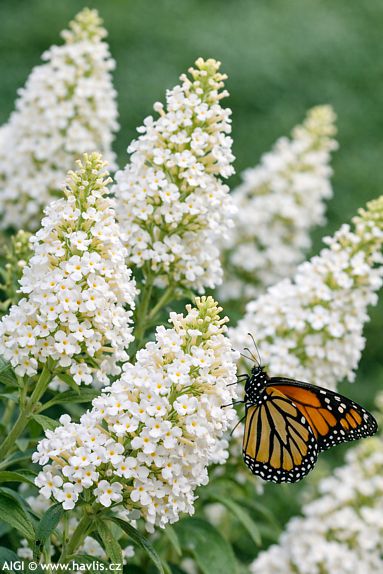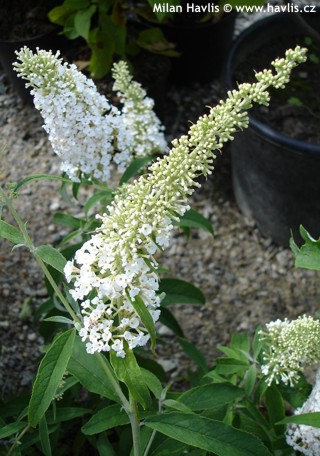
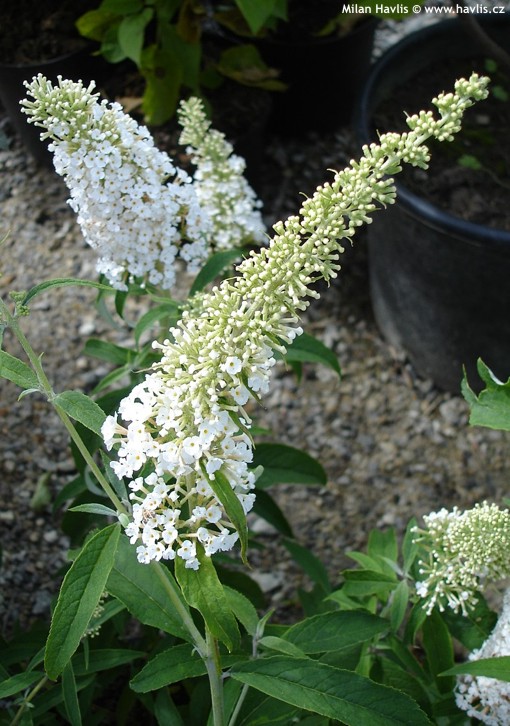
Buddleja davidii 'Minpap2' REVE DE PAPILLON WHITE butterfly bush

 Symbivit Tric (arbuscular)
 Symbivit (arbuscular)
Buddleja
The genus Buddleja, commonly known as butterfly bush, is a botanically diverse and geographically wide-ranging group of woody plants comprising more than 140 species distributed across Asia, Africa and both Americas. Having evolved on four continents, it shows remarkable variability, from small shrubs barely exceeding a metre in height to trees approaching thirty metres. Although now placed in the family Scrophulariaceae, its taxonomic history is complex – in the past it was assigned to Loganiaceae and even to its own family, Buddlejaceae, before modern systematics settled on the current concept. The genus was named by Carl Linnaeus (1707–1778) in honour of the English botanist Adam Buddle (1662–1715), following the recommendation of the physician and plant collector William Houstoun (1695–1733), who sent the first specimens of Buddleja americana from the Caribbean to England roughly fifteen years after Buddle’s death. Its ability to attract winged insects, especially butterflies, earned it the name “butterfly bush” in many languages during the twentieth century. Although no species is native to Europe, Buddleja has become one of the most widely grown ornamental shrubs here. The species differ not only in appearance but also in pollination strategy: American forms often developed long red flowers adapted to hummingbirds, whereas Asian species attract almost solely insects for which they have an abundance of nectar throughout the summer.
Buddleja davidii, David’s butterfly bush, is today one of the best-known shrubs in the world. It originates from central China, particularly the provinces of Sichuan and Hubei, where it grows on rocky slopes, river deposits and limestone outcrops. It reached Europe at the end of the nineteenth century thanks to the collections of the French missionary and naturalist Père Armand David (1826–1900), after whom it is named. The first plants appeared in European gardens in the 1880s, when Dr Augustine Henry sent seed to St Petersburg around 1887, followed shortly afterwards by Jean-André Soulié, who supplied the French nursery Vilmorin. From there, Buddleja davidii spread across Europe within a few years and in England received the RHS Award of Garden Merit as early as 1898. It is an exceptionally adaptable species – rooting on riverbanks, in rubble, in cracks of masonry and on railway embankments. This ability to colonise disturbed ground made it a symbol of post-war urban regeneration, but also a plant that has become invasive in some countries. Its extremely light seed is carried long distances by the wind, which explains why the shrub appears even in places where it was never planted.
Reve de Papillon is a novelty range of butterfly bush from France. It bears long panicles of fragrant flowers. Minpap2 White is a white flowering variety from this range. The inflorescence may look like lilac hence its other name: summer lilac. However, it can get misleading as summer lilac is more often used for lagerstroemia.
Deciduous leaves are lanceolate, pale green to almost blue-green, and slightly hairy. The shrub is upright growing and more compact than older varieties though it does make arching branches when enriched with heavy flowers. We strongly recommend hard pruning every spring to low permanent framework as buds begin to swell.
Last update 24-05-2011
Buddleja davidii and its hybrids are among the most rewarding shrubs for sunny gardens, provided they have full sun, warmth and sharply drained soil that dries quickly. Their fleshy roots dislike waterlogging and winter wet, so a gravelly or sandy substrate, a raised position and moderate watering are ideal. They flower on the current season’s growth, so they are cut back hard in spring, usually to 20–40 cm of last year’s wood, which encourages strong branching and large inflorescences; removing spent panicles during the season further prolongs flowering. Feeding should be light, with an emphasis on potassium, and the greatest winter risk is not frost but moisture around the roots. In nature they are short-lived shrubs, but with good drainage and regular spring pruning they can thrive for many years, flowering from early summer into autumn.
Vigorous cultivars need more space, deeper soil and dry out more quickly, but they tolerate very hard spring pruning. Dwarf and compact cultivars have a finer root system, cope better with restricted space and are more suitable for larger containers, but even they require perfect drainage, winter protection of the container against freezing and summer protection against overheating (never black plastic). In pots, Buddleja generally needs a larger volume of substrate, more frequent feeding and careful moisture control. They are hardy to about –29 °C, but perform better in warmer regions. In colder areas, plant older specimens with well-ripened wood.
Last update 04-08-2022; 10-06-2026