

































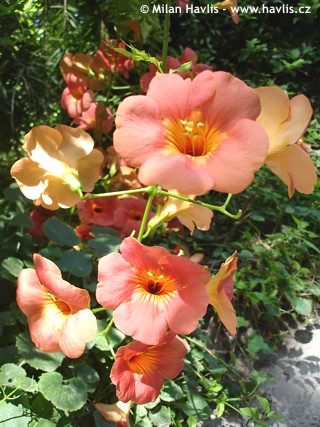
Campsis grandiflora Chinese trumpet vine - STANDARD TREE


 Symbivit Tric (arbuscular)
 Symbivit (arbuscular)
Campsis
The genus Campsis consists of only two species and they both carry the energy of subtropical climbers that, over the course of evolution, learned to ascend using small aerial rootlets and to brace themselves against tree bark as if it were a natural ladder. They belong to the family Bignoniaceae, a group known for its trumpet flowers and often woody climbing habit. C. radicans originates from North America, whereas C. grandiflora comes from East Asia, an intriguing geographical split that suggests a much earlier distribution of the genus’s ancestors across the warmer regions of the Northern Hemisphere. The genus was described by João de Loureiro (1717–1791), a Portuguese missionary and botanist working in Southeast Asia, who defined it on the basis of its characteristically curved stamens, reflected in the Greek kampein, meaning “to bend”. The nomenclatural history is, however, tangled: European gardens of the 17th century were unsure where to place the plant, and it appeared under the names Bignonia, Tecoma and even Apocynum, until the 19th century finally settled the genus in its present form. In the wild it is a climber of bright woodland edges, well‑drained riverbanks and disturbed habitats, where its rapid growth and ability to root along the stems allow it to occupy space before slower woody plants can take hold.
Campsis grandiflora was described by Carl Peter Thunberg (1743–1828), the Swedish physician and botanist, during his stay in Japan, though it must be said straight away that the species itself originates from the warmer regions of China, where it had been cultivated for centuries in temple gardens, courtyard plantings and rural homesteads. In Chinese garden tradition it held both a place and a certain reverence: it symbolised the height of summer and was often planted where its colours could brighten the late season. From there it spread to neighbouring countries with warmer climates and became part of the cultural exchange between China and Japan, where it was welcomed as a plant of exotic charm and long-standing tradition. It reached Europe only in the 19th century, at a time when gardeners were searching for species capable of bringing a touch of southern atmosphere into temperate climates. While its North American relative C. radicans quickly earned a reputation as an indefatigable conqueror of fences and walls, grandiflora was seen as its gentler, more refined, though admittedly slightly more tender counterpart, suited to sheltered positions where it can show its beauty without the risk of cold damage.
When Thunberg described Campsis grandiflora, it was not a discovery made in the wild but the result of an unusual collaboration between a European botanist and Japanese scholars. Thunberg was not allowed to move freely in Japan – he was confined to the small island of Dejima in Nagasaki and could leave it only on official journeys to Edo (modern Tokyo). Most plants he therefore never saw in nature; they were brought to him by local physicians and students of medicine who shared his interest in natural science and horticultural enthusiasm, and who wished to show him plants from regions he could never visit himself. C. grandiflora was among the ornamental species imported from China and grown in Japanese gardens, and it was in this cultivated form that it reached Thunberg – a rarity even for the Japanese themselves. His description thus captures not only a botanical species but also the atmosphere of a time when botanists worked under strict limitations and depended on the generosity and curiosity of local experts.
Probably the most eye-catching version of trumpet creepers is this Chinese one. The flowers are large and spectacular: 7-9 cm wide, salmon pink with a clear yellow throat. The buds form a raceme that blooms from July till frosts. Pinnate leaves are dark green and glossy, and make a luxurious background for the bright coloured flowers.
Originally a vine, this form was trained into a small tree. In our climate it is more tender than the other ones so we recommend growing it on a sheltered location, e.g. in front of a south-facing wall or in a closed yard. However, if you deliberately want to grow it somewhere else, overwrap the crown beginning of winter with a white woven just like roses on stems.
Pruning is a crucial issue with this plant if you want a nice one. It flowers on current year’s growths so it is desirable to have plenty of new branches. So cut back last year’s branches to 2-3 buds after danger of frosts (usually in April) to make a crown with strong branches. The wood is fragile and too long branches can easily break in strong wind. If you wish to have a dense crown sooner and are ready to miss flowering for one year you can clip new growths just after the second or third pair of leaves. If you live in good growing conditions and the branches are strong enough you can do it again at the end of summer.
Last update 05-02-2008.
Chinese trumpet vine requires a warm, sheltered and fully sunny position in order to flower abundantly. It will grow in partial shade, too, but the flowers will be paler and fewer. It thrives best in deeper, fertile and well‑drained soils that warm up quickly in spring; heavy, cold clays do not suit it. After planting it appreciates regular watering, but once established it is fairly drought‑tolerant and can cope with short dry spells. Feeding is unnecessary – too much nitrogen encourages lush vegetative growth at the expense of flowers.
Pruning is best carried out in spring after all frosts have passed. Remove weak, damaged or poorly placed shoots and retain the strong branches that will carry the summer inflorescences. In colder regions it is advisable to protect the root collar with a layer of mulch, especially on young plants. Older specimens are more resilient, but they still look their best where they are sheltered by a wall, pergola or other thermal mass that retains warmth overnight. Although technically a climber, its heavier shoots require support – ideally one that disappears within the composition and allows the plant itself to stand out. We sell only grafted plants, which will flower in the year of purchase, as plants propagated from cuttings may take 5–10 years to begin flowering. It is hardy to around –24 °C (USDA zone 6), though we do not recommend it for very exposed, windy sites in colder regions or for higher elevations.

