

































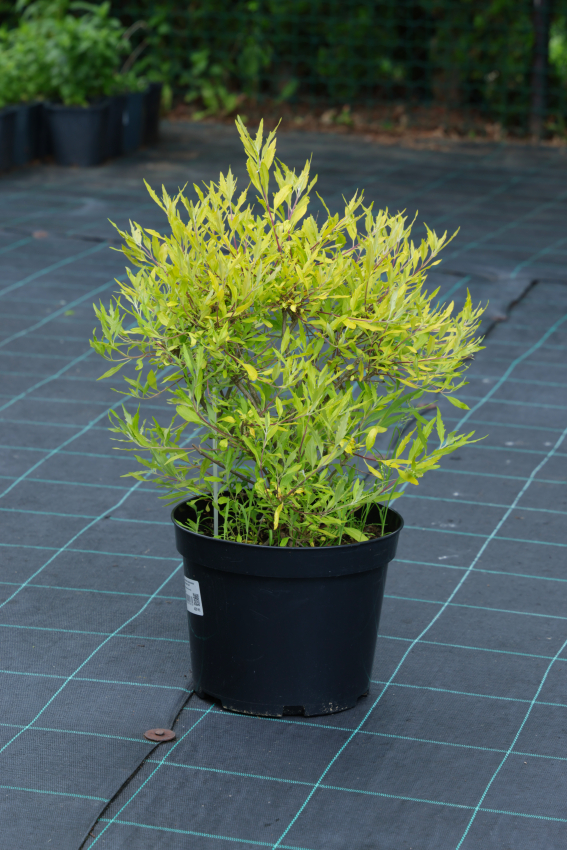
Caryopteris × clandonensis 'WORCESTER GOLD' bluebeard


 Symbivit Tric (arbuscular)
 Symbivit (arbuscular)
Caryopteris
The genus Caryopteris belongs to the mint family and includes only a handful of species native to the mountainous and dry regions of eastern Asia, from China across Mongolia to Japan. In the wild they grow on rocky slopes, river terraces and steppe margins, where hot summers alternate with cold but mostly dry winters. The first botanical descriptions appeared in the 19th century, when European herbaria began to fill with plants brought back from expeditions to then little‑explored parts of Asia. The genus was described with a degree of uncertainty, as the species were similar to one another and herbarium collections often contained transitional forms. This ambiguity later allowed the formation of a hybrid complex that became the foundation of modern garden bluebeards. Although botanically modest, the genus gained a reputation in horticulture as a reliable late‑season source of nectar and colour at a time when most shrubs have long finished flowering.
Caryopteris × clandonensis originated from a chance cross between two Asian species, C. incana and C. mongholica, in the garden of Arthur Simmonds (1877–1937) in Clandon, England, in the 1930s. Simmonds was an amateur grower with an exceptional eye for plants, and he noticed that the seedlings in his garden shared a uniform appearance and unusually long flowering. The hybrid quickly spread among growers because it combined the drought tolerance and resilience of one parent with the finer texture and richer flowering of the other. In temperate climates it became valued not only for its late colour but also for its ability to attract bees and butterflies at a time when other nectar sources are fading. Over time it gave rise to a whole group of cultivars that today form a distinct chapter of the garden assortment, alongside shrubs with similar requirements such as buddlejas, perovskias or hypericums.
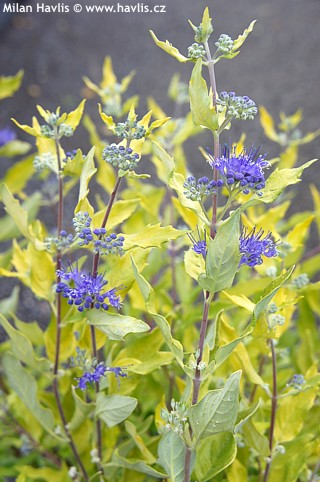
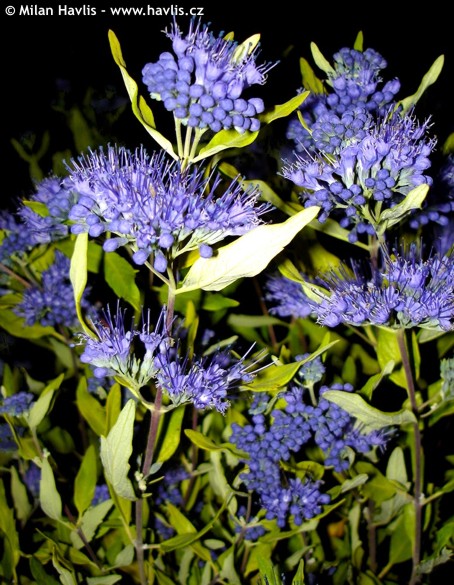
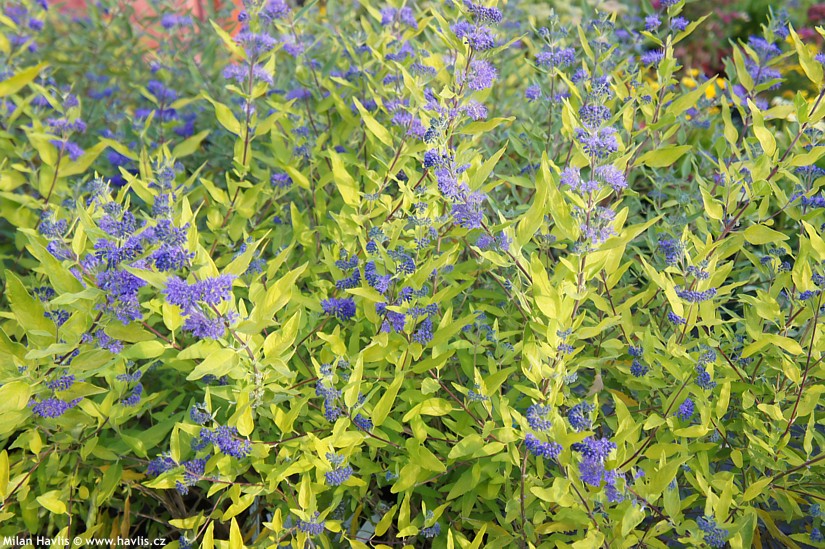
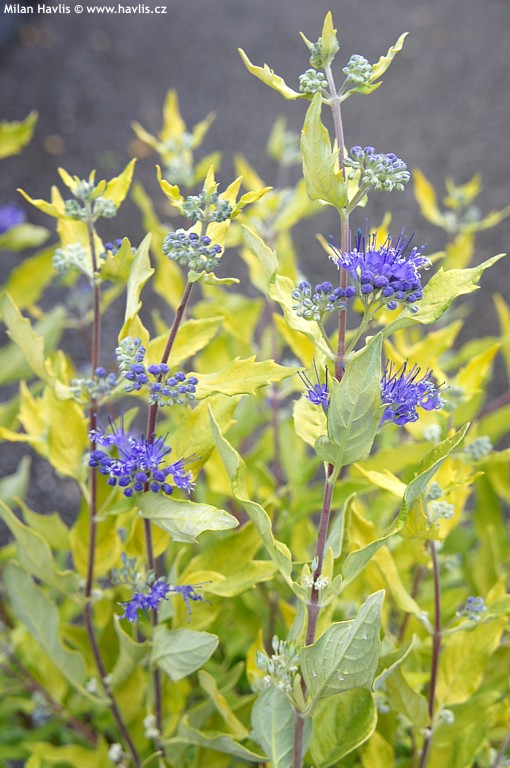
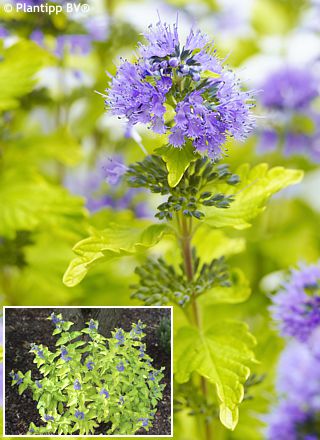
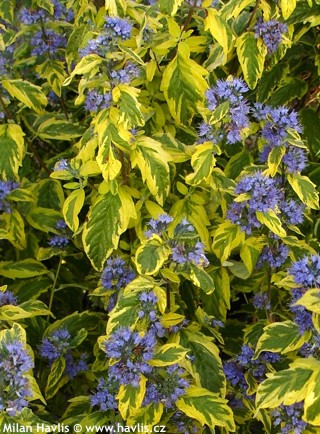
Worcester Gold is another variety of bluebeard. This one has bright yellow-green leaves. They are narrow, aromatic and silvery-green beneath. Flowers are formed in small panicles and their deep blue colour looks like sky before a storm. They attract butterflies and bumble-bees.
The flowers are arranged in small, dense panicles, have a deep blue color like the sky before a storm, and bloom profusely in the second half of summer. They are a feast for butterflies and bumblebees. The shrub grows rather wildly into an airy, slightly sprawling shape.
Last update 02-09-2009
Bluebeards need full sun and light, well‑drained soil that warms up quickly in spring. In heavy clay they suffer from winter wetness, so in compacted ground it is better to plant them slightly raised so the roots never sit in water. Watering is needed only during establishment; later they tolerate drought better than waterlogging. Feeding should be modest, ideally a small amount of compost or slow‑release fertiliser in spring. Pruning is done early in the season, removing old wood and shortening the previous year’s growth to about 20 percent of its length to encourage strong new shoots with flowers. They are unreliable in containers because they need excellent drainage yet are sensitive to drying out in pots. Wind is not a problem. Hardiness is around –25 °C, but the main risk is winter moisture rather than cold itself (USDA zone 6)
Goods are shipped all over Europe. For Russia and U.K. and for further details please read about SHIPPING OPTIONS HERE.
Are you interested in a serious discount for orders NOV-FEB? Check your options here.
THE PRICES INCLUDE VAT of 15%. For quick conversion you can use 1 CZK = approx. 0.04 EUR
- STANDARD QUALITY - Plants of this group are 1st class quality with number of branches and overall density adequate to their size and age, considering they were container grown.
- DE LUXE QUALITY - This label guarantees a luxurious quality of manually selected plants that, compared to their height and age, are exceptionally dense and beautiful.
- EXTRA - These plants are usually mature and bigger specimens with exceptional overall appearance.
- STANDARD (as described in the plant form) means a tree with a trunk of 190-210 cm and a crown at the top, unless specified differently. The commercial size for trees is their girth measured in the height of 1m from ground.
- HOBBY - These plants are of the same quality as our standard-quality plants but younger and therefore cheaper.
- SHRUB - a woody plant with branches growing bushy from the ground level.
- HALF-STANDARD or MINI-STANDARD - a small tree with shorter trunk, its size is usually specified.
- FEATHERED - These are trees with branches growing already from the base of the trunk and up along the stem.
- GRASSES and PERENNIALS - Sizes given usually read the diameter of the pot or the clump, as specified.
