




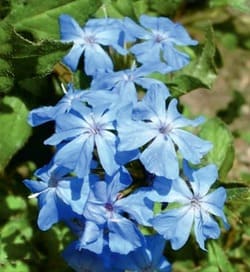






Ceratostigma plumbaginoides 'GENTIAN BLUE' hardy plumbago, leadwort

 Symbivit Tric (arbuscular)
 Symbivit (arbuscular)
Ceratostigma
The genus Ceratostigma, commonly known as leadwort or hardy plumbago, belongs to the Plumbaginaceae family and comprises just seven accepted species distributed from eastern Africa through the Himalayas to China and Indochina. The genus was established and scientifically described by Alexander von Bunge (1803–1890), a Russian-German botanist who collected numerous plants previously unknown to European science during his expedition to northern China. The name Ceratostigma itself is derived from the Greek words for horn and stigma, referring to the tiny horn-like projections found on the stigmas of the flowers and visible only upon close inspection. While the origin of the common name leadwort remains debated, one theory links it to the grey-blue colour of lead, while another traces it to traditional medicinal uses of plants in the related genus Plumbago, which were once recommended for ailments associated with the then-common effects of lead poisoning. Despite its modest size, the genus includes a remarkably diverse range of plants, from ground-covering perennials to mountain subshrubs inhabiting rocky slopes, woodland edges and alpine valleys across Asia.
The species Ceratostigma plumbaginoides was described by Alexander von Bunge (1803–1890) in 1833 from plants collected during his expedition to northern China. At the time, the region around Beijing remained only lightly explored botanically, and each new collection had the potential to contain species unknown to European science. This species became the type species of the newly established genus Ceratostigma and remains its best-known representative today. Its journey into European gardens, however, was far from straightforward. The celebrated plant collector Robert Fortune (1812–1880) encountered it during his travels around Shanghai, yet his early attempts to introduce it into cultivation were unsuccessful. It was not until 1846 that living plants were sent from Canton to the British merchant Sir George Larpent, where they flowered later that same year in his garden near London. The novelty appeared so unusual that it was briefly described under the new name Plumbago larpentae before botanists realised that it was the very species discovered and named by Bunge several years earlier in northern China.
Incidentally, did you know that blue was among the rarest and most prized colours throughout much of human history? While red, yellow and brown pigments could be obtained almost everywhere, producing a rich and lasting blue was considerably more difficult. Among the most valuable sources were indigo dyes extracted from plants and the precious stone lapis lazuli imported from what is now Afghanistan. The high cost of blue pigments meant that blue garments, textiles and decorative features served for centuries as symbols of wealth and status. In medieval Europe the colour gained further prestige through depictions of the Virgin Mary wearing a blue cloak, and its popularity was strengthened by King Louis IX (1214–1270) of France, who adopted it among the symbols of royal authority. Only towards the end of the nineteenth century was the chemical nature of indigo fully understood and industrial production established, gradually transforming blue from a luxury commodity into an everyday colour.
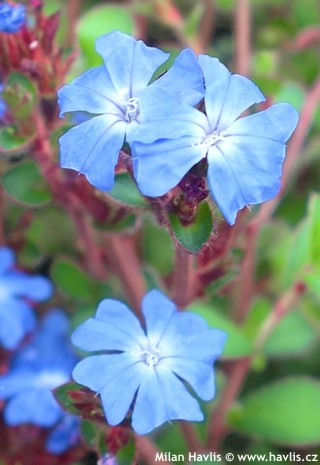
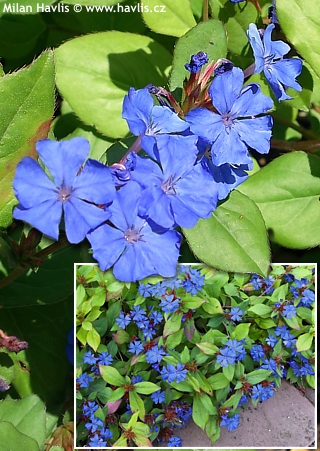
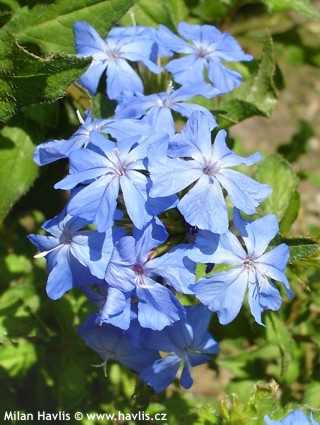
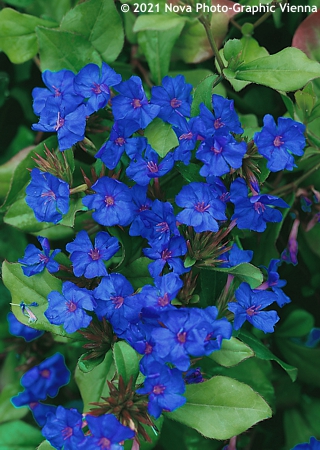
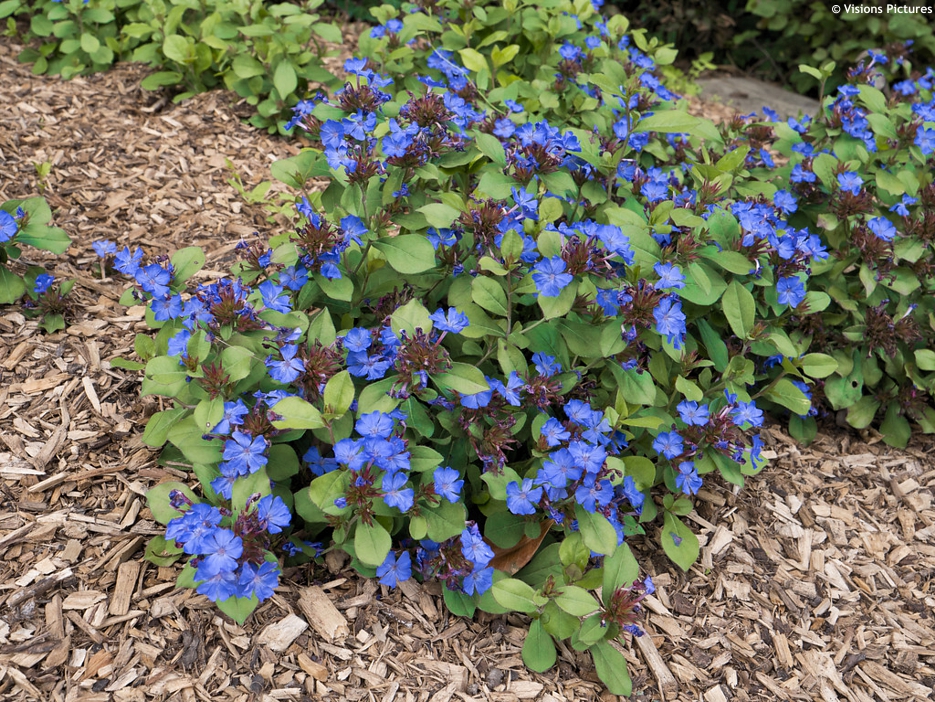
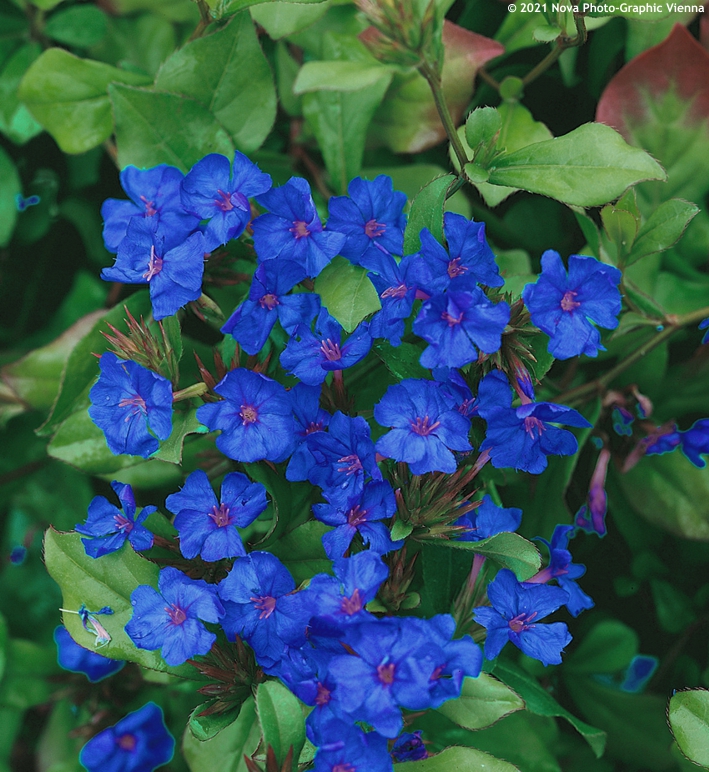
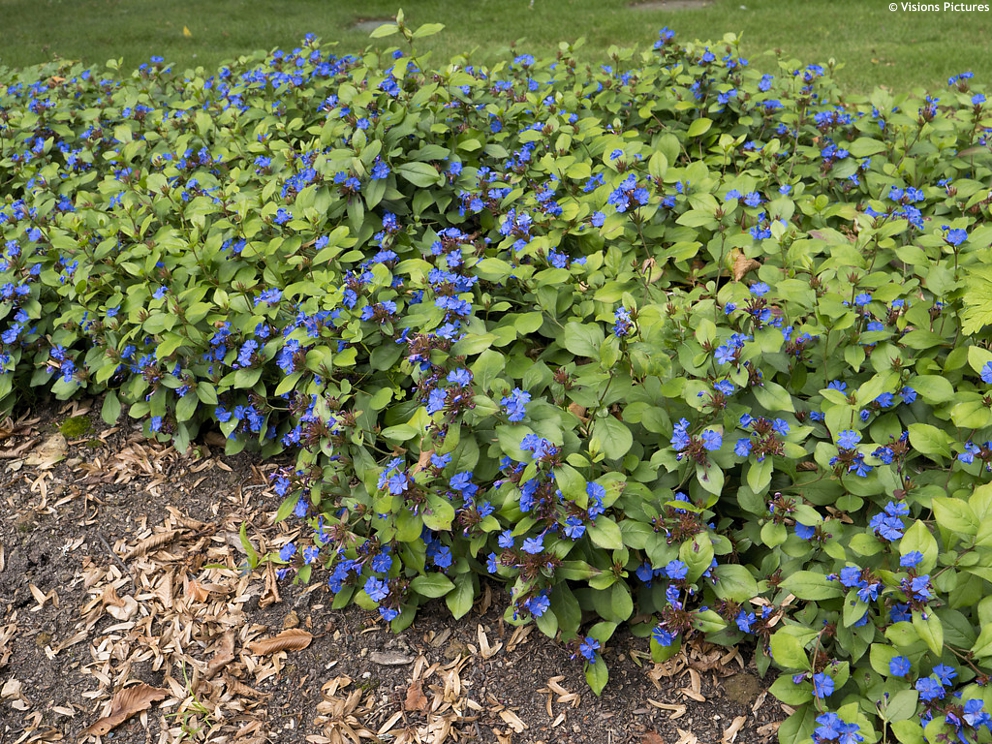
The greatest attraction of Gentian Blue leadwort is a shade of blue rarely encountered among garden perennials. In late summer, clusters of small flowers emerge above a carpet of glossy green foliage in a colour reminiscent of alpine gentians, from which the cultivar takes its name. The plant spreads gradually by underground rhizomes, forming dense colonies from which slender mahogany stems arise each spring, carrying deciduous, alternate obovate leaves along their length. These remain fresh green for most of the growing season, allowing the flowers to take centre stage, before gradually turning shades of burgundy and red while the plant continues to bloom. Unlike the cultivar 'Autumn Blue', which is valued primarily for the dramatic contrast between its flowers and autumn foliage, 'Gentian Blue' focuses on the depth, purity and intensity of its floral colour, perfectly reflected in its name.
Leadwort belongs to a modern generation of ground-covering perennials that are not dependent on a single moment of glory. For much of the season it forms an elegant, dense carpet of green foliage, followed by a profusion of blue flowers in late summer and rich red autumn colour as the season progresses. This versatility allows it to combine successfully with a surprisingly wide range of plants, bringing life to plantings that might otherwise fade during the second half of the year. It performs exceptionally well beneath open-canopied shrubs, small trees and multi-stemmed trees, where it visually links individual specimens into a cohesive composition. Equally at home in gravel gardens, along pathways or within mixed perennial borders, it is most effective when paired with plants offering finer foliage textures or warm autumn colours. Placed next to strongly blue- or purple-flowering neighbours, its unusually pure blue flowers may lose some of their visual impact.
Last update: 23-08-2021; 13-09-2026
Hardy leadwort is an undemanding perennial that performs best in full sun or light partial shade in well-drained soil. Once established, it tolerates drought considerably better than most traditional ground-cover plants, while prolonged waterlogging is far more harmful than occasional dryness. It requires no fertiliser, and excessively rich soils often encourage lush foliage at the expense of flowering. In spring, all previous year's stems should be cut back to ground level, as the plant regenerates annually from underground rhizomes. Although traditionally recommended for sunny positions, it will continue to grow and flower, albeit less abundantly, in dappled shade beneath trees and larger shrubs. If you wish the planting to spread and gradually cover a larger area, avoid landscape fabric, which restricts natural rooting and rhizome expansion. Where containment is required, a shallow root barrier is usually sufficient. This is not an aggressive plant comparable to bamboos, but over time it may occupy a larger portion of the border than originally intended. It is generally free from significant pests and diseases, is not considered poisonous, and in temperate climates routinely tolerates winter temperatures between approximately -24 °C and -26 °C (USDA zone 5b-6) without any winter protection.