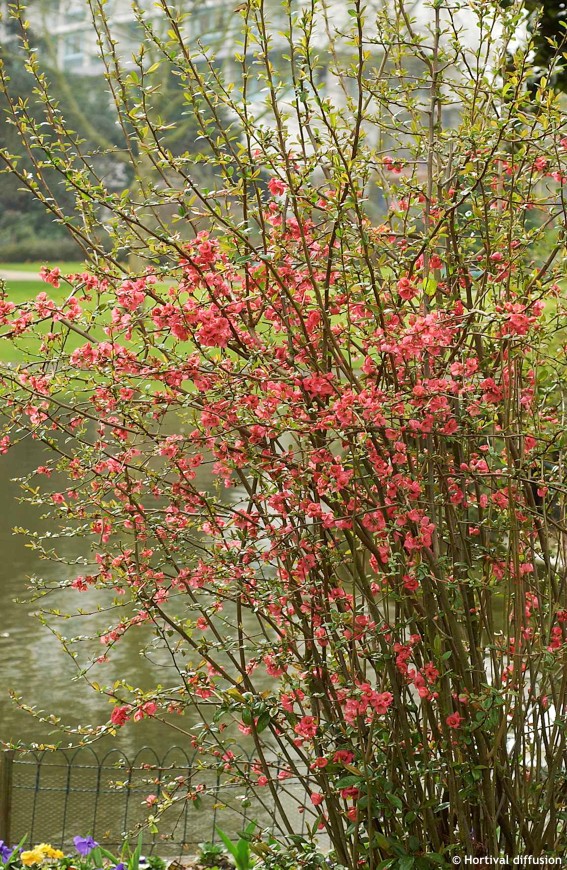
Chaenomeles speciosa 'EXIMIA' Chinese flowering quince

 Symbivit Tric (arbuscular)
 Symbivit (arbuscular)
Chaenomeles
The genus Chaenomeles comprises three to four species of deciduous shrubs in the rose family, native to eastern Asia. Botanically they are characterised by short thorny shoots, glossy leaves and striking flowers that appear very early in spring, often before the foliage. The genus was defined by Carl Peter Thunberg (1743–1828), who separated it from Cydonia on the basis of differences in floral structure and fruit morphology. The fruits resemble small, hard quinces with a strong fragrance and a high pectin content, which makes the genus easy to recognise both in the wild and in gardens.
In China, flowering quinces have a long history of cultivation and appear in classical gardens as symbols of resilience and spring renewal. Their fruits are used to make syrups, teas and medicinal decoctions, and the plants are often planted in compositions with plums and pines. In Japan, their cultural significance is even stronger: they rank among the most popular flowering shrubs of early spring, and their early bloom has become part of the traditional visual vocabulary. They appear in paintings, ceramics, textiles and everyday household objects, and they are among the most common bonsai species thanks to their ability to flower abundantly on old wood and because their striking blossoms are ideally sized for miniaturisation. In Europe, flowering quinces became popular for their hardiness, their ability to bloom when the garden is still dormant, and their suitability for forming dense, impenetrable hedges.
Chaenomeles speciosa, the flowering quince, is native to China, where it grows on sunny slopes, in thickets and along woodland edges. It reached Europe in the 19th century through botanical expeditions, particularly the collections of Robert Fortune (1812–1880), and soon became a prized ornamental shrub. The species was formally described by Étienne Pierre Ventenat (1757–1808). In temperate gardens it established itself as one of the earliest flowering shrubs, capable of lighting up the garden as early as March. Thanks to its resilience, longevity and strong spring presence, it has become a staple of cottage gardens and urban plantings alike.
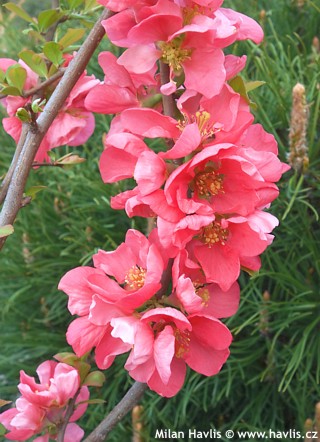
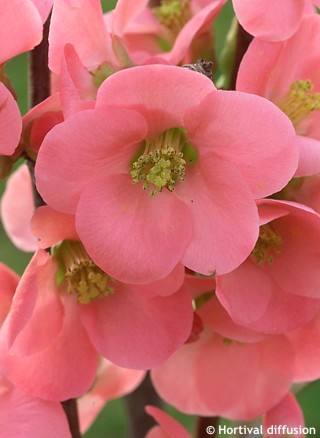
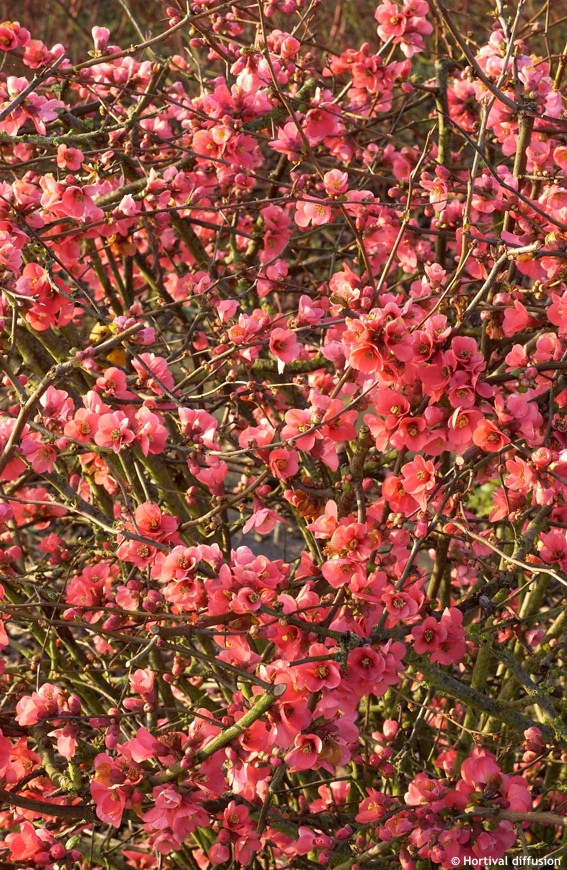
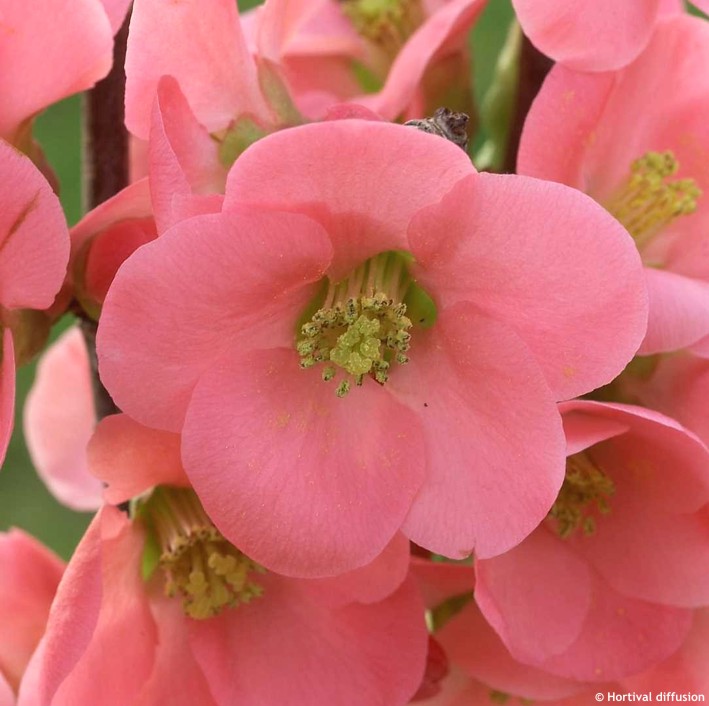
Eximia is an old Chinese flowering quince variety from Switzerland, bred by Otto Froebel in 1886. It makes medium sized, almost campanulate flowers of salmon pink colour. They commonly open in the first decade of April, however, if the winter is warm you can see numerous buds opening already in mid to late March. The shrub flowers for 6-8 weeks, and what is most interesting – it keeps small growing only about a meter tall and wide. Flowers are followed by edible, pear-shaped pomes, 4-5 cm in diameter. It grows medium fast into an upright, quite compact, and dense shrub about 2m.
Last update 14-05-2019; 23-04-2026
Chinese flowering quince grows reliably in almost any garden soil, provided it is not strongly alkaline. In chalky or high‑lime soils it tends to suffer from chlorosis, so a light, humus‑rich substrate with a neutral to slightly acidic reaction is ideal. Newly planted shrubs appreciate even moisture, but once established they are remarkably drought‑tolerant and require little to no watering. Full sun ensures the best flowering and well‑ripened shoots. Regular pruning is essential for maintaining a compact, well‑structured shrub. It is carried out after flowering, when one‑year shoots can be shortened by 30 to 80 percent to encourage branching and ensure abundant blooms the following spring. Long, weak or poorly placed branches can be removed entirely at ground level to open up the plant and highlight its strong framework. Quinces respond well even to deeper rejuvenation if done gradually. They can also be grown in outdoor containers, where they need more consistent watering and a sheltered position. The species is highly cold‑hardy, reliably withstanding temperatures down to –29 °C (USDA zone 5).