











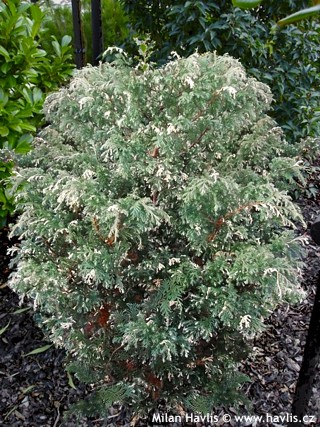
Chamaecyparis pisifera 'SQUARROSA ALBOSPICA' Sawara cypress

 Symbivit Tric (arbuscular)
 Symbivit (arbuscular)
Chamaecyparis
The genus Chamaecyparis comprises a small group of coniferous trees native exclusively to eastern Asia and the western regions of North America. Botanically, it belongs to the cypress family and is characterised by its fine branch structure, scale‑like foliage and remarkable diversity of forms and colours, which has made it one of the most important genera of ornamental conifers. The genus was first formally described by Stephan Ladislaus Endlicher (1804–1849) in the first half of the nineteenth century, at a time when Europe was becoming increasingly familiar with the flora of the Far East. Fossil evidence suggests that the ancestors of modern false cypresses were once far more widely distributed, making the genus another example of woody plants that survived major climatic shifts in restricted refuges.
The Sawara cypress is native to Japan, where it grows mainly in mountainous regions of the islands of Honshu and Kyushu at elevations of approximately 400 to 1800 metres. Its specific epithet refers to the small, pea‑like cones it produces. The species was first scientifically described by Carl Peter Thunberg (1743–1828), one of Carl Linnaeus’s most prominent students, who reached Japan during a period of near total isolation from the outside world. In its homeland, the tree has long been traditionally used; its wood is valued for its lightness, durability and fine texture and has been employed in the construction of temples, shrines and traditional bathhouses. When crushed, the branchlets release a pleasant resinous scent. The tree is regarded as a symbol of calm and balance and is often planted near sacred sites; in Central Europe it is also commonly found in cemeteries. Unlike many other false cypresses, Chamaecyparis pisifera is exceptionally variable, which has led to the selection of numerous garden forms differing in habit and colour.
Squarrosa Albospica is a very distinctive cultivar of sawara cypress that is now grown only rarely, most likely because it was gradually replaced in cultivation by the more striking and uniform cultivar Mariesii. Nevertheless, Squarrosa Albospica has a unique charm of its own, rooted in its subtler colour contrasts, softer expression and more natural, less uniform structure. At first glance it appears soft and slightly tousled, as if gently fluffed by hand. The shrub has a looser, irregular habit that slowly spreads with age, forming a soft, rounded mass without sharp edges. The foliage is notably fine and soft to the touch, borne in short, dense clusters that give the plant its characteristic “fluffy” appearance. The base colour is a fresh green, but the tips of young shoots are creamy white to silvery, making the shrub look light and lively, especially in spring and early summer. When mature, it usually reaches around one metre in both height and width, retaining a relaxed, natural character with no attempt at strict geometry.
The cultivar belongs to the Squarrosa Group, which includes forms of Sawara cypress with an even more pronounced juvenile type of foliage than those of the Plumosa Group. This is a growth stage that ordinary seedlings display only briefly after germination, before gradually developing the adult form over the following years. In squarrosas, however, this “youthful” appearance is retained permanently. The needles are longer, flatter and stand well away from the branches, often at wide angles, giving the plants a soft, open and slightly irregular character. Typical Squarrosa forms develop very dense, often lumpy shrubs or small trees with a silvery, glaucous cast and, under favourable conditions, can grow to the size of the wild species. Squarrosa Albospica most likely originated in Japan in the 19th century as a colour selection within this group and reached Europe together with other attractive forms at a time when Japanese cypresses became highly sought‑after collector’s plants. Neither the exact author nor the year of selection is documented, reflecting a period when such cultivars were spread mainly through horticultural practice. The epithet Albospica refers to the pale, whitish tips of the young shoots, which are the defining feature of this cultivar and give it a fresh, almost spring‑like appearance for much of the year.
Last update 15-02-2012; 25-02-2026
In the garden, Squarrosa Albospica serves as a soft, light accent that breaks up the stricter shapes of surrounding plants. It shows to best effect in partial shade, where the pale shoot tips do not scorch and the colour remains clean. It suits small gardens, Japanese‑inspired compositions and mixed borders with shrubs and perennials, where its fine texture contrasts with larger leaves and firmer forms. It works well as a solitary plant against a calm background, but also in groups with other evergreen shrubs, where it brings light and softness. Combined with stones, gravel or darker mulch, its pale tips stand out even more, adding lightness to the planting in winter as well, and it also looks excellent among low ornamental grasses.
Cultivation of sawara cypress is straightforward provided its basic requirements are met. It prefers acidic to neutral, humus‑rich and well‑drained soil with a constant supply of moisture, particularly during the first years after planting. Although it naturally occurs in alluvial soils with ample water, these sites never experience prolonged waterlogging, as excess water drains freely through permeable substrates. The plant does not tolerate drying out of the root ball. It thrives best in a sunny position, where its colouring remains most intense, but it will also tolerate light shade. Exposed, windy sites are unsuitable, not because of desiccation, but due to mechanical stress that can distort the fine, pendulous branches. Pruning is unnecessary and is carried out only rarely. Hardiness is excellent, withstanding temperatures down to around −34 °C (USDA zone 4) without damage.