










×Chitalpa tashkentensis 'MORNING CLOUD' chitalpa


 Symbivit Tric (arbuscular)
 Symbivit (arbuscular)
Chitalpa
If you are looking for trees that bloom in summer, chitalpa is an ideal candidate. Its story is fascinating and begins in 1964 at the botanical garden in Tashkent, then the heart of Soviet botanical science. Uzbek botanist Nikolai Fyodorovich Rusanov had a bold dream: to create a tree that would combine the exotic beauty of the desert willow (Chilopsis linearis) with the resilience of catalpas (Catalpa bignonioides, later also C. speciosa and C. ovata). Both parents come from North America, but their worlds are very different – Chilopsis is a shrub or slender tree of semi‑deserts and deserts, accustomed to scorching sun and drought, while Catalpa is a majestic tree with huge leaves and abundant flower clusters, thriving in moist soils. To unite these contrasts required long studies of catalpa phenology and the application of controlled pollination techniques within intergeneric crossing. A true scientist must be patient, and Rusanov was – after many attempts he succeeded and obtained viable seeds. Thus, the first nothogenetic hybrid was born: ×Chitalpa tashkentensis. This achievement was a sensation in the botanical world: the hybrid carried beautiful flowers over a long period, elegant foliage, and moreover gained resistance to drought and heat.
Although the Cold War still raged in the 1960s, the later détente of the 1970s also extended to scientific exchange. Robert Hebb of the New York Botanical Garden had been waiting for that moment, and in 1977 he legally exported the first two clonal lines to North America. These gave rise to the first known cultivars:
‘Pink Dawn’ – with delicate pink flowers blooming from May to September,
‘Morning Cloud’ – with white to pale pink flowers resembling clouds on the branches, though with limited resilience.
The official botanical name ×Chitalpa tashkentensis was established only in 1991 by Thomas Elias and Walter Wisura of Rancho Santa Ana Botanic Garden. Since then, the hybrid has spread across the United States, especially in the drier southwest, where it became a popular urban tree thanks to its tolerance of heat, drought, and alkaline soils. Chitalpa reached Europe only in the 1980s and took some time to find its admirers. In England and the coastal countries of the Benelux, winters may be mild, but summers are cooler and less sunny, which does not encourage abundant flowering. In continental Europe, including Central Europe, summers are hot and sunny, and here chitalpas bloom richly and reliably. Logically, one might expect it to be popular in the Mediterranean, where conditions are ideal, but for some reason it remains a marginal, collector’s tree there, still waiting to be discovered – perhaps because they already have plenty of other summer‑flowering trees 😊.
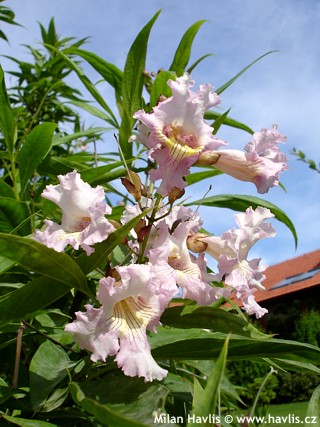
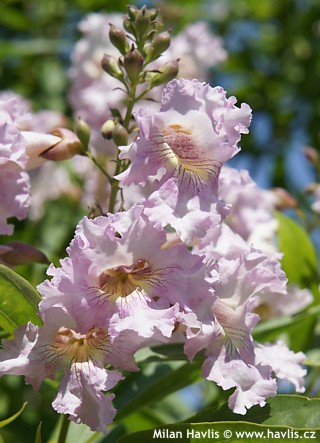
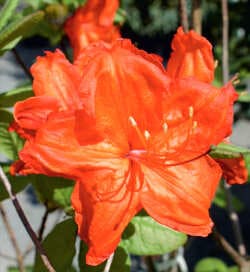
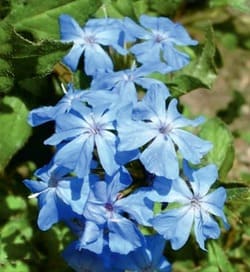
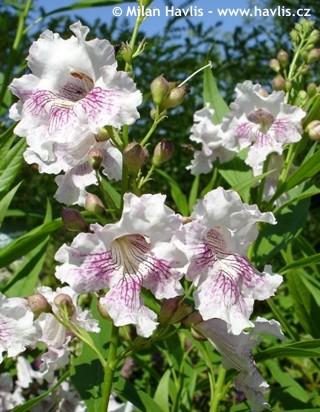
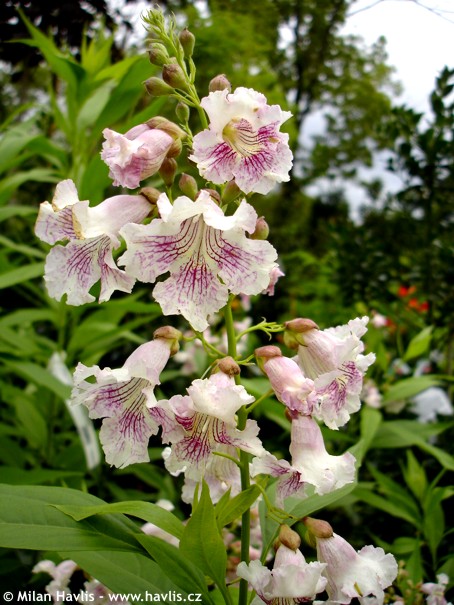
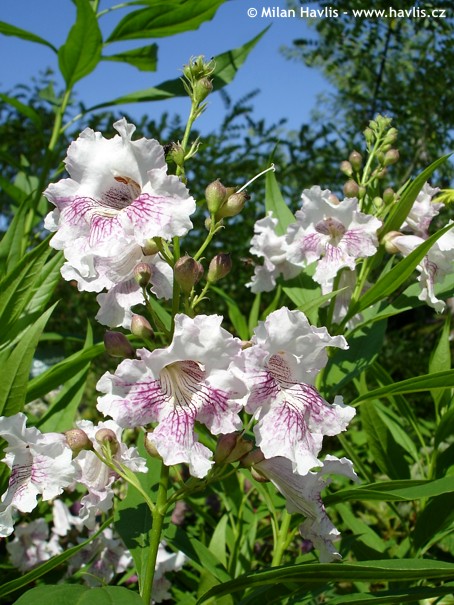
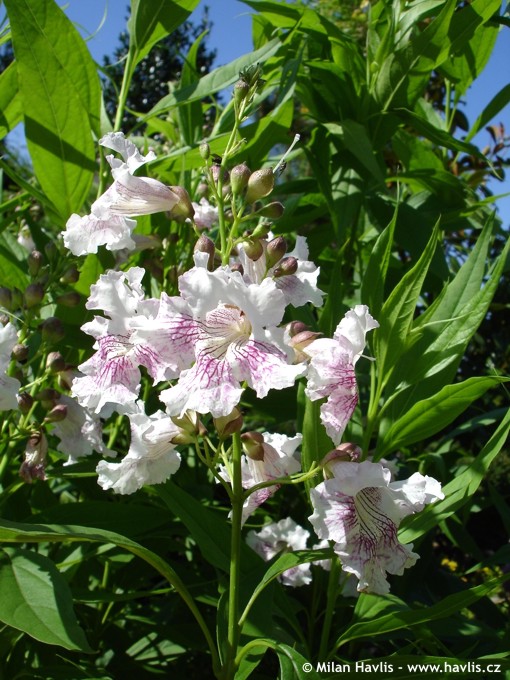
Morning Cloud is a truly exceptional cultivar of chitalpa, distinguished by its larger flowers and more airy habit. Its blossoms are nearly white with very conspicuous purple veining, their margins strikingly wavy like orchids, and their tubular form clearly reveals their belonging to the trumpet‑vine family (Bignoniaceae). The inflorescences form upright panicles 15–20 cm tall, appearing from June to August. The flowers carry a light, sweet fragrance. Together with the cultivar ‘Pink Dawn’, it was one of the first two selections derived from the original lines bred by N. F. Rusanov in Tashkent. It was introduced to the United States in 1977 and to Europe around 1983.
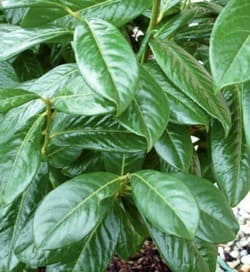
‘Morning Cloud’ grows into a tall, multi‑stemmed shrub or a standard tree when grafted onto catalpa rootstocks, reaching 5–7 m in height and 3–4 m in width at maturity. Its habit is somewhat airier and slightly pendulous, giving it a highly decorative appearance. The leaves are narrow, lanceolate, 10–20 cm long, bright green in summer and briefly turning yellow in autumn. During humid weather in early summer, younger plants may be susceptible to powdery mildew, so timely treatment with a fungicide is advisable. The cultivar is sterile – it produces neither seeds nor pods. It shows good drought tolerance, but its cold hardiness is lower than that of ‘Pink Dawn’ or ‘Summer Bells’: it reliably withstands temperatures down to about –18 °C, and is therefore better suited to regions with milder winters (USDA Zone 7 and higher), while in colder continental climates hardier cultivars are preferable.
Last update 13-08-2008; 18-07-2021; 24-11-2025
For abundant flowering, chitalpa always needs full sun and a warm summer. It tolerates neighbouring plants around the trunk and does not have aggressive roots. It will grow in almost any well-drained soil, acidic or alkaline, and is not demanding in nutrients. It withstands longer periods of drought but does not tolerate waterlogging. In youth it grows fairly quickly (30–50 cm per year), and once it begins to flower, growth slows down by half and the crown thickens and shapes nicely. It does not require pruning, but shaping is possible – prune always in spring after frosts (it flowers on new wood) and only up to one third of branch length. Deeper (rejuvenation) pruning leads to regeneration and production of long branches over one metre, and without supplementary phosphorus‑based fertilisation it may not flower that year. It leafs out very late, so do not be surprised if during a cool spring it is still bare at the beginning of May. Its hardiness has been verified as reliable down to –27 °C and reportedly even withstands –29 °C (USDA zone 5). Only once, during a severely frosty winter combined with all‑day sun, did some specimens suffer slight sunscald on exposed branches and trunks, but they regenerated over time. It requires no winter protection.