













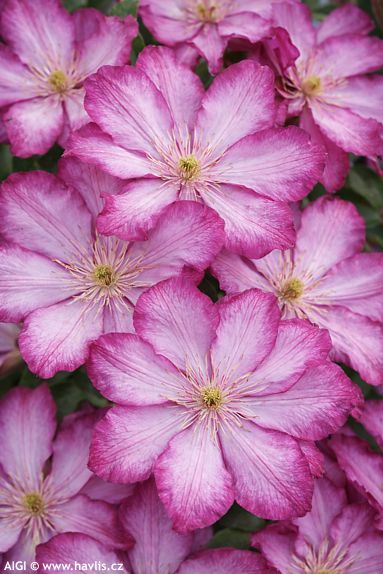
Clematis 'Zo08095' LIBERTY clematis

 Symbivit Tric (arbuscular)
 Symbivit (arbuscular)
Clematis
Clematis is a rich genus of about 370 to 380 species spread across the temperate regions of the Northern Hemisphere, with its origins in landscapes shaped by alternating cool and moist conditions – from the mountains of East Asia to the woodland edges of Europe and the prairies of North America. This is where its character was formed: a climber that leans on anything offering support and rewards the garden with beautiful flowers that, in different cultures, have come to symbolise lightness, purity or spiritual elevation. In Japanese gardens they are used as a gentle counterpoint to pines and stones. From late spring to early summer, dense stands of clematis can be seen in the mountains of Japan and China at elevations of 500 to 1500 metres, producing masses of flowers comparable in strength to the extraordinarily rich rhododendron bloom of the eastern Himalayas at roughly the same time of year. In Europe, clematis became a symbol of romantic pergolas and country walls as early as the Victorian era. In Britain they also settled firmly into the world of royal gardens – at Hampton Court Palace, one of the oldest and most prestigious royal garden complexes, they have been grown since the 18th century, and many cultivars have received RHS awards, including ‘Princess Diana’, named with the consent of the Royal Family.
Japan is one of the centres of natural diversity, with native species such as C. japonica, C. stans, C. terniflora and especially C. patens, considered one of the key parent species of modern large-flowered hybrids. Clematis has been cultivated in Japan since at least the Edo period (1603–1868), as evidenced by historical garden records and illustrations showing them in temple and court gardens. Modern breeding around the world includes other species valued for their resilience, stability and beauty: C. viticella brings reliability, long flowering and disease resistance; C. florida and C. patens contribute large, flat flowers and a wide range of colours; C. texensis adds bell-shaped forms and deep red tones; while C. montana is a source of abundant spring flowering and vigorous growth.
Over the past hundred years, different breeding lines have been developed according to climate and aesthetic preferences in various research stations. Raymond Evison from the island of Guernsey has focused on compact, repeat-flowering cultivars suitable for small gardens and containers, responding to the trend of urbanisation and limited space. The Polish school (for example Brother Stefan Franczak and Władysław Noll), today the largest European centre of clematis breeding, concentrates on hardiness, reliability and long flowering, as the local climate demands plants capable of surviving severe frosts while still producing impressive blooms. As a result, many of the most cold-resistant large-flowered cultivars now come from Poland and have become a standard for Central European conditions.
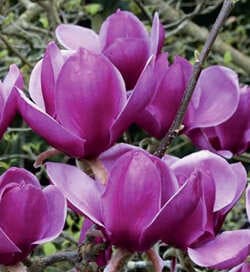
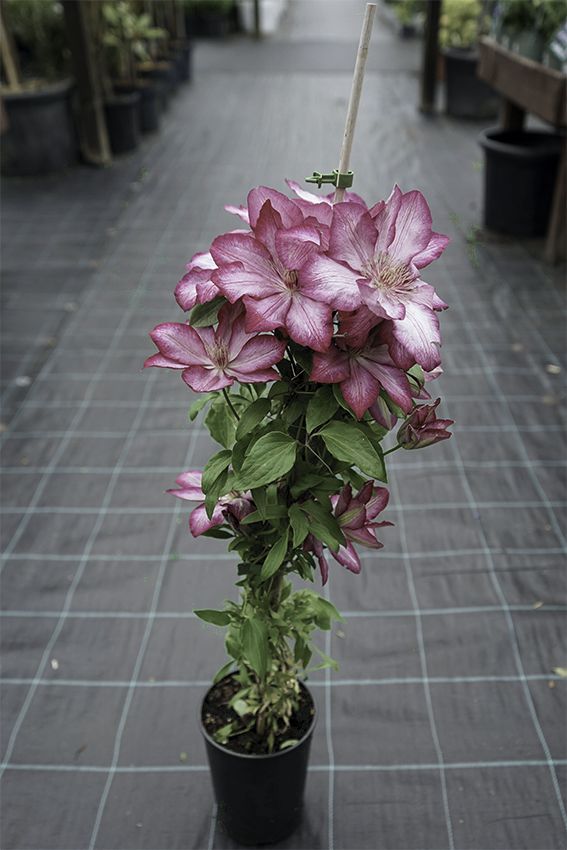
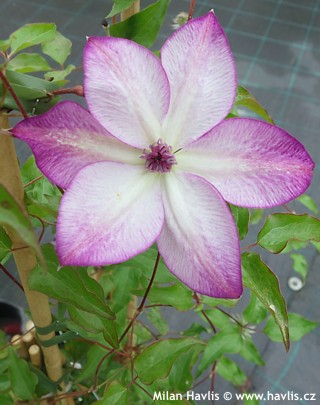
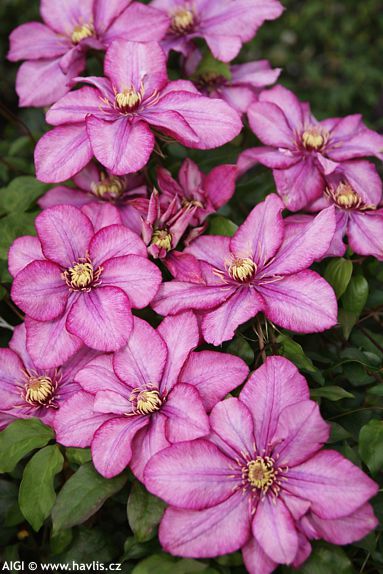
LIBERTY clematis looks as if taken straight from a lush, tropical rainforest – the colour and size of its flowers are almost unbelievable. It belongs to the Patens Group and boasts glowing neon‑pink blooms with a darker, clearly defined margin. The flowers measure 10–12 cm across, often more with generous feeding, and are formed by broad, firm tepals with gently wavy edges that create an intense colour effect in sunlight. It flowers early – the main flush appears in May on last year’s stems, followed by a second wave from August onwards, with blooms that stand out from a distance. The leaves are trifoliate, medium‑sized, deep green and slightly glossy, covering the stems well and supporting the plant’s compact appearance. Growth is moderately vigorous, with stems reaching around 2 m, and the plant behaves as a reliable, willingly climbing vine suitable for smaller pergolas, trellises or containers. ‘Liberty’ is protected by European PBR and a US plant patent and was introduced to the market in 2014; it was bred by Jan van Zoest.
It belongs to pruning group 2, which flowers on both old and new wood: the first flush forms on the lateral shoots of last year’s stems, the second on the tips of new growth. In early spring remove all dead, weak or damaged stems, and shorten strong old stems to the first pair of well-developed buds to create a solid framework for early summer flowering. After the first flush, lightly trim the spent parts to encourage new growth for late-summer flowering.
Last update 17-05-2026
Clematis needs a position where the roots remain cool and moist while the upper part of the plant enjoys full sun or light partial shade; a cool, mulched root zone and a support with elements no thicker than 1 cm, which the leaf petioles can grasp, are ideal. They prefer deep, humus-rich, well-drained but consistently moist soil; heavier soils should be improved with compost and sand. When planting, it is advisable to set the plant 5 to 10 cm deeper than it grew in the container, which encourages the formation of new buds and increases vigour. During the growing season they require regular watering and feeding from spring to mid-summer with a balanced fertiliser or one slightly higher in potassium. Young plants benefit from winter protection with light conifer branches, especially in exposed sites; with stable moisture, airy soil and firm support, clematis will reward the gardener with long and abundant flowering.
They can also be grown successfully in containers provided they have sufficient root space, stable moisture and a protected root zone. The ideal container holds at least 40 to 50 litres, is deep and very well drained, because perfect drainage determines whether frequent watering benefits the plant or leads to rot. The container must have large drainage holes, a layer of coarse material such as expanded clay at the bottom and a light, airy substrate that allows excess water to run off immediately. It should be positioned so that the compost does not overheat, for example in light partial shade or inside a double pot. The soil above the roots should be protected with a good-quality mulch, which slows drying and reduces the need for watering. Compact cultivars up to 1.5 to 2 metres perform best, as they do not develop an overly strong root system and do not require a heavy support; under these conditions clematis can grow and flower abundantly in containers for many years. Hardiness is approximately down to −30 °C (USDA zone 5).
Goods are shipped all over Europe. For Russia and U.K. and for further details please read about SHIPPING OPTIONS HERE.
Are you interested in a serious discount for orders NOV-FEB? Check your options here.
THE PRICES INCLUDE VAT of 15%. For quick conversion you can use 1 CZK = approx. 0.04 EUR
- STANDARD QUALITY - Plants of this group are 1st class quality with number of branches and overall density adequate to their size and age, considering they were container grown.
- DE LUXE QUALITY - This label guarantees a luxurious quality of manually selected plants that, compared to their height and age, are exceptionally dense and beautiful.
- EXTRA - These plants are usually mature and bigger specimens with exceptional overall appearance.
- STANDARD (as described in the plant form) means a tree with a trunk of 190-210 cm and a crown at the top, unless specified differently. The commercial size for trees is their girth measured in the height of 1m from ground.
- HOBBY - These plants are of the same quality as our standard-quality plants but younger and therefore cheaper.
- SHRUB - a woody plant with branches growing bushy from the ground level.
- HALF-STANDARD or MINI-STANDARD - a small tree with shorter trunk, its size is usually specified.
- FEATHERED - These are trees with branches growing already from the base of the trunk and up along the stem.
- GRASSES and PERENNIALS - Sizes given usually read the diameter of the pot or the clump, as specified.
