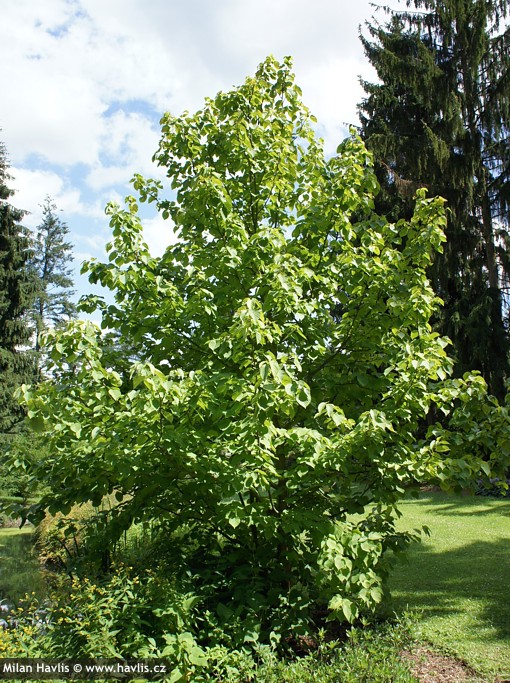
Davidia involucrata dove tree

 Symbivit Tric (arbuscular)
 Symbivit (arbuscular)
Davidia
The dove tree remembers a world long before the last Ice Age and yet has survived to the present day. During the Tertiary period, the climate of the Northern Hemisphere was warmer and forests looked very different from those we know today; with the onset of the Ice Ages, however, the dove tree disappeared from both the European and North American landscapes. For many decades it was known only by fossil remains, and botanists considered it extinct. A turning point came in 1869, when the French missionary and naturalist Armand David discovered living specimens in the mountain forests of Sichuan Province in western China. The discovery caused a sensation in the botanical world: a tree believed to have been lost forever was found alive. The first “export” followed in 1896, when the missionary Paul Farges sent seeds to France. A few took root, but far greater success was achieved by the legendary plant collector Ernest Henry Wilson, whose seeds collected between 1900 and 1904 and brought to Great Britain germinated readily, growing into strong trees that later proved capable of flowering. And here it is fair to say that dove tree, still a sought-after botanical rarity, teaches us patience: when grown from seed, it usually begins to flower only after 10 to 20 years, which is why breeders strive to develop cultivars with an earlier onset of flowering.
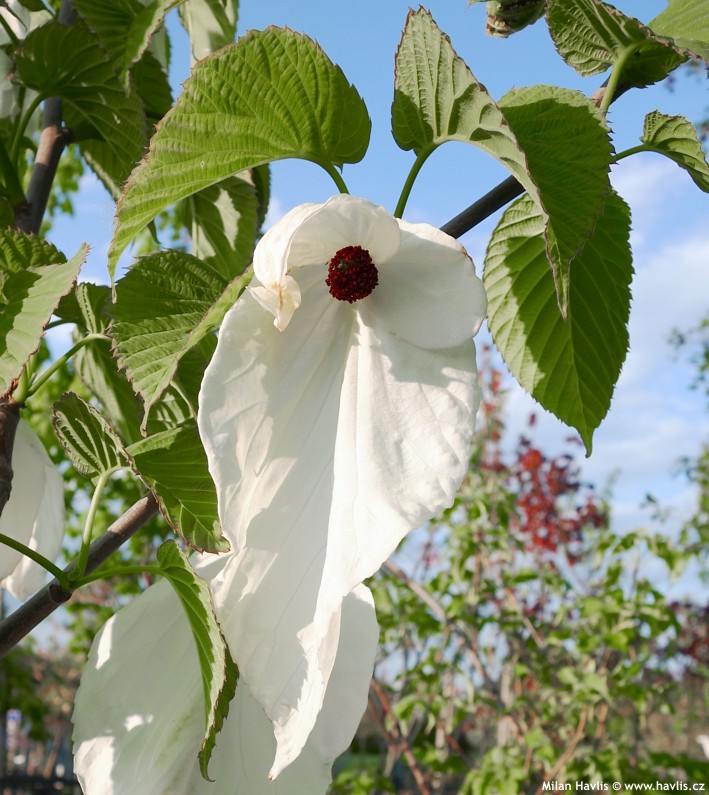
The botanical species of dove tree is a striking, robust and unmistakable tree at maturity, with a broadly spreading crown and stout branches that give it an almost monumental character. The leaves are large, heart-shaped to broadly ovate, with a distinctly serrated margin; the upper surface is deep green and the underside is typically finely downy, giving the leaves a softer, velvety appearance. This indumentum on the lower leaf surface is one of the main features by which the species can be distinguished from smooth-leaved selections. In autumn the foliage turns predominantly yellow to golden-yellow; the colouring is generally calm and natural, but we have noticed that under specific conditions – especially on more acidic, evenly moist sites and with the combination of cool nights and sunny days – more vivid scarlet and carmine red tones occasionally appear, which look quite distinctive.
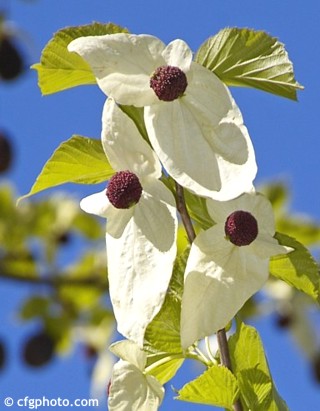
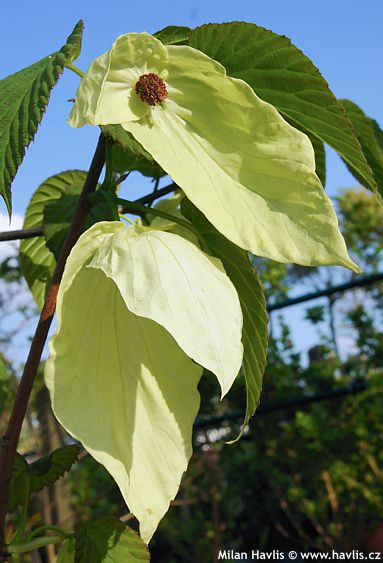
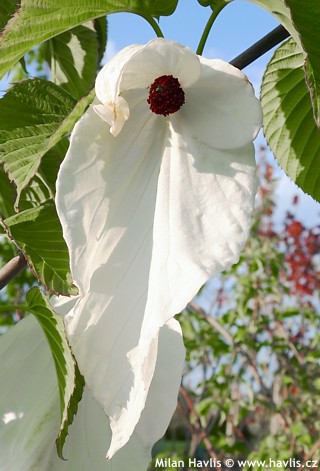
Flowering is what made the dove tree famous around the world. In May inconspicuous green inflorescences appear on the branches, each surrounded by two large white bracts, often of unequal length. These bracts hang from the branches like handkerchiefs left out to dry and sway gently in the breeze, giving the tree an almost fairytale appearance. It is this impression that gave rise to the international name “handkerchief tree”, while in English the preferred name is much more romantic: dove tree, because the pair of white bracts resembles two doves sitting opposite one another. Seedlings typically flower after 10–20 years - madam is certainly beautiful, but she keeps you hanging on — much like her handkerchiefs.
When young, the dove tree grows more upright with a regular crown structure, but it gradually widens and develops a massive, spreading crown. In gardens it usually reaches about 10-12 metres in height and approximately 8-10 metres in spread; in parks and open landscapes, given ample space and deep soil, it can grow to 15-20 metres tall and 8-12 metres wide and become a true dominant. Regular pruning is not recommended – it disrupts the natural form and often delays or entirely suppresses flowering.
Last update 28-01-2008; 17-01-2026
The dove tree does not like extremes. In the wild it grows in montane mixed forests of western and south-western China (roughly 1100-2600 m above sea level), so the ideal site is sheltered from drying winds and receives plenty of light — preferably full sun to partial shade (in warmer locations it benefits from afternoon shade). Soil should be deep, fertile, humus-rich, consistently slightly moist but well drained. Summer drought reduces leaf size and the bracts around the flowers, prevents autumn colour and can make the tree “age” within a single season; conversely, permanently waterlogged soil is an invitation to problems. Soil pH is not critical, but the best autumn colour has been observed on acidic soils. Hardiness is most often given as down to −23 °C, but we have found that in a sheltered position a tree with mature wood can tolerate short-term dips to around −27 °C, provided there are no black frosts.