Delosperma sutherlandii Sutherland's hardy iceplant

 Symbivit Tric (arbuscular)
 Symbivit (arbuscular)
Delosperma
Delosperma is a genus of low-growing, perennial succulent plants in the family Aizoaceae, native mainly to the mountainous and semi‑desert regions of southern Africa, where it inhabits rocky slopes, crevices, and places where water disappears before it has a chance to soak in. The genus was described in the early 20th century by the British botanist Nicholas Edward Brown (1849–1934), who noticed the tiny, glistening cells on the surface of the leaves—features that gave the plants their name, derived from the Greek delos ("conspicuous") and sperma ("seed"). Delospermas are characterized by their fleshy, evergreen leaves capable of storing water for long periods, and by their strictly mat‑forming, creeping habit, which allows them to create dense, low carpets. During flowering, these inconspicuous cushions transform into a blaze of daisy‑like blooms that open only in full sun and rank among the most rewarding ornaments of dry, heat‑exposed sites.
Sutherland’s ice plant was first described in the 19th century by the British botanist Joseph Dalton Hooker (1817–1911) and was reassigned to the genus Delosperma only in 1926, when Nicholas Edward Brown taxonomically consolidated the species and clarified its placement. It originates from grassland and montane regions of southern Africa, primarily within present‑day South Africa, especially the area of the former Transvaal. It occurs naturally in open, sunny locations, often within grassland communities and on stony slopes with well‑drained soil. These habitats are characterized by pronounced temperature differences between day and night and by alternating dry and wetter periods, which is reflected in the species’ good adaptability and reliable flowering. The species epithet sutherlandii commemorates Alexander Sutherland, a British plant collector active in southern Africa during the 19th century, whose field collections made a significant contribution to the knowledge of the local flora.
The species of Sutherland’s ice plant forms low, loosely branched, semi-woody perennials (subshrubs) with ascending to gently spreading shoots that gradually expand into broader clumps. The leaves are typically succulent – exactly what one would expect in a southern climate, on sun‑baked stones and along paved paths of coastal holiday resorts: fleshy and visibly full of water. They are grey‑green, cylindrical to slightly flattened, and finely hairy on the surface, especially along the margins and at the tips, which is one of the distinguishing features of this species. The leaf pubescence reduces water loss and protects the tissues from intense sunlight and temperature fluctuations. The plant maintains a compact, fresh appearance throughout most of the growing season and remains visually appealing even outside the flowering period.
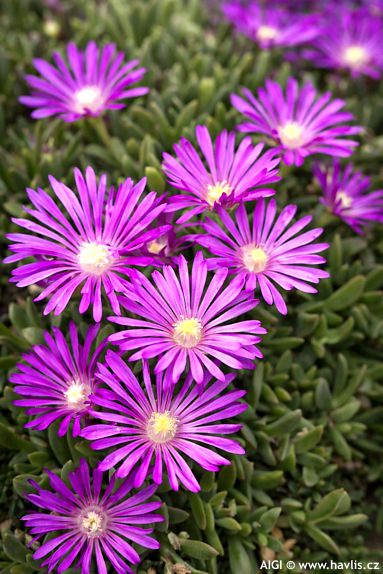
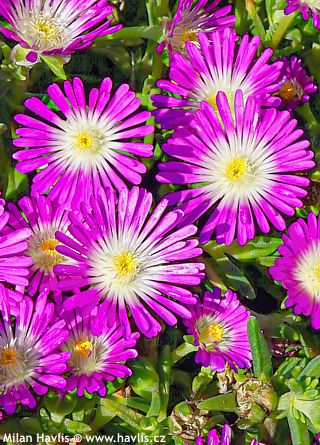
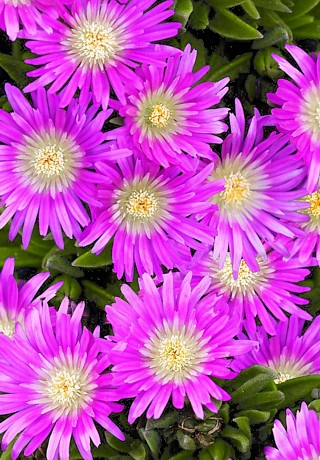
Flowering is the reason why ice plants are grown at all, and why they belong precisely where sunlight is abundant. The flowers appear from late spring and, under favourable conditions, continue well into summer. They resemble large daisies and are striking; in the species they tend to be colour‑variable, offering shades ranging from lilac‑violet to deep purple, with contrasting white filaments and yellow anthers. Selected and cultivated forms then display more uniform colouring. The flowers open only in sunny weather and close again in the evening or during overcast conditions. In temperate climates, this species is an excellent choice for sunny rock gardens, stony slopes or dry stone walls. Thanks to its long and generous flowering, Sutherland’s ice plant is considered one of the most attractive species within the genus, suitable both for specialist collections and for everyday garden use.
Last update 30-01-2013; 15-02-2026
Delosperma sutherlandii requires full sun and very well‑drained soil, ideally with a high proportion of mineral material – it will not perform in heavy soils or in ordinary garden beds with a significant clay content. It thrives best in dry, open positions, where it retains a compact habit and flowers abundantly. Watering should be limited, mainly after planting or during prolonged drought; permanent moisture is unsuitable, particularly in winter. When grown in a dry position, the plant shows good frost tolerance, down to approximately −20 °C (USDA zone 6b, with protection from winter wet being the key factor for successful overwintering. It is evergreen, non‑toxic and, under suitable conditions, long‑lived, making it well suited to gardens with low maintenance requirements.