

































Dryopteris filix-mas 'LINEARIS POLYDACTYLON' male fern

 Symbivit Tric (arbuscular)
 Symbivit (arbuscular)
Dryopteris
The genus Dryopteris is among the oldest and most widespread ferns of the Northern Hemisphere. It comprises roughly 300 species that inhabit temperate woodlands, mountain regions and cooler subtropical zones. Fossil finds show that the ancestors of today’s ferns of this type already appeared in the Mesozoic era, when ferns formed the understorey of ancient forests long before the rise of flowering plants. The generic name Dryopteris comes from Greek and means “oak fern”, a reference to the frequent occurrence of these plants in deciduous woods, especially beneath oaks. The first comprehensive botanical circumscription of the genus was made by the French botanist Michel Adanson (1727–1806), and later elaborated by, among others, Carl Ludwig Willdenow (1765–1812) and John Lindley (1799–1865). Dryopteris became one of the foundational genera around which modern pteridology, the study of ferns, developed.
In the mid‑19th century ferns became something between a science, a fashion and a mild obsession; people collected, printed, embroidered and displayed them in rooms and in Wardian cases, which made it possible to transport and cultivate exotic species far from their native homes. Charles Kingsley, an Anglican clergyman, writer and social reformer known for his novels and for popularising the natural sciences, even coined the term “pteridomania” in 1855, describing with both amusement and wonder how daughters and fathers alike were “struck” by the new passion. It turned out that fern collecting was not only a pastime for gentlemen in hats; it was an activity that crossed class and gender lines. Women found in pteridomania a respectable route into natural history and domestic display, while newly available railways and popular publications broadened collecting opportunities. Fern motifs appeared not only in pots and gardens but also on porcelain, textiles, furniture and tombstones, and their quiet, prehistoric beauty suddenly resonated with the Victorian desire to connect with an ancient nature.
The male fern, Dryopteris filix‑mas, is one of the best known and most widespread species in the genus. It was described by Carl von Linné (1707–1778) in 1753 in his Species Plantarum. The specific name filix‑mas, literally “male fern”, stems from an old folk distinction between more robust ferns, thought to evoke masculine vigour, and finer ones, thought to suggest feminine charm, rather than from any botanical sexing. This species has accompanied people for centuries. In European woods it has long been seen as a symbol of strength and endurance, and its rhizomes were used in folk medicine as a remedy against intestinal parasites, although we now know such treatments were risky. The male fern has also become the archetypal woodland fern in literature and the visual arts, often representing shade, calm and the permanence of the forest. All of this made it a cornerstone from which many attractive garden forms and cultivars were developed.
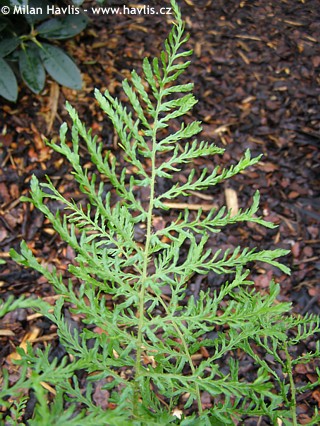
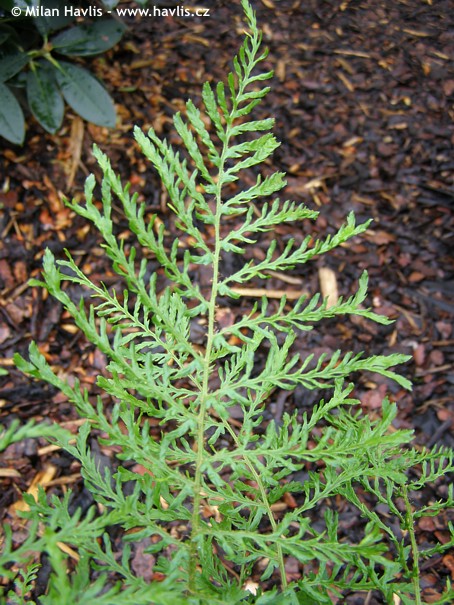
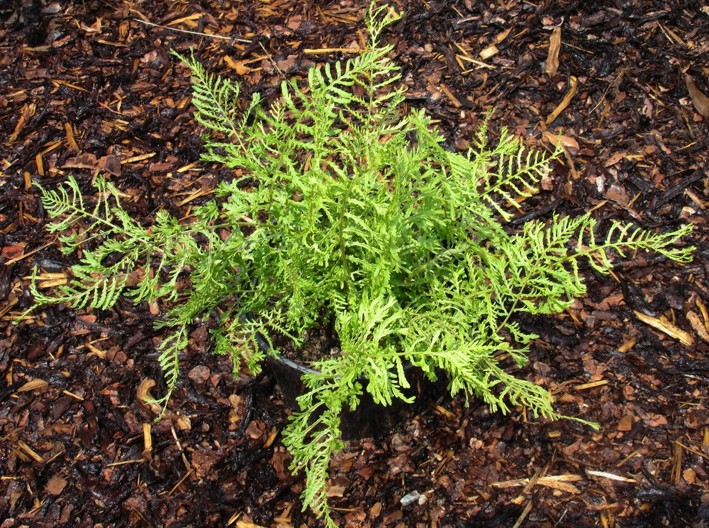
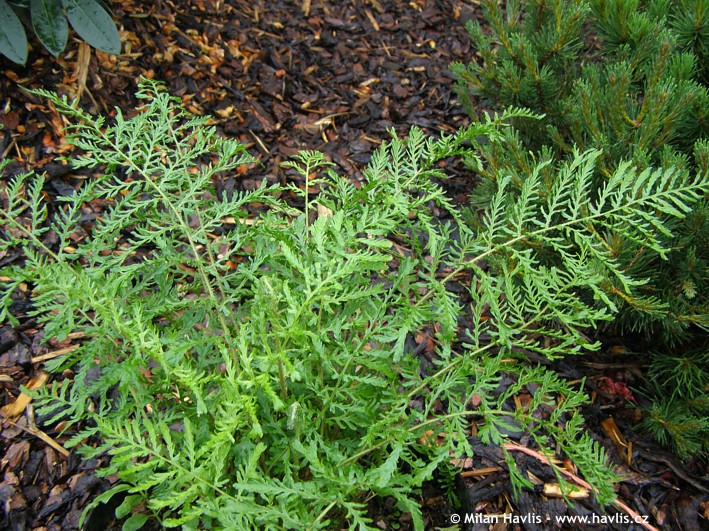
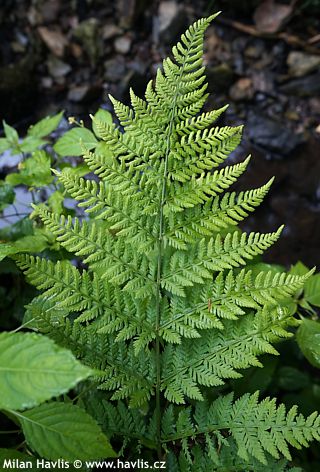
Sometimes it seems that the smaller or more delicate a plant is, the longer its Latin name becomes. The cultivar Linearis Polydactylon is a fine example. Although its name may sound like that of a prehistoric super‑flyer, it is a very delicate affair. This selection appears light, almost lace‑like, while retaining the firm, upright structure typical of the male fern. Its fronds are strikingly narrow and deeply divided into fine, finger‑like segments that themselves branch at the tips, creating a many‑fingered impression. It is precisely this unusual division that gives the plant movement and rhythm, as if the fronds gently ripple even without wind. The colour is fresh green, clear and even, without a pronounced gloss but with a soft, velvety quality that catches the dappled light of the wood. The whole clump looks airier than the typical species, less bulky but far more detailed, and with a touch of poetry it resembles a botanical illustration rather than an ordinary woodland plant.
In the landscape ‘Linearis Polydactylon’ is a fern that belongs where you want fine texture and detail. Use it either as a feature within a whole bed or as a welcome contrast to existing large‑leaved plants such as Rodgersia, Bergenia or Heuchera. It also works very well with spring bulbs such as Galanthus or Chionodoxa, which show off and occupy the space while in flower and then readily yield it to the ferns. Thanks to its airy habit it is suitable for smaller gardens or semi‑shaded corners by terraces, where it does not feel heavy or dominant but rather a subtle detail that you will notice only on closer inspection and may even want to touch it. Personally, I am somewhat ambivalent about planting it in large groups, because it can look like an untidy tangle there, lacking the firm structure of many other, more erect species.
Last update: 30-05-2007; 24-03-2026
The requirements of this fern reflect its woodland origins. It prefers partial shade to shade and humus‑rich, moderately moist soil that does not dry out deeply but is not waterlogged for long periods. It does not need regular feeding or elaborate interventions; old or damaged fronds should be removed in spring before new growth emerges. It is not suitable for containers in full sun or for dry, gravelly beds. It is not poisonous, but it is not edible and has no culinary use. In Central Europe it is fully hardy and reliably tolerates winter temperatures down to around −34 °C; some growers from the north even report tolerance to as low as −40 °C.

Goods are shipped all over Europe. For Russia and U.K. and for further details please read about SHIPPING OPTIONS HERE.
Are you interested in a serious discount for orders NOV-FEB? Check your options here.
THE PRICES INCLUDE VAT of 15%. For quick conversion you can use 1 CZK = approx. 0.04 EUR
- STANDARD QUALITY - Plants of this group are 1st class quality with number of branches and overall density adequate to their size and age, considering they were container grown.
- DE LUXE QUALITY - This label guarantees a luxurious quality of manually selected plants that, compared to their height and age, are exceptionally dense and beautiful.
- EXTRA - These plants are usually mature and bigger specimens with exceptional overall appearance.
- STANDARD (as described in the plant form) means a tree with a trunk of 190-210 cm and a crown at the top, unless specified differently. The commercial size for trees is their girth measured in the height of 1m from ground.
- HOBBY - These plants are of the same quality as our standard-quality plants but younger and therefore cheaper.
- SHRUB - a woody plant with branches growing bushy from the ground level.
- HALF-STANDARD or MINI-STANDARD - a small tree with shorter trunk, its size is usually specified.
- FEATHERED - These are trees with branches growing already from the base of the trunk and up along the stem.
- GRASSES and PERENNIALS - Sizes given usually read the diameter of the pot or the clump, as specified.
