












.jpg)
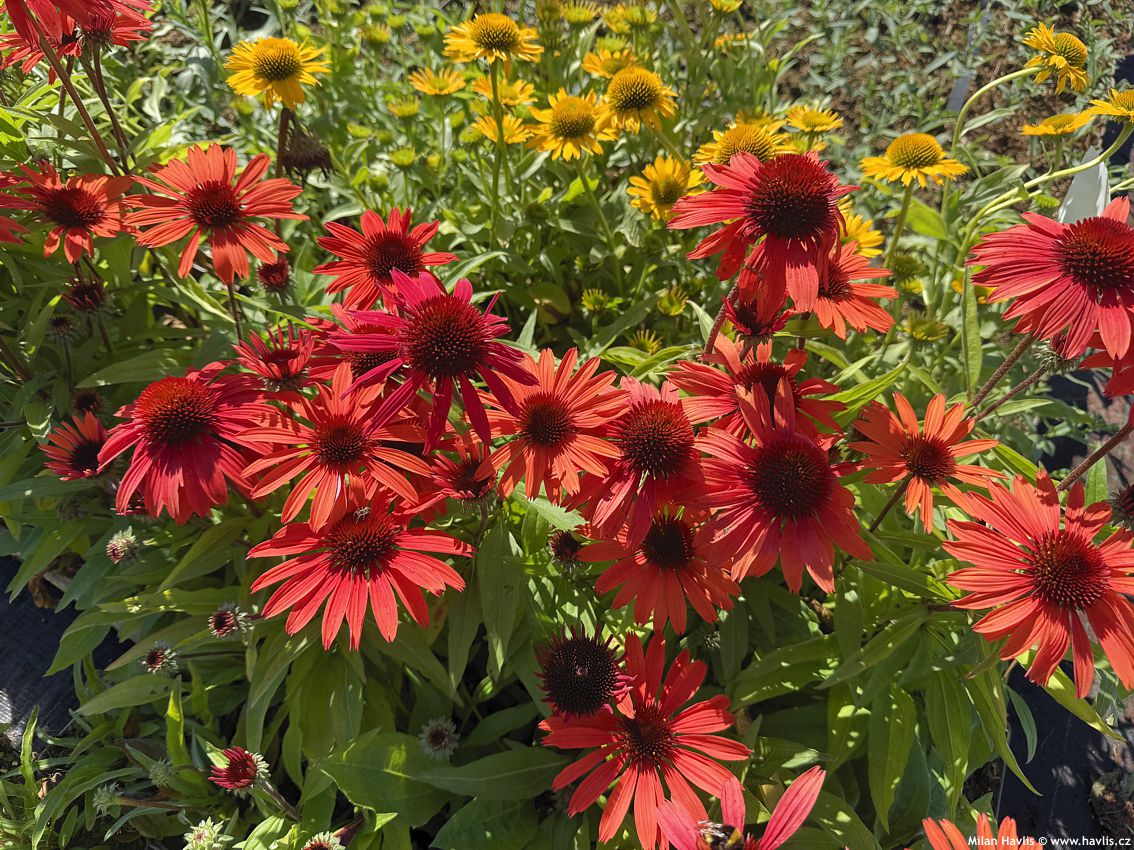
Echinacea purpurea 'Bullechi 11' SUNMAGIC VINTAGE ORANGE coneflower

 Symbivit Tric (arbuscular)
 Symbivit (arbuscular)
Echinacea
The genus Echinacea, the coneflower, comprises nine recognised species of perennial plants native to the prairies and open habitats of North America, where their ancestors have evolved over millions of years. Fossilised pollen of related members of the daisy family has been found in deposits tens of millions of years old, showing that the lineage from which coneflowers arose was present on the continent long before humans arrived. The name of the genus comes from the Greek echinos – hedgehog – and refers to the prickly cone at the centre of the flower head, a feature shared by all species. The genus was formally described by the German botanist Konrad Mönch (1744–1805) on the basis of herbarium material brought to Europe by missionaries and naturalists returning from American expeditions in the late eighteenth century. Even then, botanists noticed that the species differed not only in flower colour but also in the shape of the ray florets, height and ecological preferences, which later led to taxonomic debates about the boundaries between E. pallida, E. angustifolia and E. purpurea. The genus became known not only for its ornamental appeal but also for its traditional use by Indigenous peoples of North America, who applied coneflower preparations for pain, inflammation, snakebite and even rabies. It reached Europe at the turn of the eighteenth and nineteenth centuries, though for a long time it remained more of a botanical curiosity than a garden favourite.
Echinacea purpurea, the purple coneflower, is the most widespread species of the genus, originating from the moister prairies and bright woodland edges from Oklahoma to Tennessee, where it grows in deeper, nutrient‑rich soils. Although its formal description dates back to the Linnaean era, real interest in the species rose only when it became part of the traditional medicine of North American tribes, especially the Sioux and Comanche, who used it as a versatile remedy. It entered European gardens as an exotic perennial with an unusual flower form, but its modern fame began in the 1990s, when botanists in Chicago started crossing E. purpurea with the bright yellow E. paradoxa. In 1995 the first orange cultivar, Art’s Pride, was created, launching an era of hybrid coneflowers in shades ranging from apricot to raspberry. These hybrids spread quickly thanks to their robustness, long flowering period and ability to bring colours to gardens that had never before been seen in coneflowers. From a once medicinal prairie plant, it has become one of the most important perennials in contemporary garden design, combining cultural history, botanical interest and modern breeding enthusiasm.
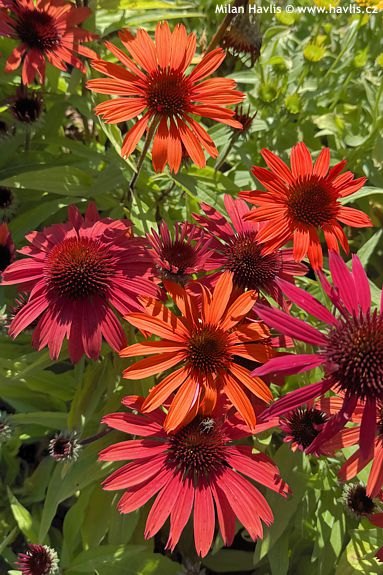
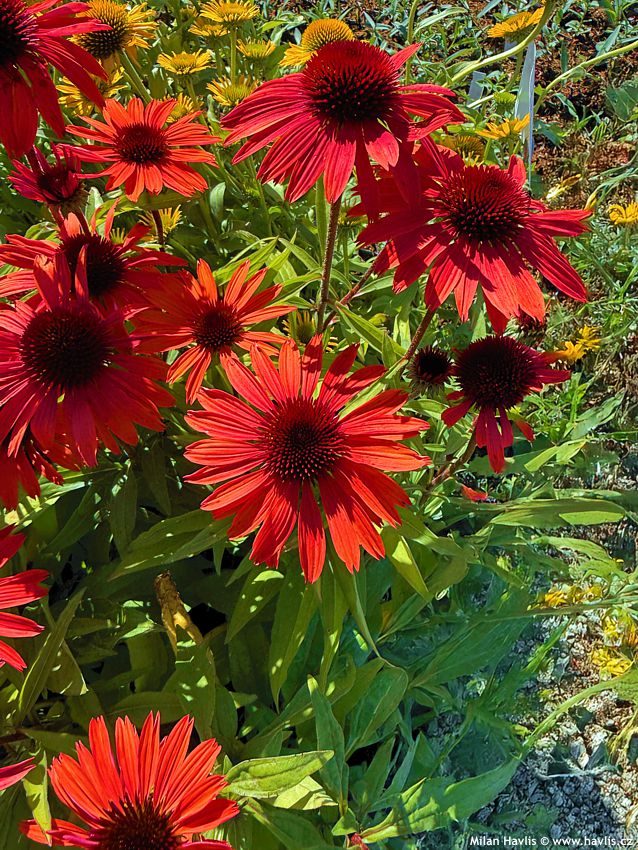
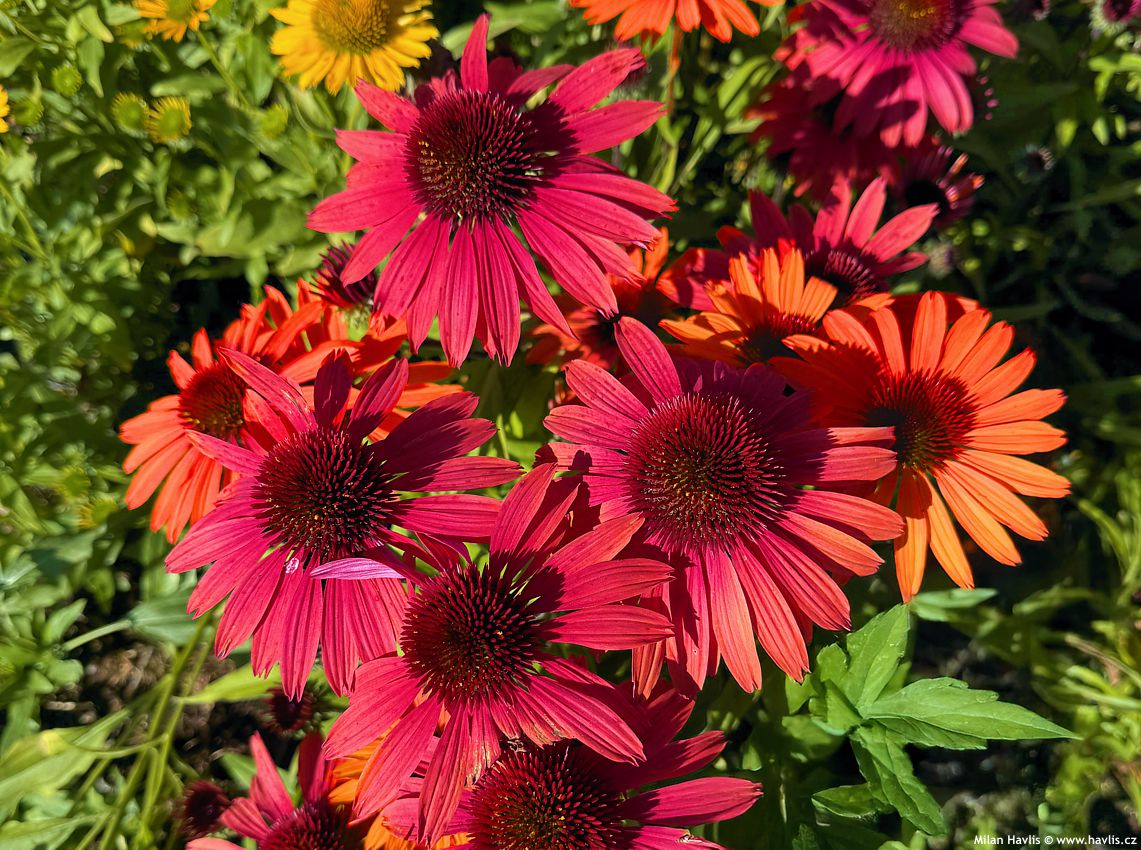
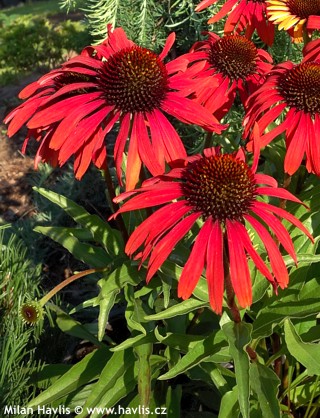
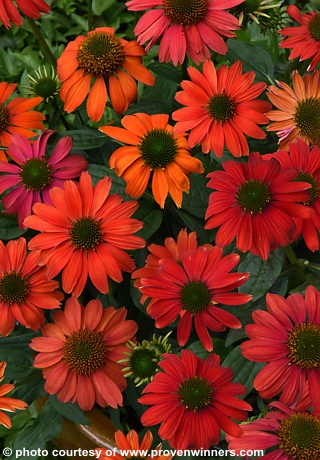
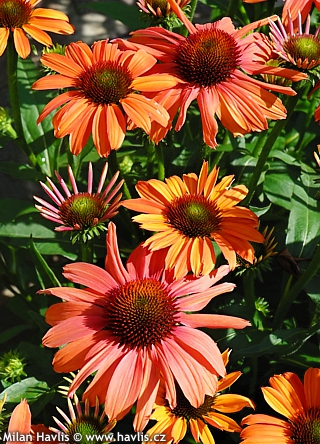
SUNMAGIC VINTAGE ORANGE coneflower comes into flower in early July and produces large blooms whose colour recalls the rind of blood oranges – a blend of deep orange and crimson red sometimes described as burnt orange. The flowers are single, measuring 10–12 cm across, and carry a sweet fragrance. Each bloom has a dark red, domed centre rich in nectar, most easily reached by bumblebees and butterflies, though honeybees will also find their way to the outer edge of the cone. Individual flowers last for two to three weeks and the plant blooms until early October. The stems are dark, firm and reach 40–60 cm, branching well even on young plants, which results in a generous number of blooms at one time. The leaves are elongated, narrowly lanceolate, fresh green, slightly rough to the touch and healthy. The plant forms dense, compact clumps. The cultivar is protected by European PBR rights no. 70085 from 2025.
The SunMagic series of coneflowers was created by Hartwig Bull of Germany at Bull Plant Genetics. Bull has long focused on developing varieties with a firm structure, stable colour and reliable growth, a philosophy reflected in his approach breed from a grower point of view. Every new series must be compact, stable, resilient, well‑branching, able to hold its colour even in extreme weather and simply grow well. SunMagic is one of his most successful projects and I believe that its strength lies partly in the fact that Bull breeds exclusively from the botanical species Echinacea purpurea, which is naturally the most robust, rather than from hybrids that can sometimes lose their perennial reliability. Hartwig Bull is also responsible for other internationally successful series: Sunbeckia, which introduced exceptionally large blooms and firm stems in rudbeckias, and SunCatcher, focused on compact sunflowers in intense colours – both regarded as annuals. Thanks to these series, plants from Bull Plant Genetics have performed well in trials from Europe and the United States to Australia, New Zealand, South Korea and Japan, and with established representation in North America they have become a steady part of the nursery trade on both sides of the Atlantic.
Last update 23-09-2026
Coneflowers are undemanding perennials that thrive in full sun and in well‑drained, fertile soil that does not remain waterlogged. They dislike acidic ground, while neutral to slightly alkaline soils suit them well. Removing spent flowers can extend the flowering period, though it is not essential, as most modern hybrids bloom reliably even without deadheading. Feeding should be moderate – a liquid fertiliser every two to three weeks during the growing season is sufficient. Because they originate from the North American prairies, where summer rainfall is more frequent than in the long dry spells typical of temperate Europe, hybrid cultivars appreciate additional watering during extended drought; otherwise they may reduce flower production. Their stems are sturdy and withstand wind and heavy summer storms. In spring, young shoots must be protected from slugs, which can damage new growth; barriers, mechanical protection and classic beer traps all work well. Coneflowers are long‑lived, overwinter successfully and require no winter cover. Most cultivars tolerate frost down to at least -29 °C, but more often to -34 °C (USDA zone 4).

Goods are shipped all over Europe. For Russia and U.K. and for further details please read about SHIPPING OPTIONS HERE.
Are you interested in a serious discount for orders NOV-FEB? Check your options here.
THE PRICES INCLUDE VAT of 15%. For quick conversion you can use 1 CZK = approx. 0.04 EUR
- STANDARD QUALITY - Plants of this group are 1st class quality with number of branches and overall density adequate to their size and age, considering they were container grown.
- DE LUXE QUALITY - This label guarantees a luxurious quality of manually selected plants that, compared to their height and age, are exceptionally dense and beautiful.
- EXTRA - These plants are usually mature and bigger specimens with exceptional overall appearance.
- STANDARD (as described in the plant form) means a tree with a trunk of 190-210 cm and a crown at the top, unless specified differently. The commercial size for trees is their girth measured in the height of 1m from ground.
- HOBBY - These plants are of the same quality as our standard-quality plants but younger and therefore cheaper.
- SHRUB - a woody plant with branches growing bushy from the ground level.
- HALF-STANDARD or MINI-STANDARD - a small tree with shorter trunk, its size is usually specified.
- FEATHERED - These are trees with branches growing already from the base of the trunk and up along the stem.
- GRASSES and PERENNIALS - Sizes given usually read the diameter of the pot or the clump, as specified.
