

































.jpg)
Elaeagnus × ebbingei (E. × submacrophylla) 'Ladet' TANEO evergreen silverthorn


 Symbivit Tric (arbuscular)
 Symbivit (arbuscular)
Elaeagnus
The genus Elaeagnus, oleaster, belongs to the oleaster family and includes roughly ninety species distributed from south‑eastern Europe to Japan. It is an ancient group of woody plants, as shown by Tertiary fossils indicating that oleasters were once common even in regions where they no longer grow today. The whole genus is characterised by tiny scales on the leaves and young shoots, giving the plants a silvery or rusty sheen while protecting them from sun and drought. Oleasters also belong among the woody plants capable of supplying part of their own nitrogen: their roots host symbiotic bacteria of the genus Frankia, which can convert atmospheric nitrogen into a usable form. Thanks to this, oleasters thrive even in poor, sandy or windy soils where many other shrubs would struggle. The genus was first defined in 1700 by Joseph Pitton de Tournefort (1656–1708), one of the most important pre‑Linnaean systematists, professor of botany at the Jardin du Roi in Paris and author of the first truly functional plant classification system based on clearly defined genera. In his major work Éléments de botanique he separated oleasters from related genera and gave them the name Elaeagnus, later adopted and formally established by Carl Linnaeus.
Within the genus, some species can hybridise, and the most vigorous combination proved to be E. macrophylla crossed with E. pungens. From the first parent the hybrid inherited large, leathery, evergreen leaves, and from the second its notable toughness, resilience and ability to regenerate quickly after pruning. Botanically it is a stable, repeatedly occurring hybrid that appears naturally wherever the ranges of the two parent species overlap, and in cultivation it has become one of the most widely grown evergreen shrubs of the temperate zone.
The history of this hybrid, commonly called evergreen silverthorn, is intriguingly tangled and shows how differently botanical and horticultural naming can develop. The Swiss botanist Camille Servettaz (1870–1947) described in 1909 a plant with strikingly large leaves under the name Elaeagnus × submacrophylla, without realising at the time that it was a hybrid. She treated it as an unexplored taxon because it matched neither E. macrophylla nor E. pungens, yet clearly bore traits of both. Only later revisions revealed that her description precisely matched what we now recognise as the hybrid of these two species. Meanwhile, the horticultural world took a different path. The prominent Dutch botanist and breeder Simon Doorenbos (1891–1980) sowed in 1929 seeds of oleasters growing together in The Hague municipal nursery and among the seedlings found a plant that differed markedly from the rest. Realising its hybrid origin, he named it Elaeagnus × ebbingei in honour of his colleague J. W. E. Ebbinge. The name quickly caught on because Doorenbos’s plants spread through European nurseries and became the backbone of modern hedges in coastal and urban areas. Only modern studies showed that Doorenbos’s name does not have botanical priority, as Elaeagnus × submacrophylla had been published earlier and is therefore considered correct. Although botanical databases and gardens now use Servettaz’s name, the powerful horticultural trade continues to work with the traditional name E. x ebbingei, and it remains uncertain if or when it will shift to E. × submacrophylla.
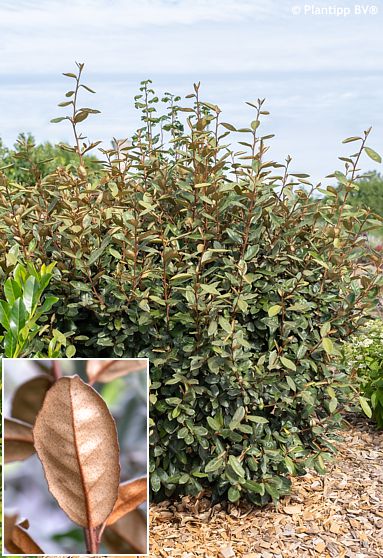
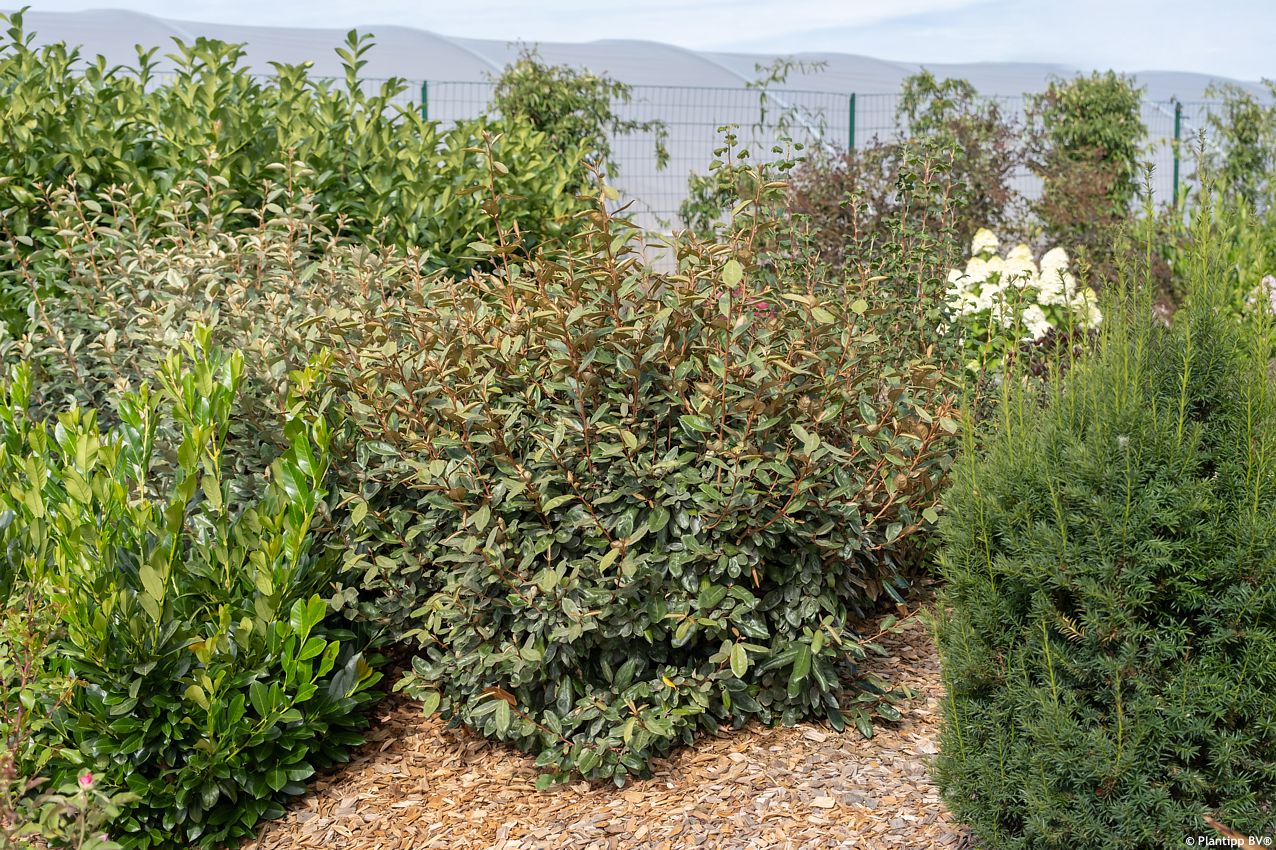
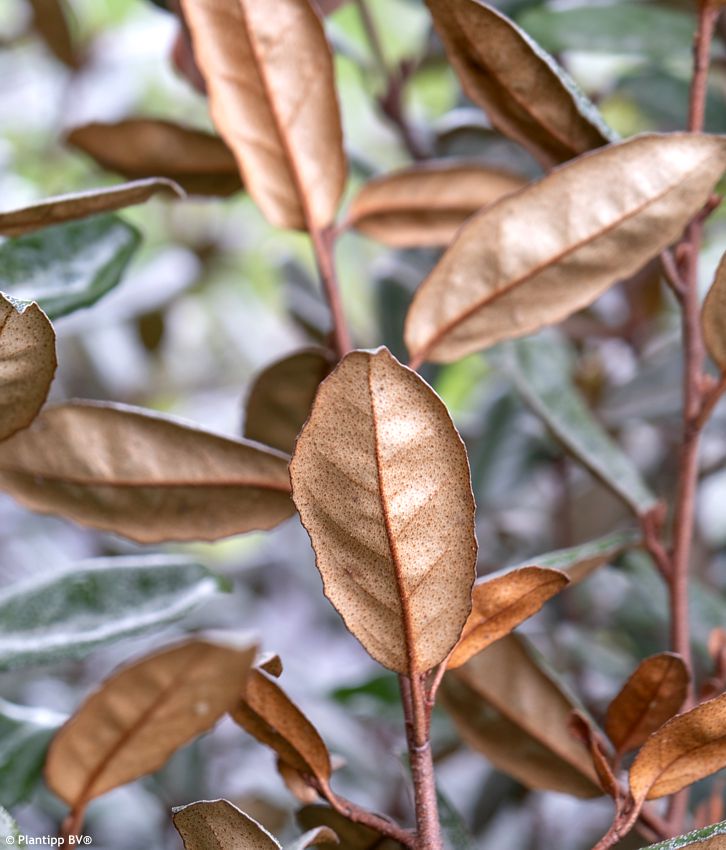
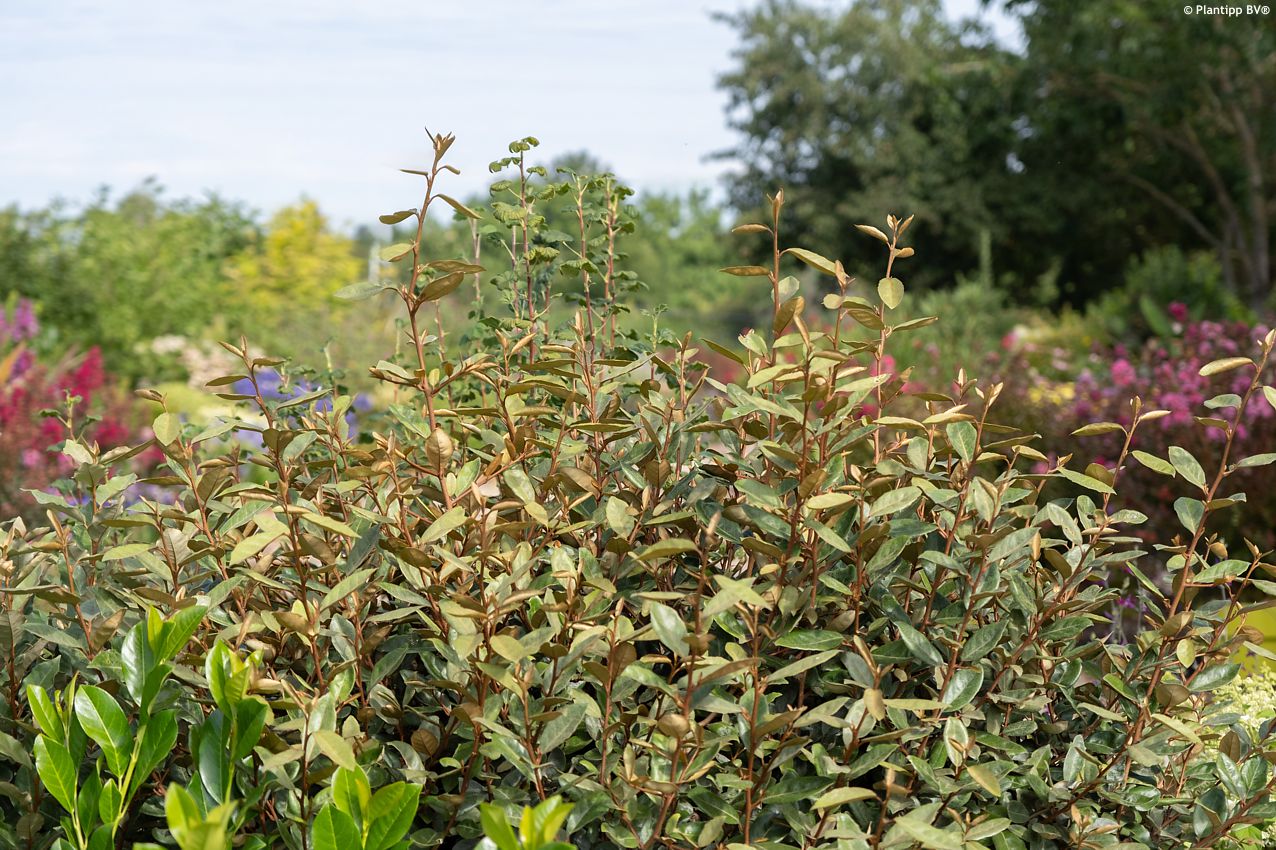
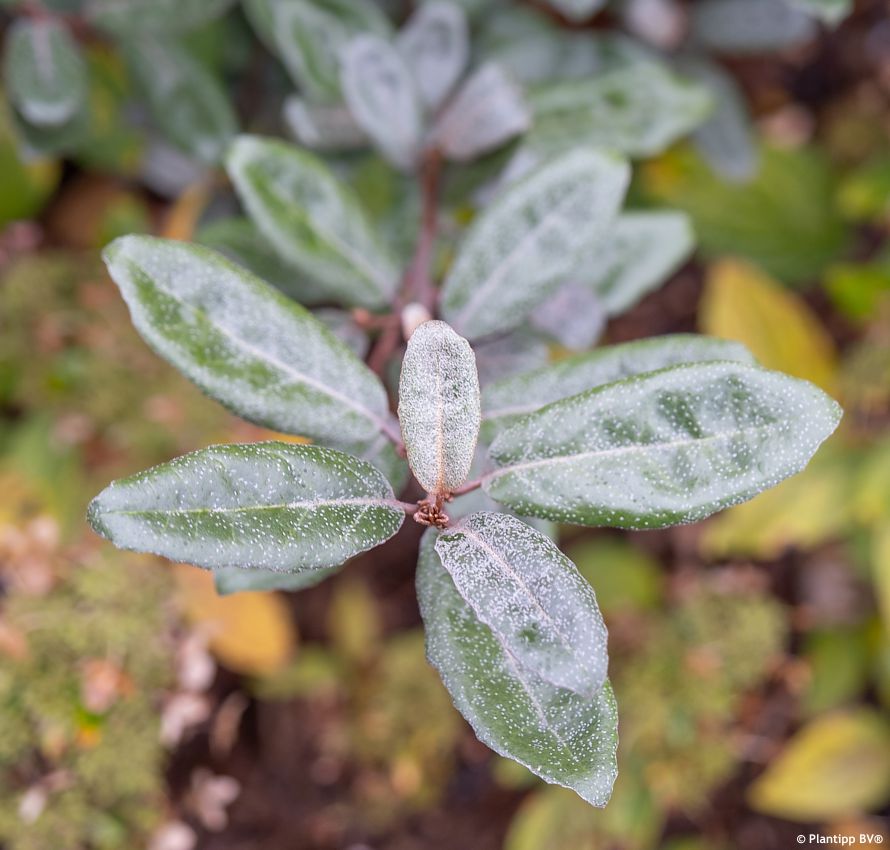
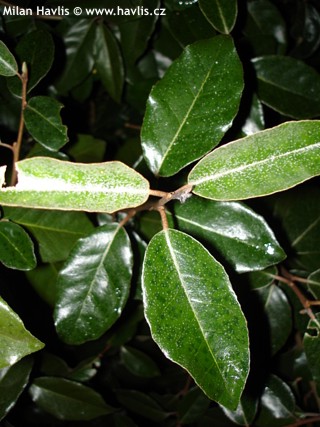
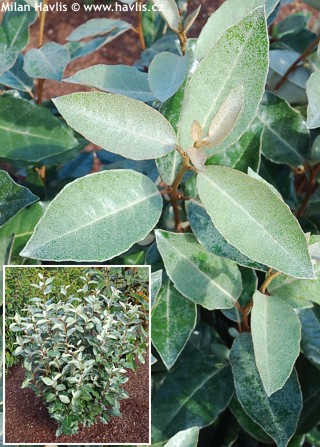
Evergreen silverthorn TANEO was selected in the French nursery Pépinières Ladan and seen from up close it looks as if dressed in a soft leather jacket – its young shoots have a warm brown shade reminiscent of natural hide, and the mature leaves glow in dark olive green with a copper undertone and a silvery-beige underside. After the spring flush of brownish shoots, the leaves take a long time to turn green, roughly three to five weeks, giving you plenty of time to enjoy the colour prelude. In summer it offers a dense, almost impenetrable habit, and with the first signs of cooler weather it begins to produce masses of wonderfully fragrant, inconspicuous flowers. They are almost white, speckled with beige dots, and their scent is sweet and strong, reminiscent of carnations and lily of the valley, while some say they also smell fruity notes of pears or plums.
The flowers are heavily visited by bees and bumblebees, and after pollination they fall quickly while small drupes develop in their place over winter. Under our conditions TANEO fruits reliably after mild winters, and in spring the small red drupes ripen and are edible. Their flavour is very good, it resembles sour cherries but sweeter, and the best ones are those that drop naturally when fully ripe. Unripe fruits have a tart, astringent taste similar to kaki.
TANEO grows at a medium rate, roughly 30–40 cm a year, dense, even and compact, giving a naturally tidy appearance and requiring little intervention. Thanks to its good branching it is considered one of the neatest cultivars within the whole hybrid. Its compact growth and dense branching make TANEO a popular choice for hedges – both clipped single‑species hedges and mixed evergreen screens, where it forms an attractive, year‑round barrier alongside other shrubs with similar requirements. For a Mediterranean feel it pairs well with arbutus, laurustinus, holm oak or phillyrea. For a livelier, more varied look reminiscent of western European gardens it works beautifully with photinias, Portuguese laurels, blue and Japanese hollies, evergreen privets and cherry laurels.
Evergreen silverthorn may show a few suddenly dried twigs each year, and here is a simple way to tell whether it is a problem: if you find orange dots of fruiting bodies on the dead twigs, it is the fungal disease Nectria cinnabarina. If there are no orange spots but white fan‑shaped sheets of mycelium under the bark at the base of the shrub or black cords in the soil, it is Armillaria, which attacks the roots. Both diseases occur mainly in heavy, poorly drained soil and are difficult to almost impossible to fight (and win). If none of these signs are present and only a few twigs die each year, it is almost always natural self‑thinning caused by dense growth, shading inside the shrub and occasional stress; in older oleasters this is normal and happens asymmetrically, just as in olives, hollies, holm oaks or cherry laurels and it is not dangerous.
Last update 15-05-2026
Evergreen silverthorn is one of the toughest evergreen shrubs and thrives in almost any well‑drained soil – from sandy to loamy to stony, ideally with neutral to slightly alkaline pH. It grows best in full sun but also tolerates partial shade very well and will grow even in deeper shade, only becoming slightly looser. After planting it needs regular watering only for a few months to establish, and afterwards watering should be avoided completely – it is highly tolerant of drought and wind. It dislikes heavy, airless and permanently wet soil, where it becomes prone to problems and grows poorly. It tolerates pruning extremely well, with the best time being early spring before growth starts, and throughout the season you can shorten over‑long shoots without concern. Mulching with a 5–7 cm layer helps retain moisture, improves soil structure, supports density and protects against rapid winter temperature fluctuations. It is hardy to about –24 °C (USDA zone 6) and can withstand even a few degrees lower for short periods, with the risk of shoot tips freezing, but it regenerates very well in spring.

Goods are shipped all over Europe. For Russia and U.K. and for further details please read about SHIPPING OPTIONS HERE.
Are you interested in a serious discount for orders NOV-FEB? Check your options here.
THE PRICES INCLUDE VAT of 15%. For quick conversion you can use 1 CZK = approx. 0.04 EUR
- STANDARD QUALITY - Plants of this group are 1st class quality with number of branches and overall density adequate to their size and age, considering they were container grown.
- DE LUXE QUALITY - This label guarantees a luxurious quality of manually selected plants that, compared to their height and age, are exceptionally dense and beautiful.
- EXTRA - These plants are usually mature and bigger specimens with exceptional overall appearance.
- STANDARD (as described in the plant form) means a tree with a trunk of 190-210 cm and a crown at the top, unless specified differently. The commercial size for trees is their girth measured in the height of 1m from ground.
- HOBBY - These plants are of the same quality as our standard-quality plants but younger and therefore cheaper.
- SHRUB - a woody plant with branches growing bushy from the ground level.
- HALF-STANDARD or MINI-STANDARD - a small tree with shorter trunk, its size is usually specified.
- FEATHERED - These are trees with branches growing already from the base of the trunk and up along the stem.
- GRASSES and PERENNIALS - Sizes given usually read the diameter of the pot or the clump, as specified.
