Euphorbia polychroma 'BONFIRE' wood spurge

 Symbivit Tric (arbuscular)
 Symbivit (arbuscular)
Euphorbia
The genus Euphorbia belongs to the spurge family (Euphorbiaceae) and includes more than 2,100 species of herbs, shrubs, and trees, making it one of the largest genera of flowering plants in the world. Individual species can differ so much that you would hardly assign them to the same family. They occur on every continent except Antarctica, with the greatest diversity in tropical and subtropical Africa, Madagascar, and the Americas, though many species also extend into the temperate zones of Europe and Asia. The genus was first described scientifically by Carl Linnaeus in 1753 in his Species Plantarum, naming it in honour of the Greek physician Euphorbus, personal doctor to King Juba II of Numidia (52 BC–23 AD), who used certain spurges in medicine. A hallmark of all spurges is their unusual inflorescence called a cyathium – a miniature cluster of male and female flowers surrounded by showy bracts, which at first glance looks like a single bloom.
Did you know that the poinsettia (Euphorbia pulcherrima) is also a spurge? In Mexico it was already known to the Aztecs under the name Cuetlaxochitl, while they used its red bracts to dye fabrics and to treat fevers back then, today it is a symbol of Christmas around the world. Some spurges even pretend to be cacti. Take Euphorbia trigona, known as the “African milk tree”: its tall, angular, spiny stems could easily fool a layperson into thinking it was a cactus, and in Africa it was planted around homes as a living hedge to ward off evil spirits and thieves. The difference, however, is fundamental: cacti come exclusively from the Americas and their spines are modified leaves, while spurges exude milky sap and their spines are modified branches. Another curious character is Euphorbia milii, native to Madagascar. Truly, it looks like anything but a spurge. In Christian tradition it became the symbol of Christ’s crown of thorns because older plants develop densely spiny, twisted stems. And I must also mention our faithful, low‑maintenance houseplant, the Madagascar jewel (Euphorbia leuconeura), which reliably “weeds” itself by shooting ripe seeds across the room and wherever they land in soil, a new seedling soon appears.
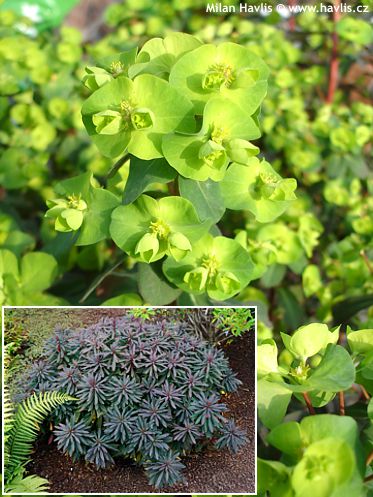
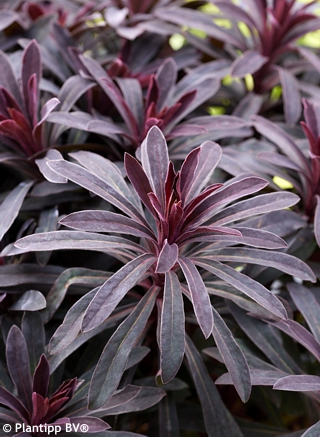
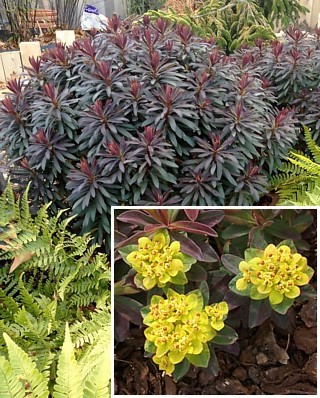
Bonfire is a new variety of wood spurge patented in 2005 by Mary Ann Faria from Rhode Island. It forms a compact, densely branched, mounded clump with narrowly elongated, deep purple red foliage, and typical spurge-like flowers (cyathia cupped by involucres in terminal cymes). The flowers are bright yellow-green which contrasts perfectly with the burgundy red leaves. Inflorescence may last for as long as 2 months.
Wood spurge will grow in almost any well-drained garden soil provided it is protected the extremes of both wet and dry conditions. Cut off all stems from previous year in early spring. Its foliage colour calls for a location where it will be appreciated best – in a rockery surrounded by white or light grey stones/pebbles or, if mulched by bark, mixed with plants of contrasting foliage. Hardy to about -29°C (USDA zone 5).
Last update: 29-01-2013