










Gaura lindheimeri (Oenothera lindheimeri) 'Gaudwwhi' GEYSER gaura, Lindheimer’s beeblossom

 Symbivit Tric (arbuscular)
 Symbivit (arbuscular)
Gaura
Oenothera is a large genus comprising more than a hundred species distributed mainly across North and South America. It belongs to the evening primrose family (Onagraceae) and includes remarkably diverse herbs and subshrubs with characteristic four‑petalled flowers that often respond to light conditions – many species open at dusk or during the night. The genus includes both low, pink‑flowered species forming compact clumps (Oenothera speciosa, O. berlandieri) and tall, yellow‑flowered evening primroses (O. biennis, O. glazioviana), which have been cultivated in Europe since the 17th century and became renowned for their large flowers opening in the evening. The genus also comprises prairie species with high drought tolerance, as well as steppe, sandy and rocky taxa. More recently, it has come to include the formerly separate monotypic genus Gaura, whose taxonomic placement within Oenothera has been confirmed by modern molecular studies. Species formerly known as Gaura represent a distinct and morphologically exceptional lineage within the genus: the only group with a light, airy habit, long slender stems and small, butterfly‑like flowers that bloom throughout the summer. Their origin in the dry prairies of southern Texas and north‑eastern Mexico is reflected in their remarkable tolerance of heat, wind and poor, stony soils.
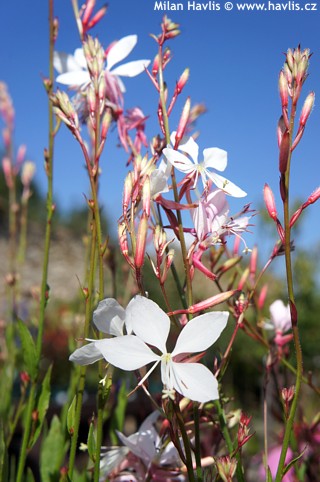
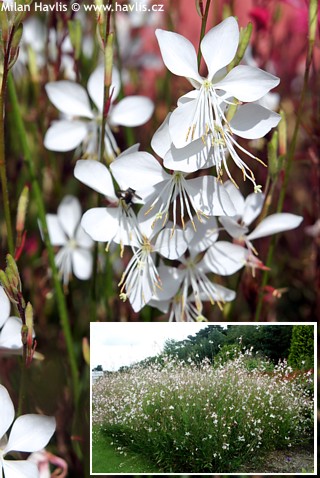
Oenothera lindheimeri, formerly Gaura lindheimeri, commonly known as Lindheimer’s beeblossom, originates from southern Texas and north‑eastern Mexico, where it grows in dry prairies, open scrub and rocky slopes. It forms loose clumps with long, thin, flexible stems bearing small, four‑petalled flowers in continuously developing racemes throughout the summer. This structure is an adaptation to windy prairie conditions – the stems do not break, the flowers are easily pollinated, and the plant tolerates drought and high temperatures exceptionally well. Ecologically, it is a typical prairie perennial with a rapid spring start, a long flowering period and high tolerance of poor, stony soils. Its natural variability has provided an excellent basis for modern breeding, which has produced a wide range of cultivars differing in habit, flower colour and foliage.
Oenothera lindheimeri entered European botany in the mid‑19th century through the work of Ferdinand Jakob Lindheimer (1801–1879), a German‑Texan botanist who, after emigrating to Texas, became one of the key figures in the floristics of the American Southwest. His extensive collections, sent to European herbaria, included hundreds of previously undescribed species – among them this light, ethereal perennial, scientifically described in 1845. In European gardens it quickly gained popularity thanks to its unusual combination of features: long flowering, gentle movement in the wind and the ability to bring lightness and airiness to plantings, qualities largely absent from the perennial palette of the time. In the 20th and 21st centuries it became one of the symbols of the “new perennial movement” popularised by designers such as Piet Oudolf – plants that are not static but respond to wind, light and the seasons.
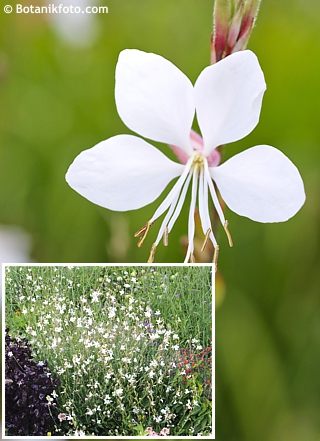
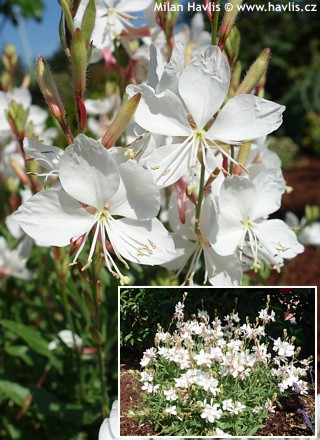
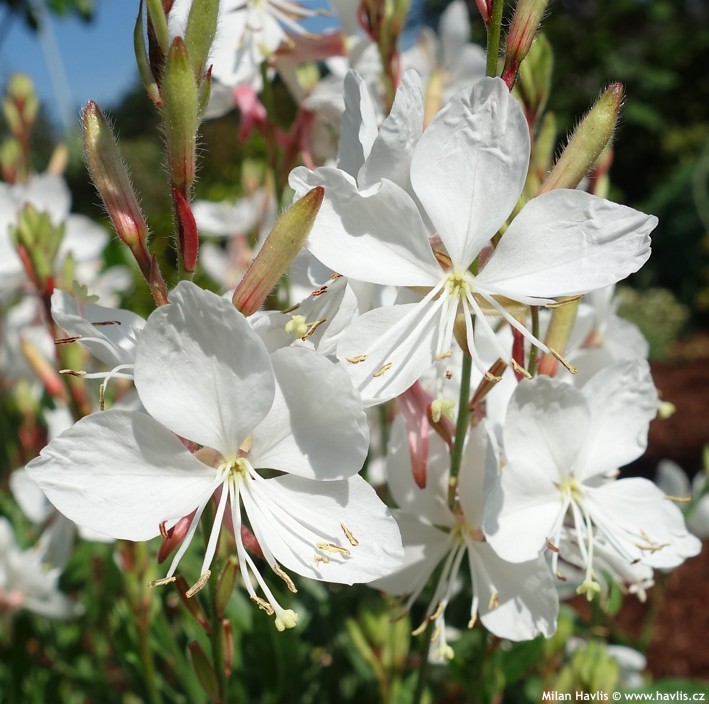
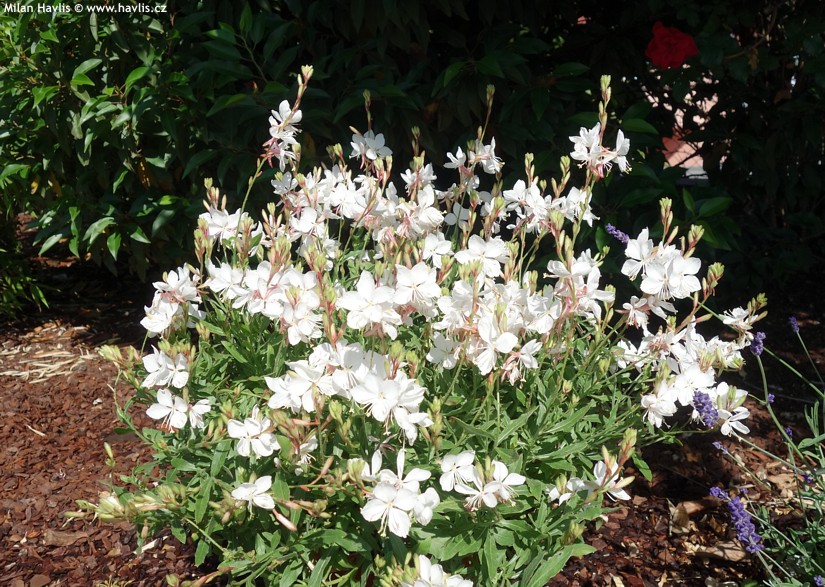
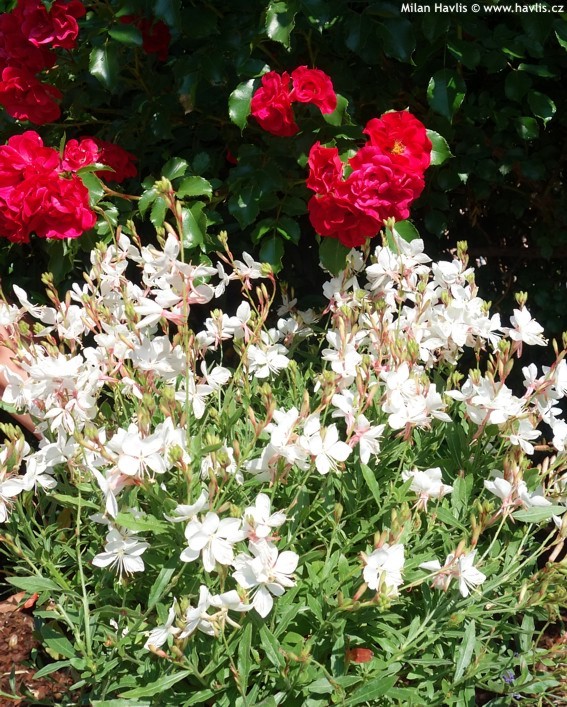
GEYSER, sometimes listed more precisely as ‘Geyser White’, is the first gaura cultivar in the Dutch GEYSER series and represents a reliable, long‑lived selection with a low, compact habit and exceptionally abundant flowering from early summer to early autumn. It forms clean, sturdy clumps approximately 30 cm tall in leaf, which carry flowering stems reaching around 60 cm as the season progresses. The flowers are, by the standards of gauras, strikingly broad and fully open, with pure white petals arranged in the upper part of the bloom in a way that recalls upright “ears”. From their centre emerge short, softly pink stamens, giving the flower a distinctive and unmistakable expression. The leaves are narrow, finely toothed and fresh green, arranged in light rosettes that lend the plant a clean and airy appearance. The overall effect is surprisingly harmonious and compared with common cultivars the flowers appear more pronounced, more graphic and more legible even from a distance. The plant flowers continuously, producing new buds at a rapid pace, and thanks to its compact habit it maintains a tidy shape even at the height of the season. The cultivar was registered under patent PP18279 (2007) and remains one of the most reliable white forms suitable both for borders and for modern, nature‑inspired plantings.
Last update 20-6-2018; 19-06-2026
Gauras thrive best in full sun and in well‑drained, rather poor soils that warm up quickly in spring. They do not tolerate heavy, persistently wet substrates, where the roots easily rot; on the contrary, they appreciate light, sandy or gravelly mixes. After planting they require regular watering, but once established they are markedly drought‑tolerant and cope well with short dry spells. Excess nitrogen leads to overly lush growth and poorer stem stability, so fertilise only sparingly or not at all. These are perennials with a partially woody base, which needs to be cut back close to the ground in spring – but very late, only after all frosts and the risk of wet snow have passed. Gauras emerge late, only with the arrival of genuinely warm weather. If they become lax during summer, they can be rejuvenated at the end of July by cutting back by half and applying fertiliser; they will quickly produce new, shorter and sturdier flowering stems.
In colder regions it is advisable to protect the crown with a layer of dry mulch, or cover the whole plant with conifer branches, especially in young specimens; older plants tend to be more reliable but still appreciate a sheltered position. In containers they require a very free‑draining substrate and more regular watering, but they are generally less reliable over winter. Gauras are short‑lived perennials, but under good conditions non‑sterile cultivars often reseed themselves. For a consistently attractive display it is advisable to renew the planting every few years with young plants. In marginal growing conditions, white‑flowered forms tend to be the most resilient. Hardiness usually ranges between –20 and –25 °C.