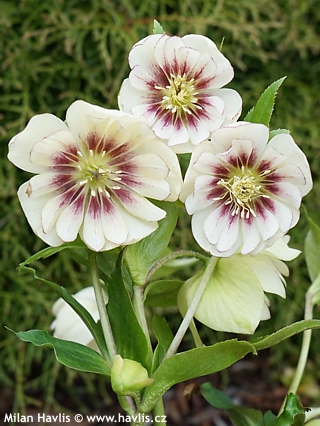
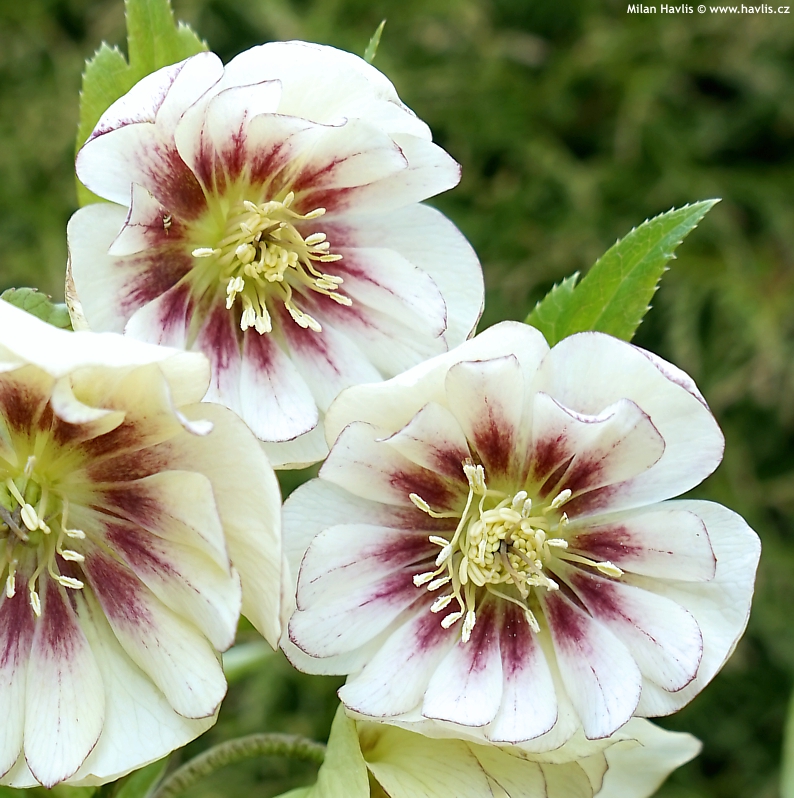
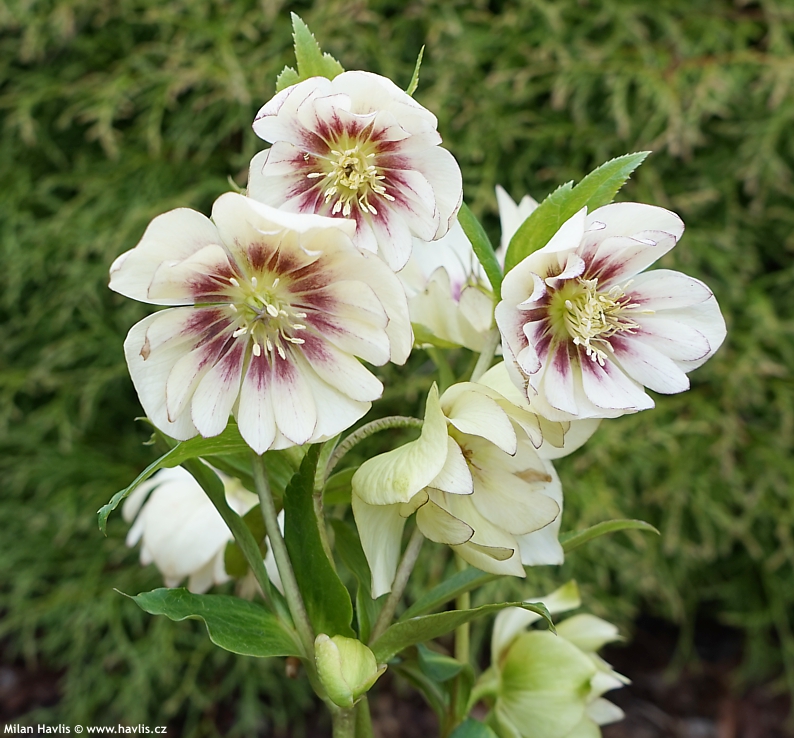
Helleborus orientalis 'WHITE DARK CENTRE' hellebore, Lenten rose

 Symbivit Tric (arbuscular)
 Symbivit (arbuscular)
Helleborus
The genus Helleborus comprises roughly twenty species of perennial plants distributed mainly across Europe and western Asia, especially in the mountainous and sub‑montane regions of the Balkans, the Alps and the Apennines. Direct fossil evidence is lacking, but genetic relationships and present‑day distribution point to a very ancient origin, probably reaching deep into the Tertiary. Hellebores were already known to classical physicians, as shown by the writings of Hippocrates and Pliny the Elder, who used them as drastic medicinal remedies. This is reflected in the Greek etymology of the name, most often interpreted as a combination of helein (to kill) and bora (a deadly food). It refers to the plant’s highly poisonous properties, valued in antiquity as powerful purgatives but easily fatal when used without expertise. The genus received its modern name and place in botany in the mid‑18th century thanks to Carl Linnaeus (1707–1778), who described it in 1753 in Species Plantarum. Hellebores are no novelty in Czech and Slovak gardens either; our grandmothers already enjoyed their flowers in winter and early spring. The only thing that has changed since then are the cultivars and colours, which are ever more numerous and increasingly beautiful. They are evergreen perennials with a remarkably structured flower. The “petals” we see at first glance, white or coloured, are in fact enlarged sepals surrounding a ring of true petals – the corolla segments, usually periwinkle green and occasionally red, which have become tubular and bear the nectaries.
Lenten rose is a south‑eastern European species whose natural range stretches from Greece across the Balkans to northern Turkey and the Caucasus, where it grows in semi‑shaded woodland, scrub and on humus‑rich, calcareous slopes. It was first described in 1789 by the French naturalist Jean‑Baptiste Lamarck (1744–1829), who chose the epithet “orientalis” to distinguish it clearly from the black hellebore (H. niger), another European species whose centre of distribution lies further west, from Switzerland and Germany to Slovenia and Croatia. The eastern hellebore is instead a plant of the Balkans and the Caucasus, forming variable populations with flowers in cream, pink, wine‑red and speckled shades. Its common name Lenten rose refers to the fact that it flowers during Lent, appearing in late winter and early spring when few other perennials are in bloom. Its high frost tolerance is striking and extremely valuable in cultivation: despite originating from regions with milder winters, it reliably withstands temperatures around –34 °C, and growers in Canada report survival down to –37 °C in sheltered sites. This combination of hardiness and natural colour variability made it the foundation of today’s garden hybrids known collectively as Helleborus × hybridus.
White Dark Centre is such a technical name that I suspect this hellebore is simply a selection awaiting its commercial name. And it should receive a beautiful one corresponding to its unique appearance. This is a semi-double hellebore with two sets of flower petals. There are 5 outer large petals just like in every hellebore. But there are also 13 inner petals, finely cut and narrowly spoon-shaped which give the flower a touch of specialty. Their colours is creamy white with a somewhat blurred maroon eye around the centre. Flowers come out according to weather, mostly from February until late April atop 30-35 cm tall, upright stems. Evergreen leaves are leathery, palmate, and deep green and form a compact clump.
Last update 22-03-2022
Eastern hellebore likes heavy, evenly moist, neutral to alkaline, rich in humus soil in dappled shade or filtered sun and will take full shade, too. Fertilizing will increase flowering and help the leaves remain strong and nice throughout the winter. Grow it somewhere near your house entrance or close to the window you look out of frequently so that you can enjoy the plant when it starts flowering since at that time the weather outside is not yet ideal for walking around the garden. The flowers can cheer up a number of grey and gloomy days of late winter therefore thumbs up for hellebore! Harmful if eaten. It copes with harsh conditions and is hardy to at least -34 °C (USDA zone 4), some Canadians growers even confirm they grow them in zone 3 (to -37 °C)