









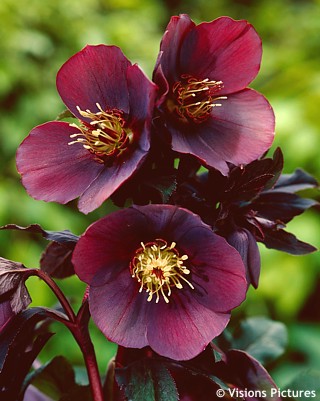
Helleborus 'SP REGINA' hellebore, Lenten rose

 Symbivit Tric (arbuscular)
 Symbivit (arbuscular)
Helleborus
The genus Helleborus comprises roughly twenty species of perennial plants distributed mainly across Europe and western Asia, especially in the mountainous and sub‑montane regions of the Balkans, the Alps and the Apennines. Direct fossil evidence is lacking, but genetic relationships and present‑day distribution point to a very ancient origin, probably reaching deep into the Tertiary. Hellebores were already known to classical physicians, as shown by the writings of Hippocrates and Pliny the Elder, who used them as drastic medicinal remedies. This is reflected in the Greek etymology of the name, most often interpreted as a combination of helein (to kill) and bora (a deadly food). It refers to the plant’s highly poisonous properties, valued in antiquity as powerful purgatives but easily fatal when used without expertise.
The genus received its modern name and place in botany in the mid‑18th century thanks to Carl Linnaeus (1707–1778), who described it in 1753 in Species Plantarum. Hellebores are no novelty in Czech and Slovak gardens either; our grandmothers already enjoyed their flowers in winter and early spring. The only thing that has changed since then are the cultivars and colours, which are ever more numerous and increasingly beautiful. They are evergreen perennials with a remarkably structured flower. The “petals” we see at first glance, white or coloured, are in fact enlarged sepals surrounding a ring of true petals – the corolla segments, usually periwinkle green and occasionally red, which have become tubular and bear the nectaries.
Hybrid hellebores now form a large and important group of these evergreen perennials, as they combine characteristics that no single species could provide on its own. One advantage is that hellebores are naturally highly variable, which is why the gradual crossing of several species has proved so successful. The foundation of most modern cultivars is Helleborus orientalis from Turkey and the Caucasus, valued for its remarkable diversity of flower colours and forms. Early winter flowering came from Christmas rose (H. niger) of the Alps and northern Balkans, while fragrant hellebore (H. odorus) from the Balkans contributed vigour, resilience and yellowish tones. Purple hellebore (H. purpurascens) from Romania and neighbouring regions enriched the range with purple shades and early flowering. Several lesser-known species also played their part. The Dalmatian hellebore (H. multifidus) from Croatia and Bosnia contributed finely divided foliage, Corsican hellebore (H. argutifolius) from Corsica added robust growth and bold evergreen leaves, while Mallorcan hellebore (H. lividus) brought marbled foliage and pink-flushed stems.
Important contributions to the breeding of modern hellebores were made by Helen Ballard (1908–1995), Eric Smith (1926–2018), David Hovland and Georgina Hovland of the Harvington strain, later joined by the German Heuger nursery and a number of contemporary European breeders responsible for many of today's double-flowered, anemone-flowered and unusually coloured cultivars.
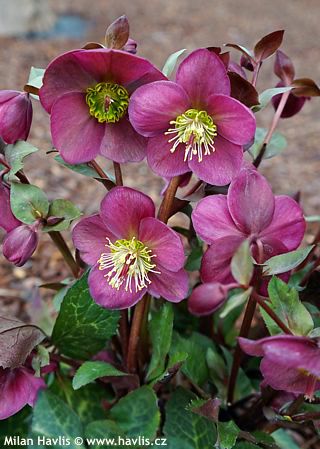
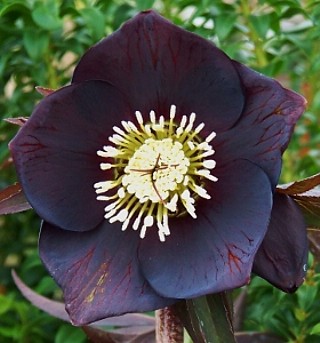
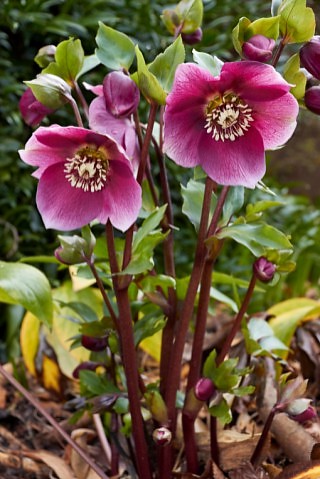
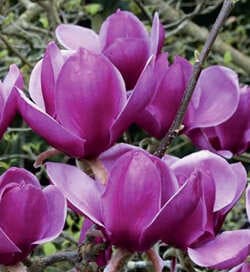
Regina is another Lenten rose variety with very dark flowers. It is from Spring Promise® series and makes medium large, 4-5 cm across flowers from January for about 3-4 months. The center of the flower is decorated with creamy yellowish stamens. Stems are strong and upright, 35-40 cm tall. Leaves are leathery, deep green, palmately divided into 5 leaflets.
These hellebores from the Spring Promise (SP) series have been bred by the German company Heuger since the mid‑20th century. Their modern series includes the most successful cultivars bred to date, in a wide range of colors and flower types.
Hellebore likes heavy, evenly moist, neutral to alkaline, rich in humus soil in dappled shade or filtered sun. This hybrid will prefer at least half a day with direct sunlight. Fertilizing will increase flowering and help the leaves remain strong and nice throughout the winter. Grow it somewhere near your house entrance or close to the window you look out of frequently so that you can enjoy the plant when it starts flowering since at that time the weather outside is not yet ideal for walking around the garden. The flowers can cheer up a number of grey and dull days of late winter therefore thumbs up for hellebore! Hardy to min. -29°C (USDA zone 5).
Last update 30-11-2016
Most hybrid hellebores share similar growing requirements. Any exceptions, such as differences in hardiness or site preferences, are always mentioned in the description of the individual cultivar. Hybrid hellebores perform best in partial shade or dappled light beneath deciduous trees and shrubs. The soil should be humus-rich, fertile, well-drained, yet not prone to drying out. They prefer neutral to alkaline conditions and dislike the acidic soils typically used for heathers and rhododendrons, including pure peat. They generally perform far better in heavier soils containing some clay. Once established, they tolerate short periods of drought reasonably well, but they look their best in soil that retains moderate moisture throughout most of the year. Prolonged waterlogging and sites exposed to intense year-round sun are best avoided.
Hellebores are long-lived plants and dislike frequent transplanting, so it pays to choose their position carefully from the outset. In spring, they appreciate an application of compost or a slow-release organic fertiliser. Older leaves can be removed in late winter or just before flowering, particularly if they are damaged, flattened or affected by disease. Fresh foliage usually emerges shortly after flowering. Most hybrid hellebores are fully hardy in our conditions to approximately –27 to –29 °C (USDA zone 5) and require no winter protection. Many cultivars also self-seed readily over time, producing interesting and often surprisingly different offspring in the garden. All parts of the plant are poisonous, though fortunately hellebores produce nothing particularly tempting to eat.