.jpg)
Heuchera 'SNOWY PANKY' coral bells

 Symbivit Tric (arbuscular)
 Symbivit (arbuscular)
Heuchera
Heucheras – coral bells are undemanding yet striking perennials that have gained popularity thanks to their beautiful foliage and delicate flowers, sometimes appearing in rich inflorescences. They form dense clumps of leaves with a breathtaking range of colours. The genus was named after Johann Heinrich von Heucher (1677–1746), a German physician and professor. It includes around forty species of perennial plants, mostly native to North America, except for H. sichotensis from the Russian Far East. To Europe, heucheras were introduced in the 18th century. their classification can be quite challenging as in the wild, these plants often crossbreed, and their flowers change shape significantly as they mature. That’s why so many breeders are drawn to them – their variable gene pool invites experimentation, and the thrill of discovering something new at the end of a breeding attempt is simply irresistible 😊.
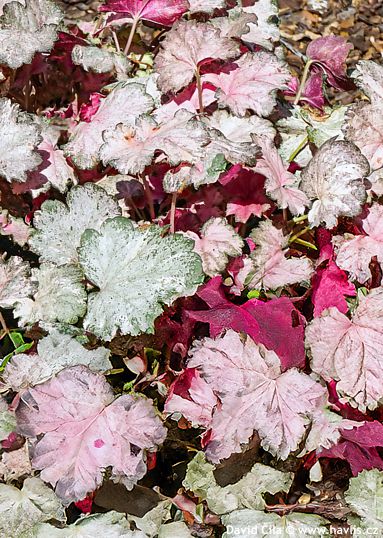
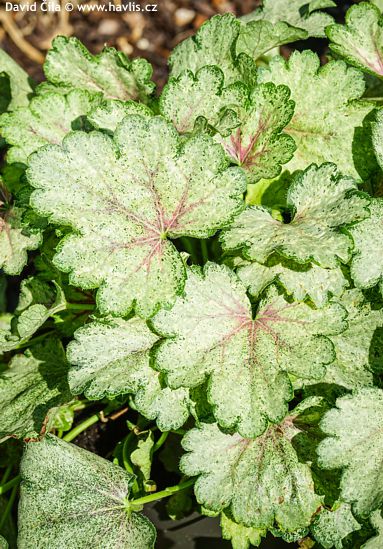
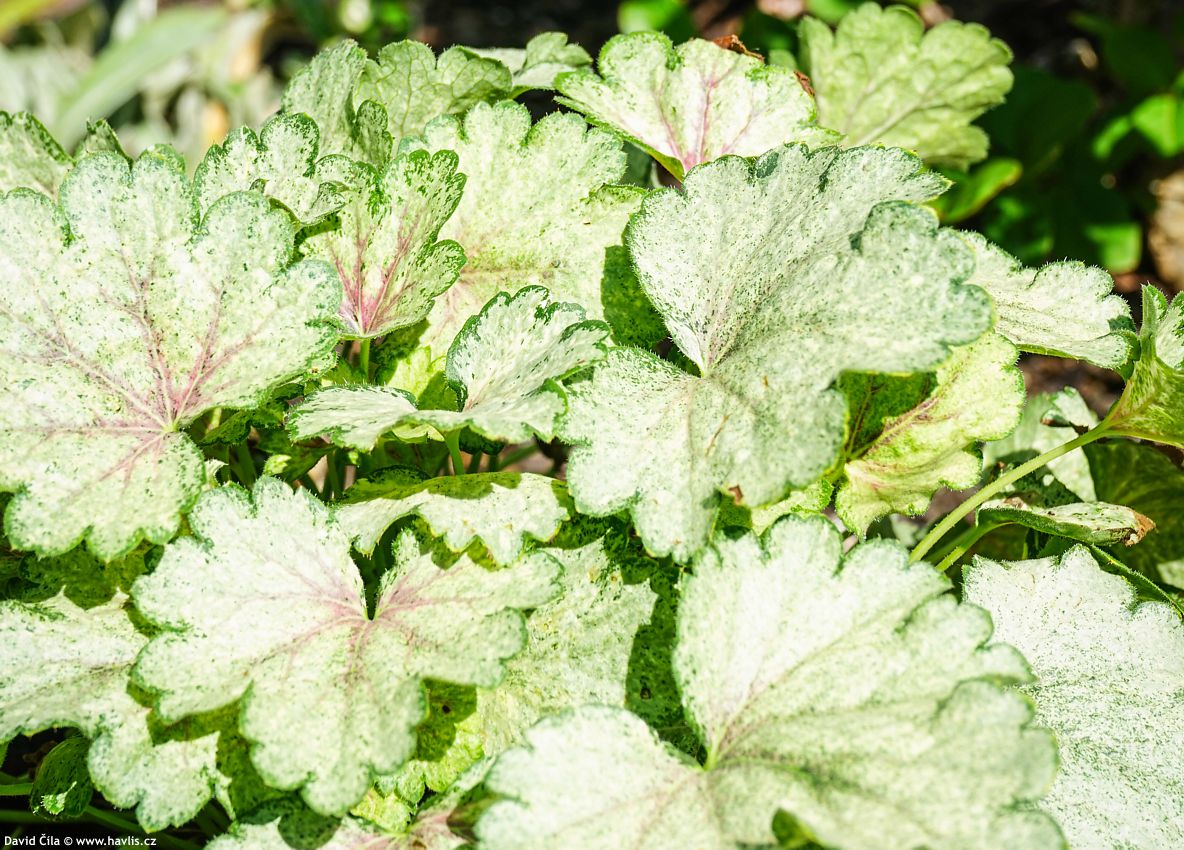
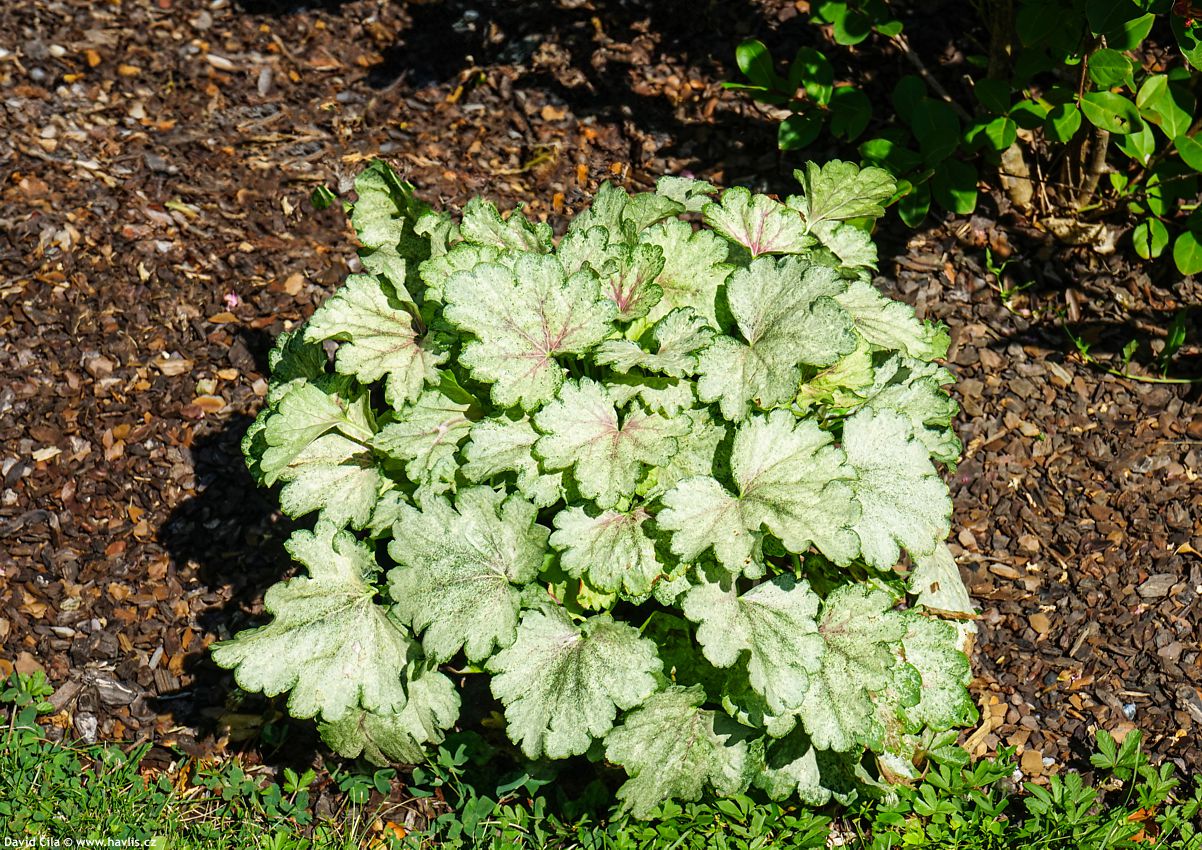
Over the past decades, we have grown accustomed to colour explosions and dramatic contrasts in coral bells – effects for which even Shakespeare might have been grateful – but Snowy Panky works with a different kind of storytelling. Its strength lies neither in darkness nor in saturation, but in the cool, luminous patterning of its foliage. The leaf is based on a very pale, silvery‑white background, into which delicate marbling in fresh green tones irregularly seeps, concentrated primarily along sharply defined veins flushed with purplish pink. The leaf surface appears clean and almost fragile, as if dusted with fine snow, yet it retains firmness and structural integrity. The pattern is neither uniform nor stable – it shifts with temperature, light intensity, and leaf age, ensuring the plant never appears flat or static. Snowy Panky forms a compact clump of low to medium stature with a regular, well‑balanced habit. The leaves are medium‑sized, firm, shallowly lobed, and arranged in a calm, orderly rosette. They are not evergreen and die back before winter.
Unlike many foliage‑focused coral bells, flowering is a highly significant visual feature of Snowy Panky. In late June and early July, it produces abundant, upright inflorescences bearing numerous small flowers in vivid shades of pink to deep rose‑red, creating a striking and lively contrast above the pale foliage. The flowers are not merely an accessory but an integral part of the plant’s overall expression, significantly extending its ornamental season.
The cultivar was selected in 2017 by French breeder Diederik Alexander Maria Scheys. Snowy Panky belongs to an authorial line focused on marbled foliage with high pattern stability. Since 2024, it has been protected by U.S. Plant Patent US PP36245 and European Plant Breeders’ Rights PBR EU 61425. In the garden, it performs best in partial shade, where both its pale foliage and contrasting flowers can fully stand out. It combines particularly well with dark‑leaved coral bells, delicate ferns, silvery sedges, or the calm green masses of Liriope. In such compositions, it acts as a welcome source of light, brightening the planting without disturbing the balance or tranquillity of the whole.
Coral bells are hardy and mostly evergreen perennials, mainly used as ground covers, however, they are excellent companions to plants with other textures, especially when mass planted. They prefer lightly shaded locations and evenly moist, nutrient-rich soil—soil pH does not matter. With occasional watering, they can tolerate full sun, except for light-colored varieties, unless specifically bred for sun exposure. They can even grow in shade, though their colors will be less vivid. In early spring, simply trim all leaves, allowing fresh new foliage to emerge. Fertilization is not required but significantly enhances their appearance and vigour. They are hardy to approximately -34 °C (USDA zone 4) and can be grown in outdoor containers as well.
Last update 15-02-2026
Coral bells are hardy and mostly evergreen perennials, mainly used as ground covers, however, they are excellent companions to plants with other textures, especially when mass planted. They prefer lightly shaded locations and evenly moist, nutrient-rich soil—soil pH does not matter. With occasional watering, they can tolerate full sun, except for light-colored varieties, unless specifically bred for sun exposure. They can even grow in shade, though their colors will be less vivid. In early spring, simply trim all leaves, allowing fresh new foliage to emerge. Fertilization is not required but significantly enhances their appearance and vigour. They are hardy to approximately -34 °C (USDA zone 4) and can be grown in outdoor containers as well