

































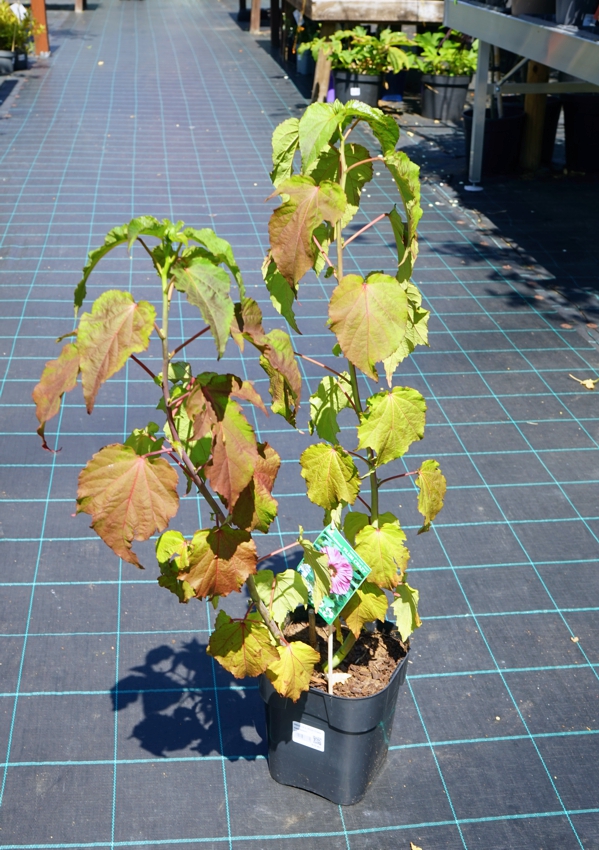
Hibiscus × 'PLUM CRAZY' swamp mallow, hardy hibiscus

 Symbivit Tric (arbuscular)
 Symbivit (arbuscular)
Hibiscus
The genus Hibiscus includes more than 300 species of mallows distributed from East Asia (e.g. H. syriacus and H. rosa‑sinensis) through tropical Africa (H. sabdariffa) to North America (H. moscheutos, H. coccineus, H. laevis). It comprises woody shrubs, subtropical bushes and robust herbaceous perennials, and grows in very different habitats: wetland species occupy coastal lagoons, river deltas and marshes, while others come from dry savannas or warm scrublands. This ecological breadth is reflected in their morphology and requirements, from water‑loving marsh hibiscus to species that tolerate drought and poor soils. Historically, hibiscus appears in the writings of ancient authors, in medieval herbals and in early botanical illustrations of the seventeenth and eighteenth centuries. European naturalists began to describe the genus systematically during the era of overseas expeditions, and Carl Linnaeus included Hibiscus in his Species Plantarum in 1753. The genus is characterised by its prominent flowers, rapid growth and ability to adapt to different climates, which makes hibiscus one of the most rewarding ornamental plants across continents.
Hibiscus moscheutos, the North American swamp mallow from wetlands stretching from Ontario to Texas, is a herbaceous (non-woody) species that entered European awareness even before Linnaeus formally described it in 1753. The finest evidence is Mark Catesby’s 1731 illustration, the first preserved European depiction of the plant, created in the swamps of Virginia and the Carolinas. Catesby drew a flower so large that he had to place it on a separate sheet. A few decades later, John Bartram (1699–1777) began sending seeds and living plants to England, turning a marsh species into a horticultural curiosity, a plant that looked tropical but tolerated frost. In nature it grows in shallow lagoons, seasonally flooded meadows and the edges of swamps, where it forms large but non‑invasive clumps rooted in heavy, moist soil. It also had practical value for local communities, for example the Shinnecock used it as a diuretic. In European gardens it became a valued perennial because it combines North American wildness with cultivated elegance, which makes it one of the most impressive summer plants of the temperate zone.
American breeders of the 20th century discovered that swamp mallow crosses readily with other attractive species such as H. laevis, H. coccineus, H. palustris and H. militaris. The first breakthrough came in 1950 when Robert Darby of Maryland introduced his hybrid ‘Lord Baltimore’, followed five years later by ‘Lady Baltimore’. These were the first swamp mallow cultivars with pure red flowers and finer foliage, and their success and national pride earned them the popular name “American hibiscus”. A true revolution came with the Fleming brothers of Nebraska, who worked on hybridisation for four decades and gradually selected plants with dark copper to purple foliage, compact growth and hardiness down to -34 °C, which was unprecedented at the time. Their cultivars such as ‘Kopper King’, ‘Old Yella’ and ‘Plum Crazy’ showed that swamp mallows could be not only rare collectibles but also perfectly garden‑worthy. Their work was followed at the turn of the millennium by several breeding programmes, including the modern Texas A&M AgriLife programme, which produced the first hardy cultivar with a bluish tint similar to that seen in H. syriacus, named ‘Blue Angel’. Today, hybrid swamp mallow is available in a wide range of flower and foliage colours, and new cultivars continue to appear not only for their beauty but also because they have proved in practice to be less demanding for water or wet soil than the original species and grow reliably in ordinary garden soil even under scorching sun.
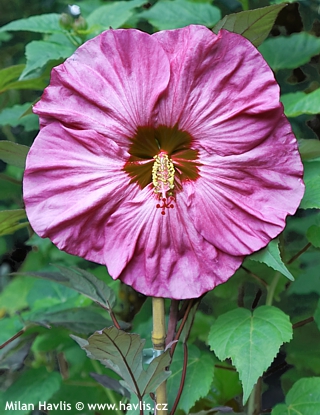
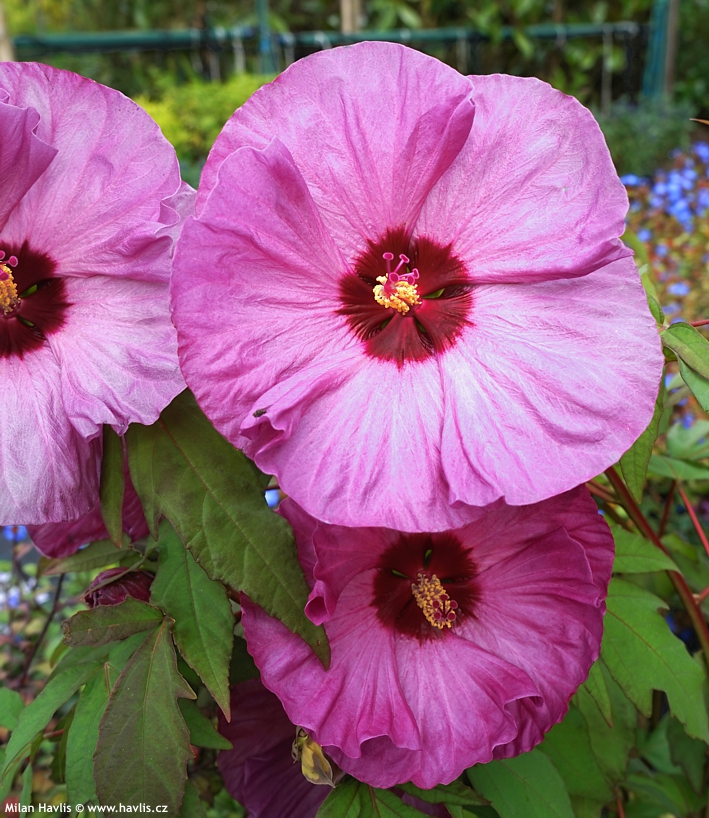
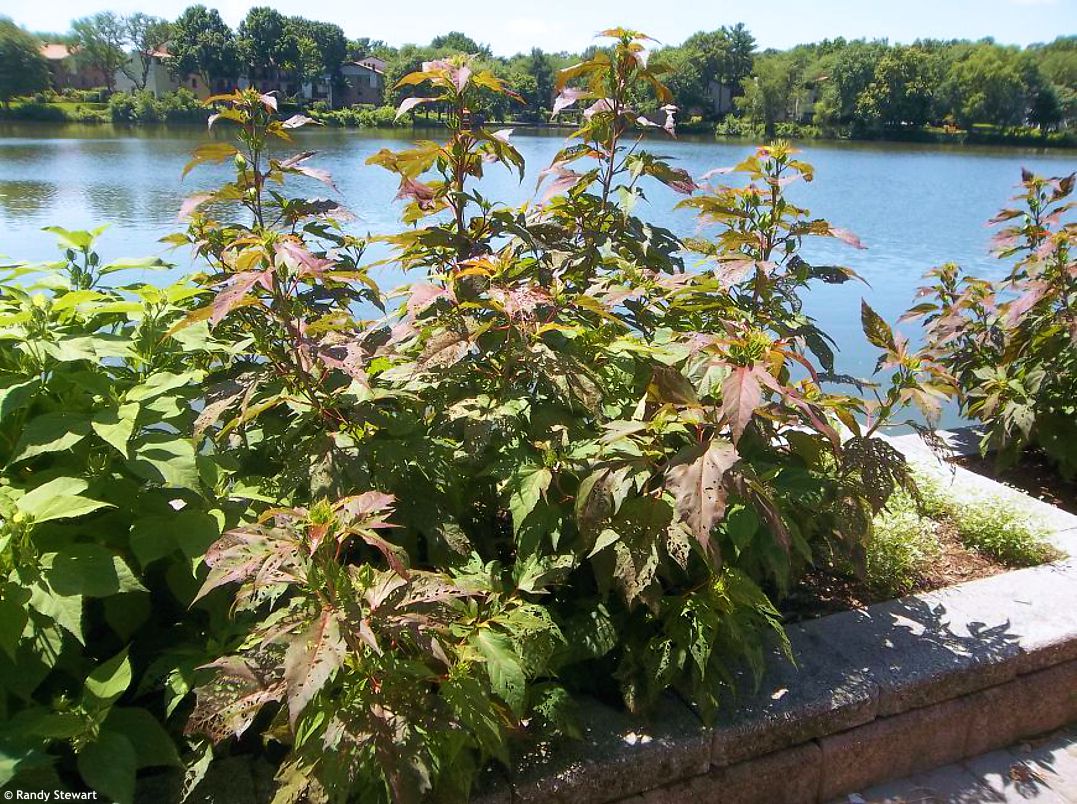
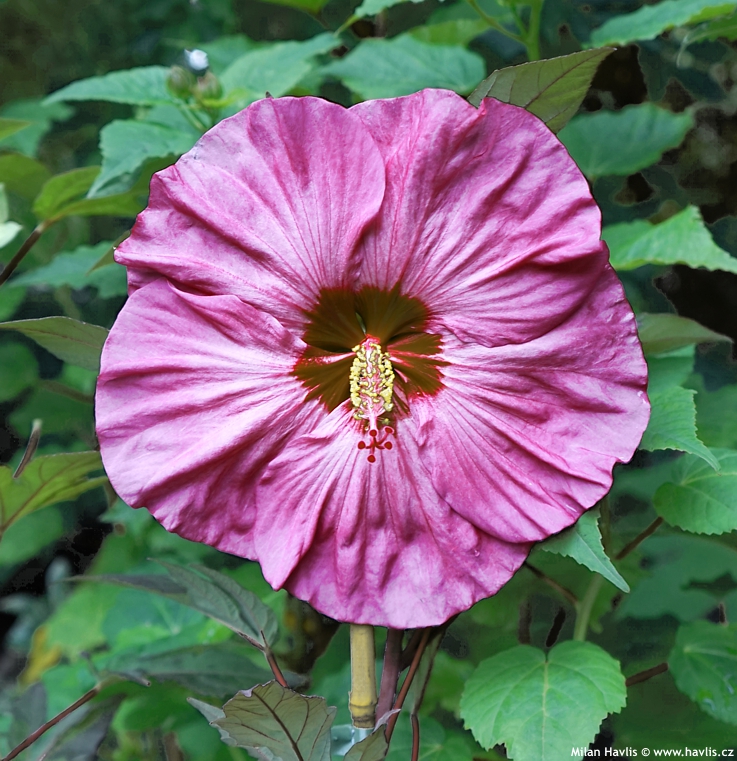
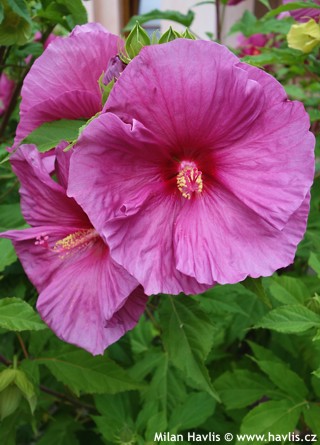
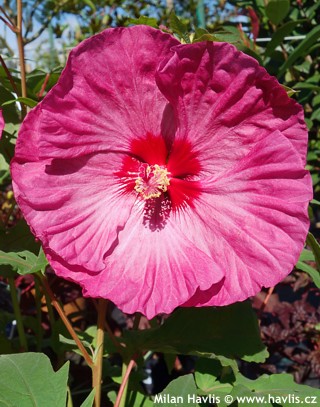
Plum Crazy is a compact hybrid swamp mallow from Nebraska created by David Fleming and Gretchen Zwetzig as part of their forty‑year interspecific breeding work, and it is one of their best‑known cultivars. It bears large flowers about eighteen centimetres across in pastel lilac to antique pink shades with a subtle plum tint. The petals have gently ruffled margins and a prominent deep purple to almost black eye reminiscent of ornamental poppies. Flowering begins in August and continues into October as long as the weather remains warm and sunny. The foliage is initially green and deeply lobed, later becoming dark green with a wine‑red sheen, and in late summer it turns golden orange to red. The petioles and upper stem sections carry a purplish wine tone. The plant has a compact habit, forming sturdy, well‑branched clumps that reach around eighty centimetres in height. The cultivar was patented in 2001 under number PP11854 and its hardiness reaches approximately minus thirty‑four degrees Celsius.
Last update: 28-09-2022; 31-08-2026
Swamp mallow and its hybrids are surprisingly undemanding and long‑lived perennials that require only a few fundamental steps to produce huge flowers every summer. They thrive best in full sun or light partial shade for only part of the day. Not all parent species of the hybrids come from wetlands, so permanently waterlogged soil is not necessary and could even pose a winter risk in our climate. However, during the growing season they tolerate occasional flooding and heavy clay soil, and their roots cope well with it. They grow reliably in ordinary garden soil with occasional watering during dry periods and prefer neutral to slightly acidic pH. Strongly calcareous alkaline soil does not suit them. Fertilising is not essential, but as perennials they respond quickly and positively with vigorous growth, branching and richer bud formation. Mulching helps retain moisture and keeps the roots cooler but is not essential. Some cultivars benefit from winter cover of the stem base. During extremely dry winters it can help to water the dormant clump once a month during frost‑free periods.
Care is straightforward. In spring, cut back previous year’s stems to about five centimetres above the ground, as new shoots emerge from their bases. They are among the last perennials to awaken, so do not worry if little is visible yet in May. Once they start growing, they develop rapidly. Tall cultivars may need staking, or you can cut them back by half in mid-June; flowering will be slightly delayed, but the plants will be shorter, sturdier and produce more blooms. During flowering it is useful to remove spent flowers so that fertile cultivars do not waste energy on seed production. All swamp mallows and their hybrids are fully hardy between -24 and -34 °C (USDA zones 4-6) depending on the cultivar. The hardier ones can be grown in outdoor containers where they appreciate more frequent watering and regular feeding.
Goods are shipped all over Europe. For Russia and U.K. and for further details please read about SHIPPING OPTIONS HERE.
Are you interested in a serious discount for orders NOV-FEB? Check your options here.
THE PRICES INCLUDE VAT of 15%. For quick conversion you can use 1 CZK = approx. 0.04 EUR
- STANDARD QUALITY - Plants of this group are 1st class quality with number of branches and overall density adequate to their size and age, considering they were container grown.
- DE LUXE QUALITY - This label guarantees a luxurious quality of manually selected plants that, compared to their height and age, are exceptionally dense and beautiful.
- EXTRA - These plants are usually mature and bigger specimens with exceptional overall appearance.
- STANDARD (as described in the plant form) means a tree with a trunk of 190-210 cm and a crown at the top, unless specified differently. The commercial size for trees is their girth measured in the height of 1m from ground.
- HOBBY - These plants are of the same quality as our standard-quality plants but younger and therefore cheaper.
- SHRUB - a woody plant with branches growing bushy from the ground level.
- HALF-STANDARD or MINI-STANDARD - a small tree with shorter trunk, its size is usually specified.
- FEATHERED - These are trees with branches growing already from the base of the trunk and up along the stem.
- GRASSES and PERENNIALS - Sizes given usually read the diameter of the pot or the clump, as specified.
