
















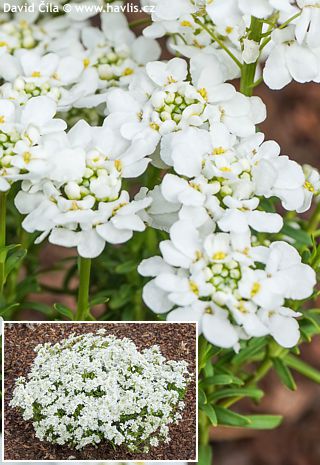
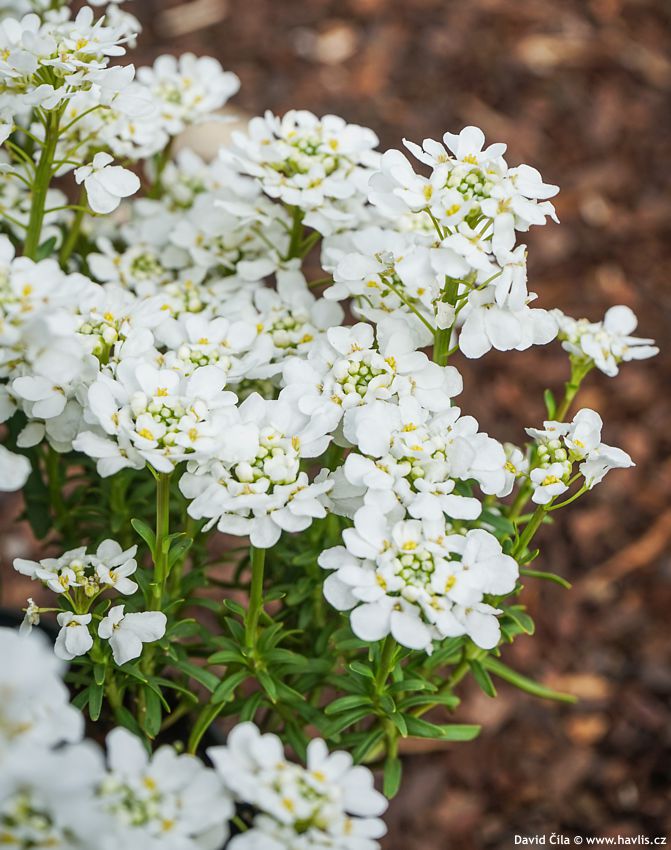
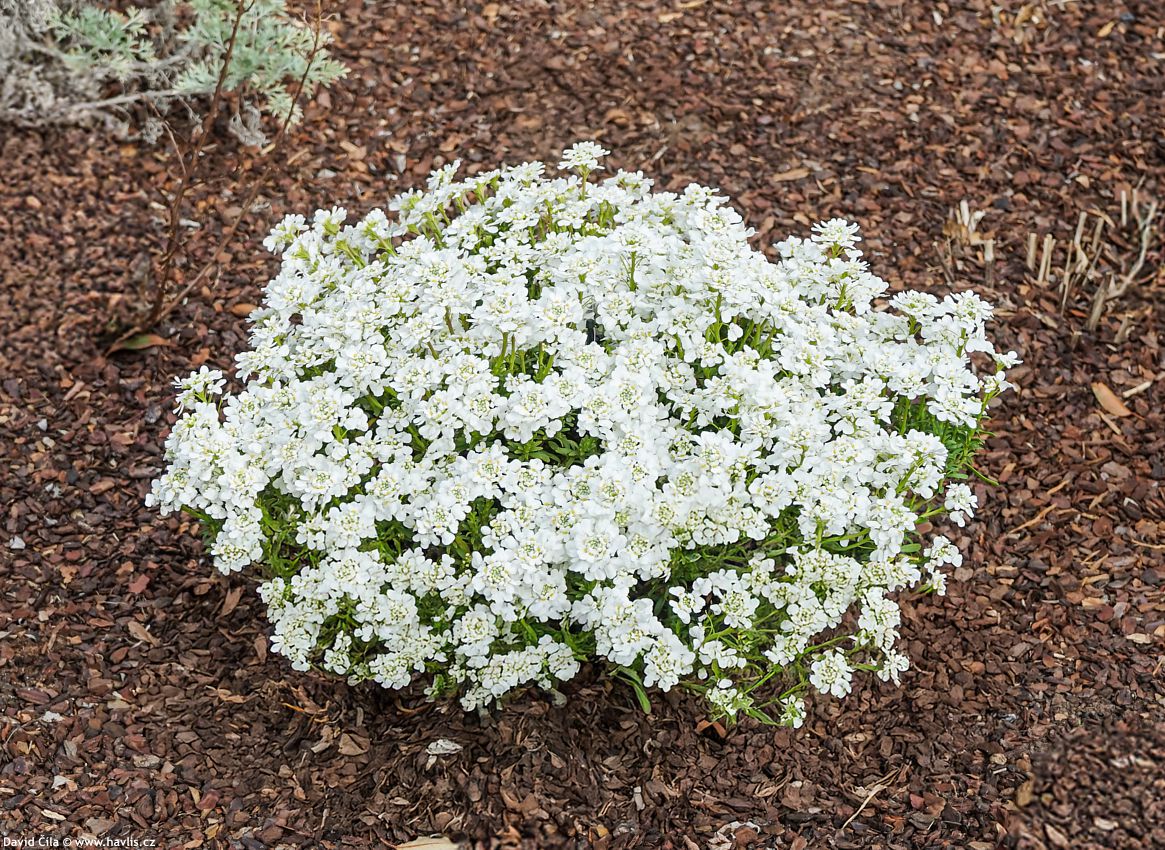
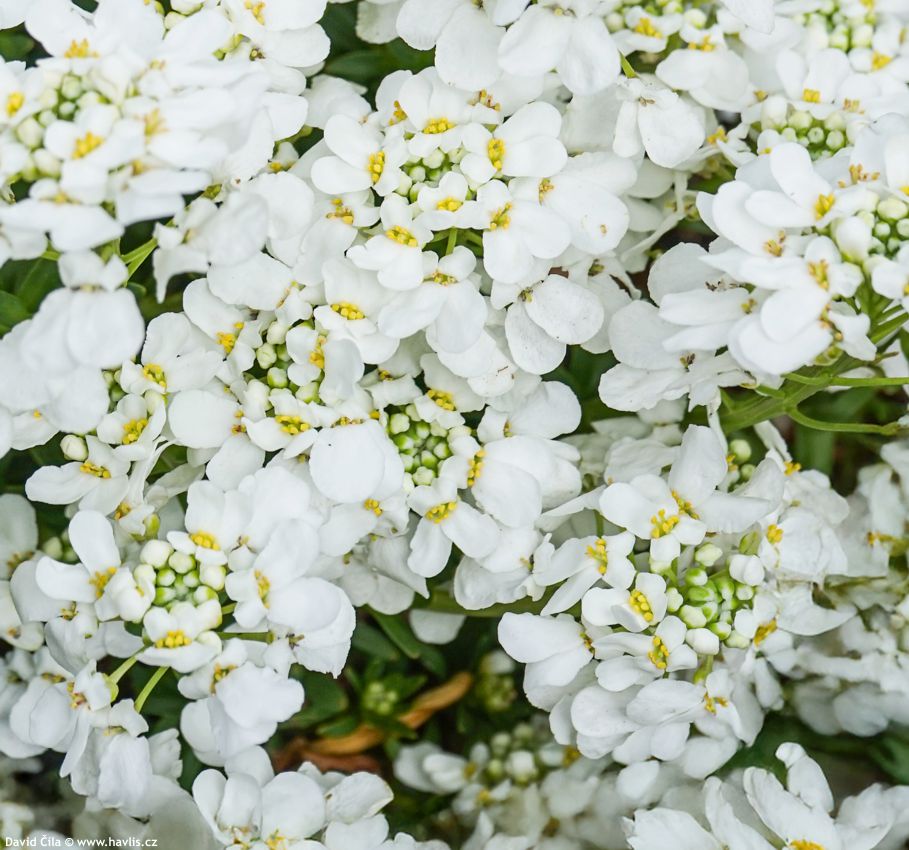
Iberis sempervirens 'IBSZ0002' SNOWSURFER™ FORTE candytuft

 Symbivit Tric (arbuscular)
 Symbivit (arbuscular)
Iberis
The genus Iberis belongs to the mustard family and comprises roughly thirty related species united by the clear legacy of Mediterranean rocky slopes and a set of shared traits: four‑petalled flowers, dry siliques and a tendency towards low, spreading growth. Even so, there are striking differences among them. Perhaps the best‑known, Iberis sempervirens, is a typical evergreen cushion plant that forms continuous white carpets in spring; Iberis saxatilis is a rock‑hugging, even lower species that clings tightly to stone and excels in gravel gardens; Iberis umbellata, often grown as an annual, has more upright stems and a wider range of flower colours; Iberis amara, known as bitter candytuft, is annual or biennial and biologically notable for its asymmetric petals (two are markedly larger), a feature frequently used in genetic studies; and several local endemics, especially those in mountain enclaves, are adapted to very specific substrates. All share a preference for sun, well‑drained, often calcareous soils and the ability to form dense mats that in the wild often resist herbivory thanks to the bitter, pungent secondary compounds typical of the mustard family. In early spring, however, their nectar‑rich flowers serve as an abundant resource for many pollinators. The genus Iberis was formally established by Carl Linnaeus (1707–1778) in Species Plantarum (1753), though the name itself comes from classical Latin, where it refers to the Iberian Peninsula.
The species Iberis sempervirens, candytuft, was described by Carl Linnaeus (1707–1778) along with the rest of the genus and later studied by other botanists. In the 18th and 19th centuries it was mapped and documented in detail by figures such as Carlo Allioni (1728–1804) and Pierre Edmond Boissier (1810–1885), who recorded local variants and its distribution across the Mediterranean. In the 20th and 21st centuries, modern taxonomists and institutions such as the Royal Botanic Gardens, Kew (Plants of the World Online), Flora Europaea and horticultural organisations (RHS) have used contemporary laboratory methods to consolidate and standardise the current understanding of the genus and its species. Iberis sempervirens is native to the Mediterranean region – the Pyrenees, southern Europe, Turkey and north‑western Africa – where it forms low cushions on dry, calcareous slopes. This ability to thrive in rather inhospitable places made it an ideal candidate for breeding efforts aimed at creating attractive perennials capable of coping with similar conditions in gardens. Many cultivars have been developed; by the end of 2025, the register of recognised cultivars already lists more than fifty entries, differing from one another and from the botanical species in flower size, colour, flowering duration and growth habit.
In 2008 Dutch breeder Henricus Stemkens began a project of crossbreeding candytuft with the aim of developing new varieties of remarkable qualities. He named his series SNOWSURFER™, and in 2016, introduced his second creation called SNOWSURFER™ FORTE. This variety is vigorously growing, producing large inflorescences early in the season of spring Iberis. The inflorescences are 5–7 cm wide and composed of snow-white flowers that bloom as early as the end of April.
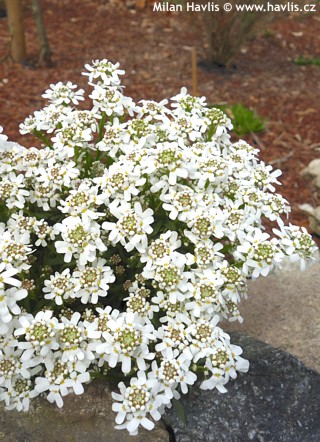
The leaves are small, evergreen, deep green, and the plant is well-branched, making dense clumps despite its vigorous growth. It forms a low, mounding habit, and after flowering, it is recommended to prune it by half to promote even denser growth and to prevent the formation of empty patches with strong, leafless, semi-woody stems. The variety is protected by these patents: PP29382 (USA – 2018) and 45499 (EU – 2017).
Last update 18-04-2025
Its requirements and care are straightforward. It needs full sun; otherwise it flowers less and the cushion may loosen. The soil must be well drained, ideally gravelly or sandy, because persistent moisture is the most common cause of failure. Watering is necessary only at planting and for a few weeks afterwards to help it establish, and during prolonged droughts. Feeding is unnecessary; in fact, overly rich soil leads to lusher but less compact growth. Light trimming immediately after flowering helps maintain shape and encourages density. It can be grown in containers if the pot is shallow, wide and very well drained. Wind does not trouble it, but long periods of winter wet do. Candytufts are extremely hardy, tolerating down to −34 °C as long as the soil is not waterlogged.


.jpg)
