













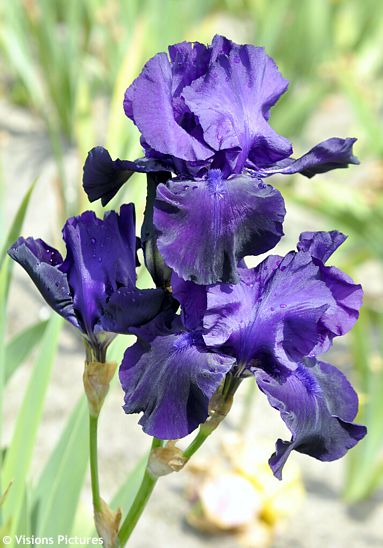
Iris (sk. germanica) 'STORM CENTER' beared iris

 Symbivit Tric (arbuscular)
 Symbivit (arbuscular)
Iris
The genus Iris comprises approximately 300 species distributed mainly throughout the temperate regions of the Northern Hemisphere, from the Pyrenees through the Mediterranean and the Caucasus to the Himalayas, Central Asia, China, and North America. It belongs to the iris family (Iridaceae), making it a close relative of plants familiar to most gardeners from summer borders, including gladioli (Gladiolus) and crocosmias (Crocosmia). The genus takes its name from Iris, the Greek goddess of the rainbow, and few botanical names could be more appropriate. Irises offer an extraordinary range of colours, forms, and survival strategies. Some species inhabit sun-baked rocky slopes of Western Asia, while others grow in permanently damp meadows or along the banks of rivers and streams. They have accompanied humanity for millennia. Their distinctive flowers appear on Minoan frescoes from Knossos dating back more than three and a half thousand years, and some historians and heraldic scholars believe a stylised iris flower may also have influenced the French fleur-de-lis: ⚜. Although the name translates as “lily flower”, the symbol is often associated with the Yellow Flag Iris (Iris pseudacorus), a species once abundant in the marshlands of France and traditionally linked with Frankish kings. No conclusive historical evidence exists, however, and the true origin of this famous emblem remains open to debate. The genus was formally described by Carl Linnaeus in 1753, yet the botanical boundaries of Iris are still not completely settled, and modern genetic research continues.
There are so many irises that finding a single “typical iris” is almost impossible. Among them are species from near-desert regions of the Middle East as well as inhabitants of wetlands, river floodplains, and mountain meadows. The most familiar are the bearded irises centred around Iris × germanica, Iris pallida, and Iris variegata, species native primarily to the Balkans, the northern Mediterranean, and Western Asia. A completely different group is formed by the Siberian irises (Iris sibirica), which occupy moist meadows from Central Europe to Siberia, while Japanese irises (Iris ensata) are closely associated with wetlands and the traditional gardens of East Asia. North American Louisiana irises have adapted to seasonally flooded landscapes along the Gulf Coast, whereas the Yellow Flag Iris (Iris pseudacorus) is inseparable from European marshes and watersides. A separate chapter belongs to the bulb-forming species, such as Iris reticulata and Iris xiphium, which survive periods of drought hidden safely below ground. This remarkable diversity is reflected even in the prestigious Encyclopedia of Garden Plants, where the Royal Horticultural Society devoted almost 11 large-format pages to the genus, a level of coverage reserved for only a select few plant groups of outstanding botanical significance. And from experience, we know it is also a measure of their popularity.
So-called bearded irises rank among the most successful ornamental plants ever cultivated. Although they are often associated with the name Iris × germanica, they have little connection with Germany beyond a long and distinguished horticultural tradition. Their story does not begin with a single species but with a long sequence of hybridisations involving Mediterranean and Middle Eastern irises, most notably I. pallida, I. variegata, I. cypriana, and I. mesopotamica. Similar hybrids were already being grown in European monastery and castle gardens during the Middle Ages, but the true breeding revolution only arrived in the nineteenth century. One of the pivotal figures was the English physiologist and botanist Michael Foster (1836-1907), who was among the first to employ systematic interspecific breeding in pursuit of larger flowers, a broader colour range, and stronger plants. His work was followed by French breeders of the Cayeux family and later by numerous specialists throughout Europe and North America. Within little more than a century, these relatively simple garden irises evolved into the modern Tall Bearded Iris group, comprising tens of thousands of registered cultivars.
Iris cultivar Storm Center dates back to 1979, and it is easy to see why it remains popular today. I would probably describe its most significant asset as purity of colour. Where many dark bearded irises rely on contrast, veining, or dramatic transitions between shades, this cultivar is built around a remarkably uniform deep violet to blue-violet tone that extends across almost the entire flower, including the beard. In iris terminology, it belongs among the so-called self-coloured cultivars, meaning the standards and falls display essentially the same colour. The large blooms have gently ruffled petals with a velvety texture, shifting with the light from dark inky hues to rich royal purple. Plants reach approximately 95 cm in height and carry themselves with a notably calm, almost majestic presence when in flower. In temperate climates, flowering usually begins in the second half of May and continues into the first half of June, although exact timing naturally depends on the progress of spring.
The cultivar was introduced by Schreiner's Gardens in 1979 and received an Honorable Mention from the American Iris Society just two years later. The name Storm Center is highly evocative and, truthfully, somewhat ambiguous. It may refer either to a meteorological centre monitoring storms and other extreme weather events or to the very heart of a storm system itself, often accompanied by skies dramatically coloured in dark shades of blue.
Bearded irises benefit from a certain generosity of space. They are at their best in uncluttered borders, gravel gardens, dry banks, or the front sections of perennial plantings where their rhizomes are not shaded by surrounding vegetation. Thanks to the Mediterranean heritage of their ancestors, they combine beautifully with plants that enjoy similar conditions, including the flower-rich Perovskia, Salvia, Nepeta, and Lavandula. Their sword-like foliage is complemented perfectly by silver-leaved Artemisia, Santolina, and Jacobaea, while Stachys, low-growing Anthemis, or Erigeron make attractive underplantings whose contrasting textures add another layer of interest. On the other hand, if you are looking for a real wow effect, try combining them with Euphorbia or Hebe, whose highly structured, almost stoic yet undeniably majestic appearance provides a striking counterpart. The list of possible companions is, of course, far longer, but when selecting partners always keep in mind the strong foliage and substantial flowers of bearded irises, because when they bloom, they command almost all of the attention. For that reason, planting larger groups of a single cultivar is often more effective than mixing numerous varieties together. In both public and private landscapes, they are particularly valuable for dry sites and areas with limited irrigation, where, once established, they require surprisingly little maintenance.
Last update 04-10-2026
Bearded irises require full sun and well-drained soil that never remains waterlogged for prolonged periods during winter. In fact, winter wet is a far more common cause of failure than summer drought. The rhizomes should remain close to the soil surface and should not be buried beneath mulch or engulfed by neighbouring plants, as they depend on warmth and good air circulation. Over time they gradually spread outward by means of their rhizomes, but they are never invasive or weedy. If a clump becomes too large, surplus rhizomes can be lifted and replanted elsewhere with very little effort. Although modern cultivars are remarkably durable once established, they flower most freely in moderately fertile soils that are not overfed with nitrogen. Older recommendations to bury them within dense perennial plantings are now largely considered outdated, as competition from neighbouring plants steadily reduces both vigour and flowering performance. Growing them in containers is possible, provided the pots are sufficiently deep and exceptionally well drained. The plants are not edible and may cause digestive upset if ingested, while sap from the rhizomes can irritate sensitive skin. Most modern Tall Bearded Irises tolerate winter temperatures down to approximately -40 °C without difficulty.

Goods are shipped all over Europe. For Russia and U.K. and for further details please read about SHIPPING OPTIONS HERE.
Are you interested in a serious discount for orders NOV-FEB? Check your options here.
THE PRICES INCLUDE VAT of 15%. For quick conversion you can use 1 CZK = approx. 0.04 EUR
- STANDARD QUALITY - Plants of this group are 1st class quality with number of branches and overall density adequate to their size and age, considering they were container grown.
- DE LUXE QUALITY - This label guarantees a luxurious quality of manually selected plants that, compared to their height and age, are exceptionally dense and beautiful.
- EXTRA - These plants are usually mature and bigger specimens with exceptional overall appearance.
- STANDARD (as described in the plant form) means a tree with a trunk of 190-210 cm and a crown at the top, unless specified differently. The commercial size for trees is their girth measured in the height of 1m from ground.
- HOBBY - These plants are of the same quality as our standard-quality plants but younger and therefore cheaper.
- SHRUB - a woody plant with branches growing bushy from the ground level.
- HALF-STANDARD or MINI-STANDARD - a small tree with shorter trunk, its size is usually specified.
- FEATHERED - These are trees with branches growing already from the base of the trunk and up along the stem.
- GRASSES and PERENNIALS - Sizes given usually read the diameter of the pot or the clump, as specified.
