










Kniphofia 'LEMON POPSICLE'™ torch lily, red hot poker

 Symbivit Tric (arbuscular)
 Symbivit (arbuscular)
Kniphofia
The story of the genus Kniphofia began long before people realised that the grassy mountains of southern and eastern Africa hide unexpected treasures. The name was first used by the German botanist Conrad Moench in 1794, when he separated the then‑known “tritomas” from Aletris and Veltheimia and dedicated the group to his compatriot Johann Hieronymus Kniphof (1704–1763). The modern, accepted circumscription of the genus, however, comes from Lorenz Oken, who redefined Kniphofia in 1841; his concept is the one used today. Today we know that the genus comprises roughly 70–73 species, all native to Africa, with a single exception in Yemen and a few species on Madagascar. Their home lies mainly in the higher and cooler regions of eastern and southern Africa, where individual species often grow on isolated mountain ridges. This fragmented landscape caused kniphofias to diversify rapidly over time, and some species are so close to one another that botanists still struggle to draw clear boundaries. This history, shaped by glacial cycles, secondary contacts and repeated isolation, explains the taxonomic complexity of the genus, which botanists such as Syd Ramdhani, Nigel P. Barker and Himansu Baijnath have described as a “recent afromontane radiation”. Do you understand any of that? Do not worry – I am not entirely sure they do either 😊 Kniphofias are, in any case, a story of long evolution whose intricate branches are still being unravelled.
Hybrid kniphofias are essentially a gardener’s attempt to reconcile African temperament with the winters of temperate climates. Breeders discovered long ago that if a plant is to survive frost, wet soil and the occasional icy wind, it must have species from higher and colder parts of southern Africa in its lineage. It is precisely in places such as Lesotho, KwaZulu-Natal or the Free State that kniphofias grow in conditions surprisingly similar to those found in temperate gardens. The backbone of most hybrids is K. uvaria, a reliable species from grassy mountain slopes that tolerates cold and winter moisture and passes on steady growth and a willingness to flower. Even more important are K. caulescens and K. brachystachya, both from the cold highlands of Lesotho, where frost is not an exception but a regular visitor. These species give hybrids strength, compact growth and the ability to overwinter in places where most African plants would not even attempt to root. Occasionally K. foliosa from the Ethiopian highlands is added, lending hybrids a gentler appearance and abundant nectar while still maintaining good hardiness. In contrast, species from warmer and wetter regions, such as K. laxiflora or the impressive but winter‑tender K. northiae, are rarely used in hybrids for temperate climates – their sensitivity to winter wet would weaken the resulting plants. Modern hybrids are therefore a carefully assembled blend of high‑altitude genes that evolved in Africa over thousands of years, and it is precisely thanks to them that kniphofias now thrive in places their wild ancestors would never have imagined.
The English common name of Kniphofia has travelled a surprisingly lively path. The earliest name, “red-hot poker”, appeared in the 19th century and captured the plant’s dramatic flower spikes that look as if someone had plunged a glowing iron into the border. Soon after came “torch lily”, a gentler and more botanical term that emphasised the torch-like inflorescences while hinting at the plant’s place among monocots. In some regions “tritoma” survived well into the 20th century, inherited from older botanical classifications before Moench separated the genus. Today “red-hot poker” remains the most widespread name, partly because it conveys the plant’s character in a single glance, while “torch lily” persists in more formal horticultural writing.
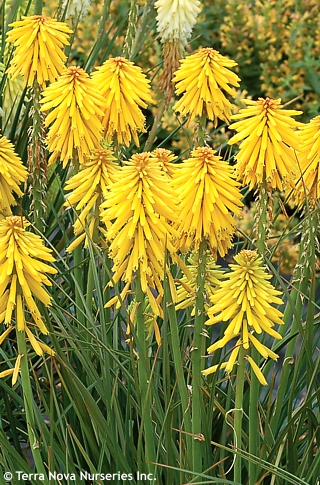
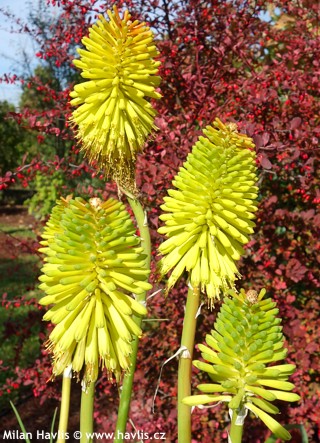
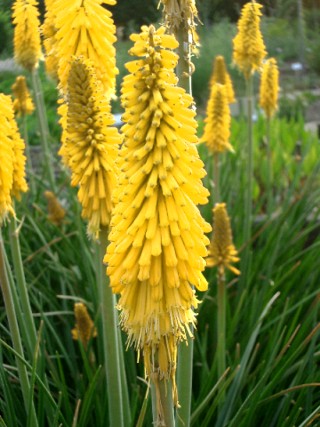
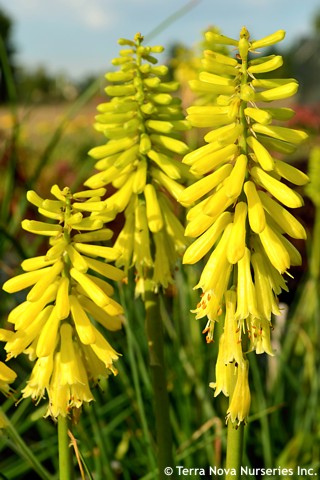
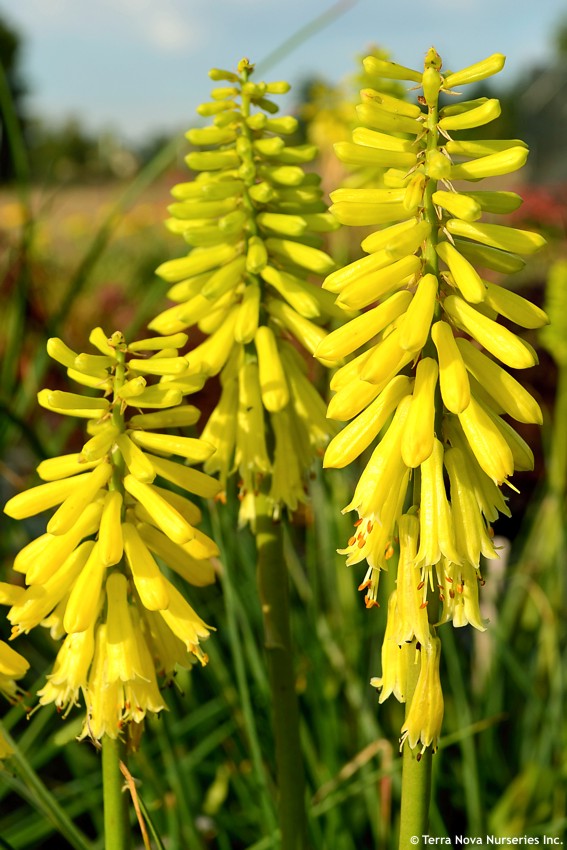
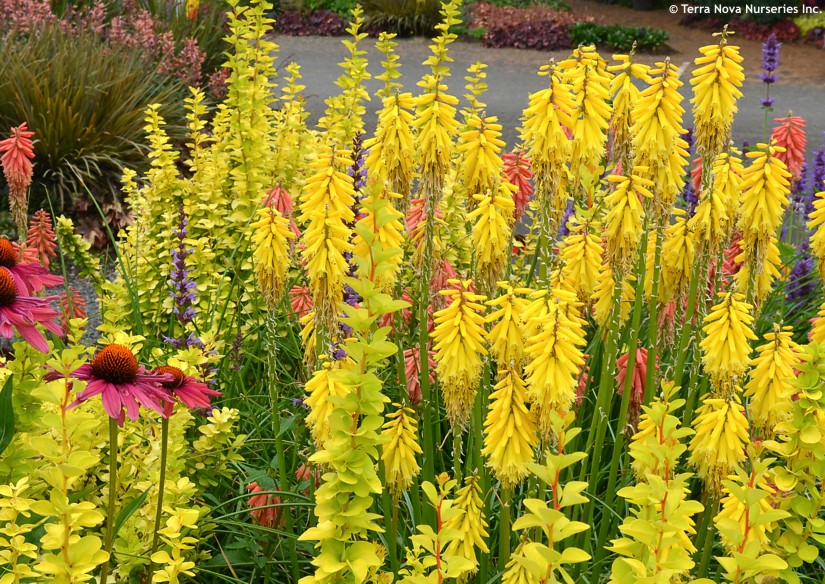
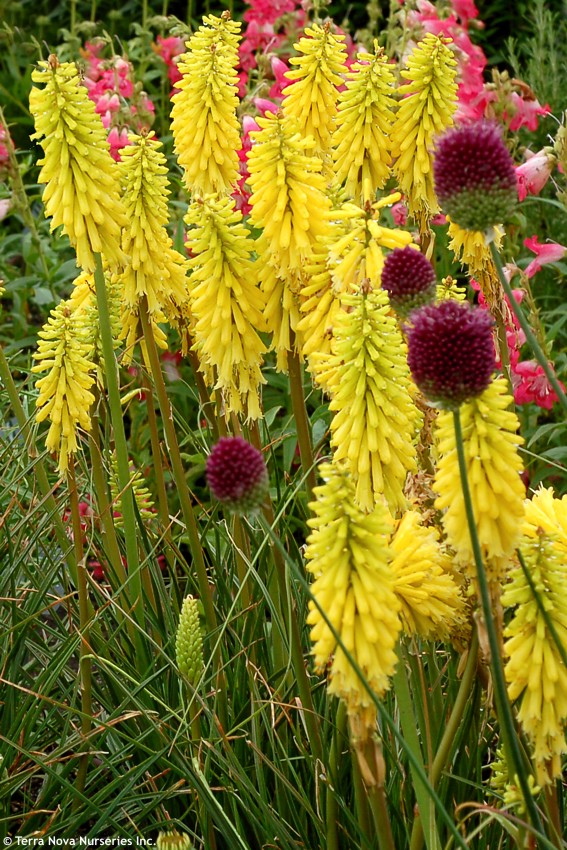
Lemon Popsicle™ is a torch lily with rich lemon yellow flowers opening from green buds. Its spike-like inflorescence appear atop strong, smooth stems from mid July. Under ideal growing conditions and in fertile soil it will flower continuously until September. Commonly it flowers for about 6 weeks and then repeats flowering in a weaker flush from early September. Semi-deciduous leaves are linear, narrow, dark green, and look like day-lily leaves but are firmer and more erect. Flowering stems are strong and do not bend in wind or rain.
Popsicle™ is a torch lily series bred by Janet N. Egger from Terra Nova Nursery in the USA. In spite of its name we don’t suggest eating the flowers or storing them in a freezer :-) Popsicle™ series comprises of several torch lily varieties of various flower colours or combinations. Most importantly, they are popular for their increased hardiness and tolerance to heavier soil. Both these advantages are very beneficial for Czech and Slovak conditions which is why we recommend Popsicles™ over any other cultivar. Hardy to min. -27 °C (USDA zone 5b).
Last update 04-12-2017
Hybrid kniphofias are easy-going plants once we understand their origins: most of them have high‑altitude species in their lineage, adapted to cold but perfectly drained soils. They therefore need a sunny position and ground that never holds standing water. In heavy clay it is essential to improve drainage or raise the planting slightly, otherwise the plant is more likely to die from winter wet than from frost. They enjoy moisture only in summer, when they grow and form their flower spikes; in winter it is better if the soil dries out quickly. Feeding should be moderate, once or twice a season, ideally with a fertiliser low in nitrogen so the plant does not produce overly soft foliage. They do not require pruning, only the removal of last year’s leaves in spring, which protect the crown through winter, and spent flower stems cut back to the base during the flowering season. Growing in containers is possible, but only in large pots with excellent drainage and winter shelter under a roof, because the combination of frost and wet compost is the worst scenario for kniphofias.
Cold hardiness varies significantly depending on the parentage of each hybrid. Traditional lines based on K. uvaria and K. caulescens tolerate around –20 to –24 °C, sometimes slightly more if kept in dry soil. Hybrids with K. brachystachya in their background tend to be even tougher, as this species comes from the coldest highlands of Lesotho. Modern breeding has pushed the limits much further: complex high‑altitude hybrid lines, including those inspired by American series such as Popsicle, withstand temperatures down to –30 °C, making them among the hardiest kniphofias available. Provided they have full sun, dry winters and enough space for the clump to expand, they reward the gardener with taller and fuller flower spikes every year and prove to be surprisingly long-lived perennials.