












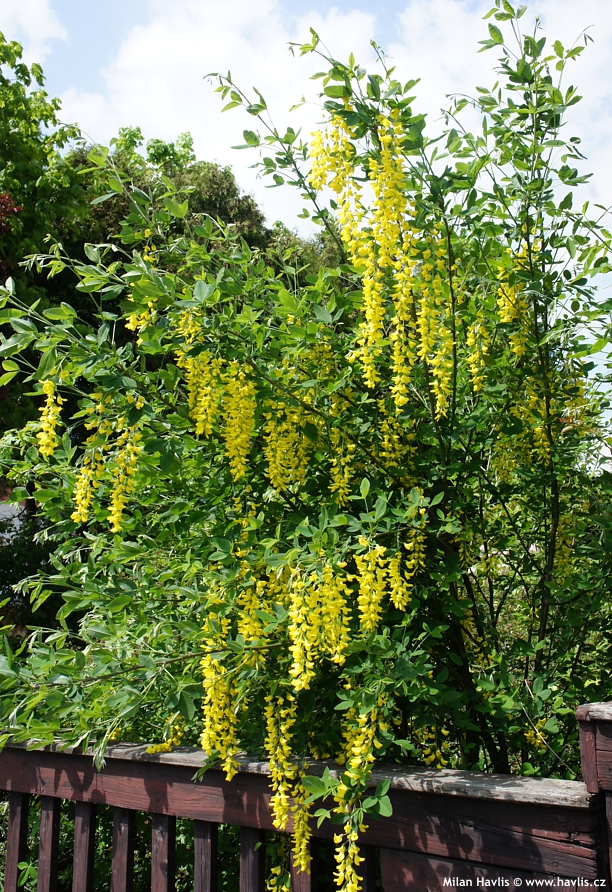
Laburnum × watereri 'VOSSII' golden rain, golden chain tree

 Symbivit Tric (arbuscular)
 Symbivit (arbuscular)
Laburnum
The genus Laburnum comprises a small group of European trees and shrubs found mainly in central and southern Europe on rocky, sunny slopes and in open mountain woodlands. It contains only a few species, which is unusual within the pea family, and fossil evidence is scarce, suggesting that the genus evolved in relatively stable, isolated regions. In English, Laburnum is commonly known as golden rain, a name that can be confusing because the similar‑sounding goldenrain tree refers to a completely different species, Koelreuteria paniculata. The history of Laburnum taxonomy is marked by minor disputes, as the two principal species are very similar and their diagnostic features overlap, which led to uncertainty in identification during the 18th and 19th centuries. Early botanical descriptions arose at a time when European botany was still being unified, and different authors disagreed on which characters should be considered decisive. This ambiguity later created the conditions for recognising hybrid plants occurring naturally in regions where the two species overlap.
The hybrid species Laburnum × watereri originated through natural crossing between the alpine laburnum and the common laburnum in areas where the two species meet, particularly in southern Switzerland and northern Italy. It was first described by the German botanist Leopold Dippel (1827–1914) in 1893, after he noticed plants showing traits of both parents and producing unusually long racemes. The hybrid quickly became popular because it combines the airy crown, strong branches and abundant flowering that surpasses both parent species. Laburnums have long been associated with spring celebrations in Europe; their pendulous yellow racemes resemble garlands or strings of beads and were often planted near houses as symbols of abundance. In Britain, the hybrid became the foundation of the famous laburnum tunnels that still attract visitors to botanical gardens. Laburnum × watereri is also valued for producing fewer pods than the pure species, reducing the risk of contact with poisonous seeds and making it suitable for gardens frequented by children or pets. It is sometimes mistakenly taken for a yellow‑flowered wisteria because of the similar pendulous racemes.
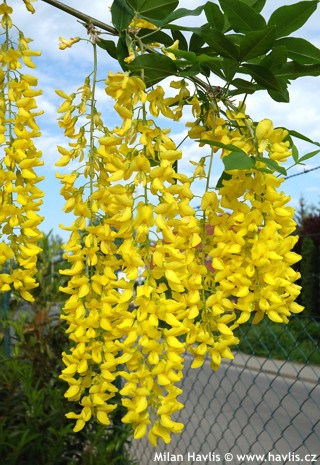
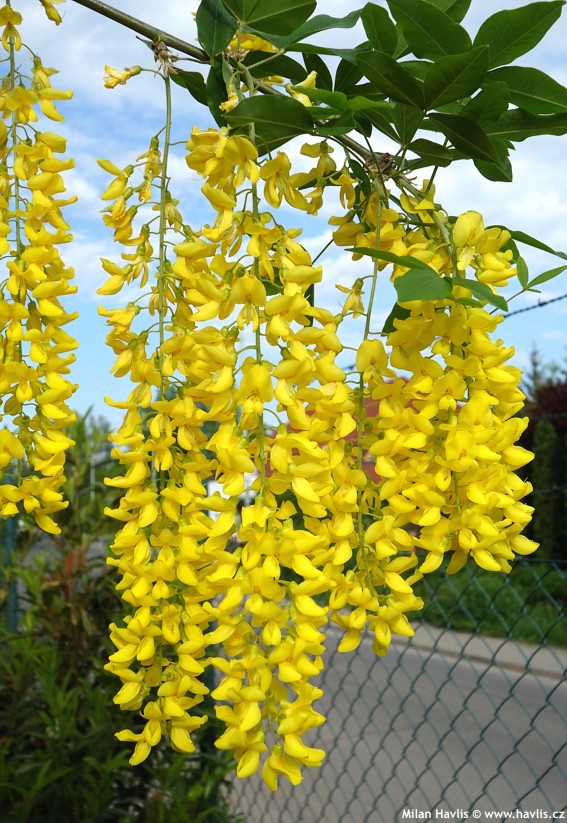
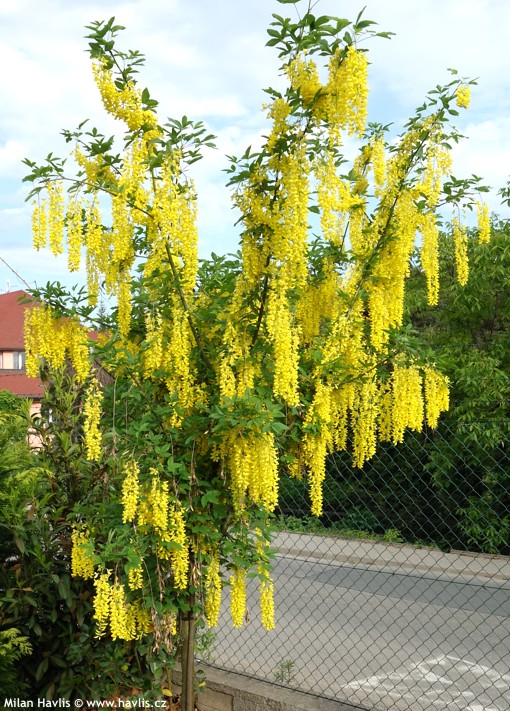
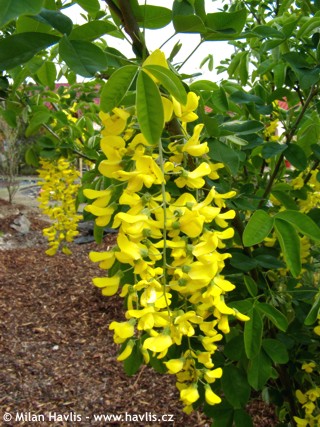
Vossii is the best‑known and most widely grown laburnum, admired for its exceptionally long racemes, reaching up to 50 cm and creating a golden waterfall in full bloom. The flowers are rich yellow, lightly scented and produced in great profusion, far more than in either parent species, appearing from late May into early June. The cultivar forms only a small number of pods, which is practical in gardens with children or animals and also reduces the invasiveness typical of L. anagyroides. The clover-like leaves are deciduous, trifoliate and fresh green; young shoots are bright and lively, while older wood turns brownish‑green. The crown is vase‑shaped, resembling a slender letter Y, with branches spreading at about 1.5 m and forming a light, translucent structure that remains elegant even outside the flowering season. ‘Vossii’ originated in the renowned Waterer nursery in England, famous in the 19th century for selecting ornamental trees and shrubs, and its name refers to one of the nursery’s lines. It has become the emblematic laburnum and is still regarded as the most reliable choice for gardens and public plantings.
‘Vossii’ is ideal for arches, pergolas and walk‑through structures, where its long racemes can be displayed to full effect and create a spectacle rarely matched by other laburnums. In smaller gardens it works best as a solitary tree, allowing its broad crown to develop and become a spring focal point. It pairs beautifully with shrubs that flower slightly later, such as spiraeas or lilacs, extending the spring season and softening the transition from yellow to pastel tones. In naturalistic plantings it complements birches, which share a similarly light branching structure. In regions with cooler, more stable springs than central Europe, flowering is especially abundant, as steady temperatures, moist weather and minimal pruning support the formation of long racemes that do not fade quickly under intense early‑summer sun.
Last update 18-01-2009; 01-07-2026
In Britain, laburnums are often trained to develop strong, almost bare branches from which long racemes emerge directly from the wood in spring. This is achieved by selectively removing most lateral shoots after flowering or in late summer, once it is clear which shoots are promising. The plant then directs its energy into the main branches and produces short, sturdy spur‑like growths that develop into flower buds during summer. This method is particularly effective when training the plant over an arch or pergola, as it creates a clean, stable framework while encouraging the formation of long racemes. The key is gradual work over several seasons and avoiding blanket shortening of all branches, which would remove future flower buds.
Laburnums need a sunny position and well‑drained soil that is neutral to alkaline. They dislike waterlogged conditions, as excess moisture around the roots reduces flower‑bud formation and leads to poor flowering. They perform best in regions with long, moist springs and without sharp temperature fluctuations, as stable weather supports the development of long racemes. They are not suitable for container growing, as the root system requires space. All parts of the plant are poisonous. According to verified American sources, the hybrid tolerates temperatures down to approximately –29 °C (USDA zone 5).

Goods are shipped all over Europe. For Russia and U.K. and for further details please read about SHIPPING OPTIONS HERE.
Are you interested in a serious discount for orders NOV-FEB? Check your options here.
THE PRICES INCLUDE VAT of 15%. For quick conversion you can use 1 CZK = approx. 0.04 EUR
- STANDARD QUALITY - Plants of this group are 1st class quality with number of branches and overall density adequate to their size and age, considering they were container grown.
- DE LUXE QUALITY - This label guarantees a luxurious quality of manually selected plants that, compared to their height and age, are exceptionally dense and beautiful.
- EXTRA - These plants are usually mature and bigger specimens with exceptional overall appearance.
- STANDARD (as described in the plant form) means a tree with a trunk of 190-210 cm and a crown at the top, unless specified differently. The commercial size for trees is their girth measured in the height of 1m from ground.
- HOBBY - These plants are of the same quality as our standard-quality plants but younger and therefore cheaper.
- SHRUB - a woody plant with branches growing bushy from the ground level.
- HALF-STANDARD or MINI-STANDARD - a small tree with shorter trunk, its size is usually specified.
- FEATHERED - These are trees with branches growing already from the base of the trunk and up along the stem.
- GRASSES and PERENNIALS - Sizes given usually read the diameter of the pot or the clump, as specified.
