

































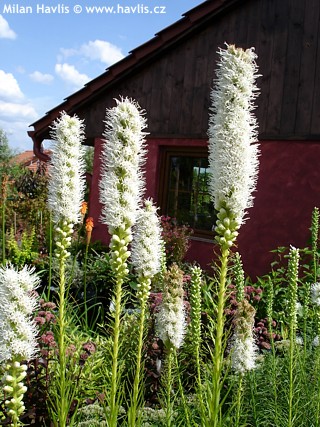
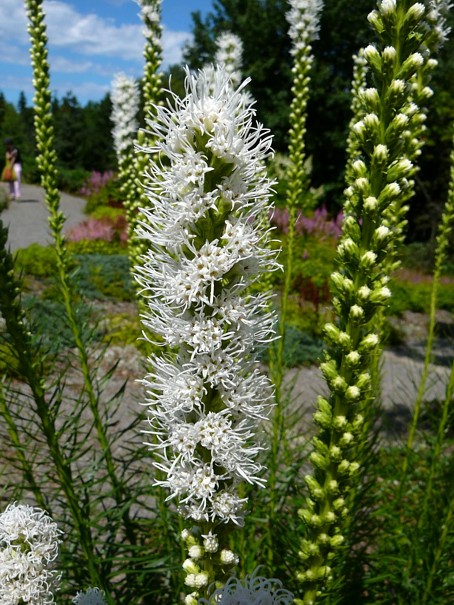
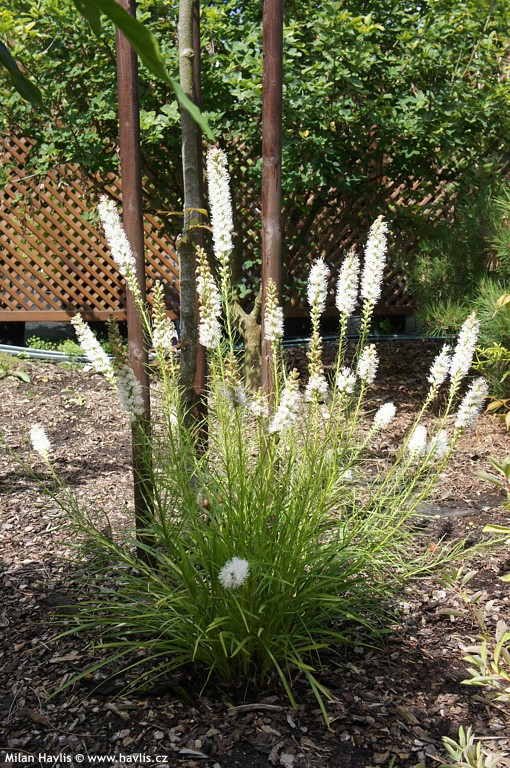
Liatris spicata 'FLORISTAN WHITE' blazing star, gayfeather

 Symbivit Tric (arbuscular)
 Symbivit (arbuscular)
Liatris
The genus Liatris is one of the quiet treasures of the North American prairies, a group of roughly forty to forty‑three species that evolved exclusively within the United States, Canada and, marginally, the Bahamas. It was first described botanically by Thomas Walter (1740–1789) in 1788, although the name Liatris became firmly established only later as a nomen conservandum, since several competing names circulated in early botanical literature. Modern taxonomy clearly separates it from the related genera Carphephorus and Garberia, despite certain shared morphological traits – a boundary that remained controversial for a long time until molecular studies finally resolved it. Liatris is a genus of plants that learned to live with fire, wind and seasonal flooding, and its upright flower spikes are now among the most distinctive symbols of the American prairie flora.
Carl Ludwig Willdenow (1765–1812) described Liatris spicata in 1803, and since then it has become one of the best‑known prairie perennials, largely because, unlike most other species of Liatris, it thrives in wetter soils and along marshy margins. Its natural range stretches from New York State down to Florida and westwards to Louisiana, growing in seasonally wet meadows, tall‑grass communities and the fringes of marshes – places that turn into hot, humming chambers of insect life during summer. In such habitats it becomes one of the most important nectar sources for butterflies, bees and hummingbirds, which is why American university gardens recommend it as a “late‑season nectar plant”. It reached European gardens in the early nineteenth century, when botanical institutions began cultivating it as an exotic prairie curiosity, and it gradually became a familiar perennial thanks to its reliability, long flowering season and ability to thrive even where other prairie species fail due to higher moisture levels.
Leafing through old prairie journals, I discover that blazing star was never just some purple bottle‑brush stuck in the grass, but a plant with a social life far richer than anything Marge Simpson ever enjoyed. Prairie warriors brewed a decoction from its roots to strengthen their voice before battle, because dust and smoke from the fires could turn even the bravest hero into a croaking wreck; blazing star gained a reputation as the plant that “cleans the breath” and “holds the voice”, which is perhaps the most poetic horticultural trait any perennial has ever had. Nineteenth‑century entomologists noticed something else: when it flowers, butterflies line up on its spikes like cars on a motorway – some species even lay their eggs exclusively on it, so you could say blazing star was a butterfly nursery long before ecological gardening made it fashionable. And then there is its relationship with fire: while most plants give up after a blaze, blazing star behaves as if it were its favourite sport. Prairie fire clears space and releases nutrients, so the plant shoots up with even greater enthusiasm – no wonder naturalists wrote, in full colour, that “after fire, the prairie rises like a purple Phoenix”. As if that weren’t enough, some communities used its dried roots as perfume for clothing. What do you think – could it compete with ripe quinces tucked into a wardrobe? 😊 In Illinois it was even planted along roadsides as landmarks for postal carriers, because its tall spikes were visible from afar. It may sound like the first practical navigation system, but once everyone planted their own, how was the poor postman supposed to know which blazing star was whispering the name of the correct recipient?
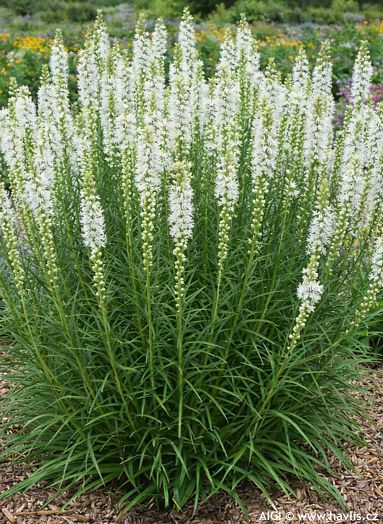
Floristan White is a white‑flowered cultivar of blazing star, selected from American prairie populations and introduced into European gardens only in the second half of the twentieth century. It was chosen within a breeding programme aimed at producing a stable white inflorescence, as white forms of Liatris spicata occur only rarely in nature and tend to be genetically unreliable. The name ‘Floristan’ derives from the Floristan series – a group of cultivars developed for professional floristry and cut‑flower production; white spikes were in demand at the time for contrasting arrangements, and so a cultivar was created to serve as the “white flag of the prairie” – clean, striking and dependable.
The plant typically reaches 80–100 cm, similar to the species, but its habit is slightly more upright and disciplined thanks to firmer stems, which is why it quickly became popular in modern prairie plantings. The inflorescences form long, dense spikes composed of small white heads that open from the top downwards, keeping the plant fresh‑looking for a very long time. The white colour has a gentle creamy undertone that shifts to a cool white in full sun, giving the plant an elegant vertical presence among pink, purple and blue perennials. The leaves are dark green, narrow and grass‑like, forming a firm basal tuft that holds its shape even in hot weather. Flowering is reliable, beginning in July and continuing into September.
Last revision 15‑06‑2008; 06‑07‑2026.
In cultivation, Liatris spicata requires full sun to produce firm, upright spikes that do not splay outwards; it will survive in partial shade, but the inflorescences tend to be shorter and less dense. The soil should be moderately well‑drained, ideally sandy‑loam, with consistent moisture during the growing season. Unlike most other species of Liatris, this one originates from wetter prairies and marsh edges, where the ground is briefly flooded after heavy rain yet remains aerated thanks to deep prairie root systems; short‑term waterlogging benefits it, whereas prolonged saturation will kill it. Feeding should be light, once or twice per season, preferably with organic fertiliser or compost, as overly rich soil leads to soft growth and leaning stems. Pruning is not essential for the plant’s survival, but removing spent spikes prevents seed exhaustion and keeps the plant tidy; the dry stems are best left standing over winter, as they provide structure and shelter for insects. Liatris spicata is reliably hardy down to −34 °C (USDA zone 4) and requires no winter protection. It can be grown in containers only for short periods, as it needs deeper soil and stable moisture than a pot can provide. The plant is non‑toxic, does not trigger allergic reactions, and thanks to its prairie origins tolerates wind well unless it is extreme.

Goods are shipped all over Europe. For Russia and U.K. and for further details please read about SHIPPING OPTIONS HERE.
Are you interested in a serious discount for orders NOV-FEB? Check your options here.
THE PRICES INCLUDE VAT of 15%. For quick conversion you can use 1 CZK = approx. 0.04 EUR
- STANDARD QUALITY - Plants of this group are 1st class quality with number of branches and overall density adequate to their size and age, considering they were container grown.
- DE LUXE QUALITY - This label guarantees a luxurious quality of manually selected plants that, compared to their height and age, are exceptionally dense and beautiful.
- EXTRA - These plants are usually mature and bigger specimens with exceptional overall appearance.
- STANDARD (as described in the plant form) means a tree with a trunk of 190-210 cm and a crown at the top, unless specified differently. The commercial size for trees is their girth measured in the height of 1m from ground.
- HOBBY - These plants are of the same quality as our standard-quality plants but younger and therefore cheaper.
- SHRUB - a woody plant with branches growing bushy from the ground level.
- HALF-STANDARD or MINI-STANDARD - a small tree with shorter trunk, its size is usually specified.
- FEATHERED - These are trees with branches growing already from the base of the trunk and up along the stem.
- GRASSES and PERENNIALS - Sizes given usually read the diameter of the pot or the clump, as specified.
