

































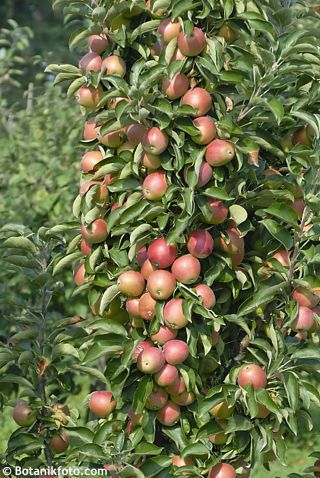
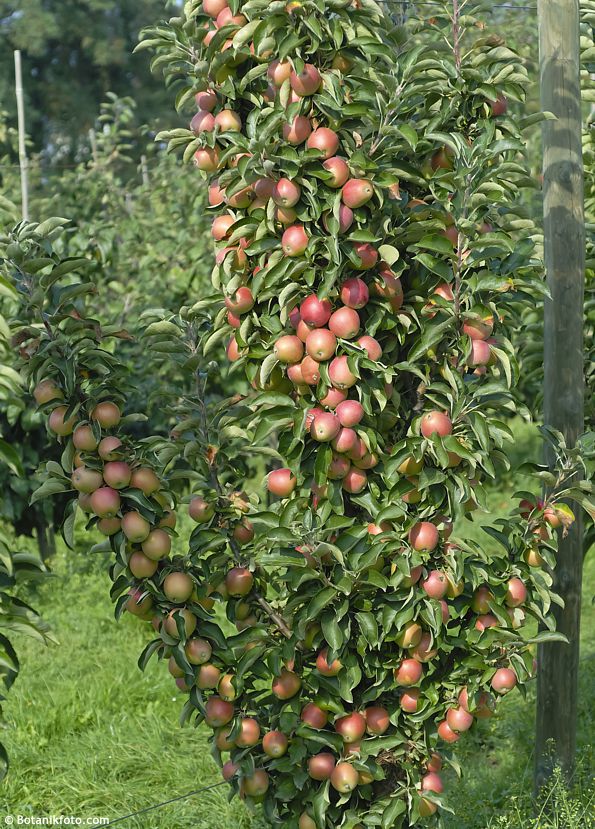
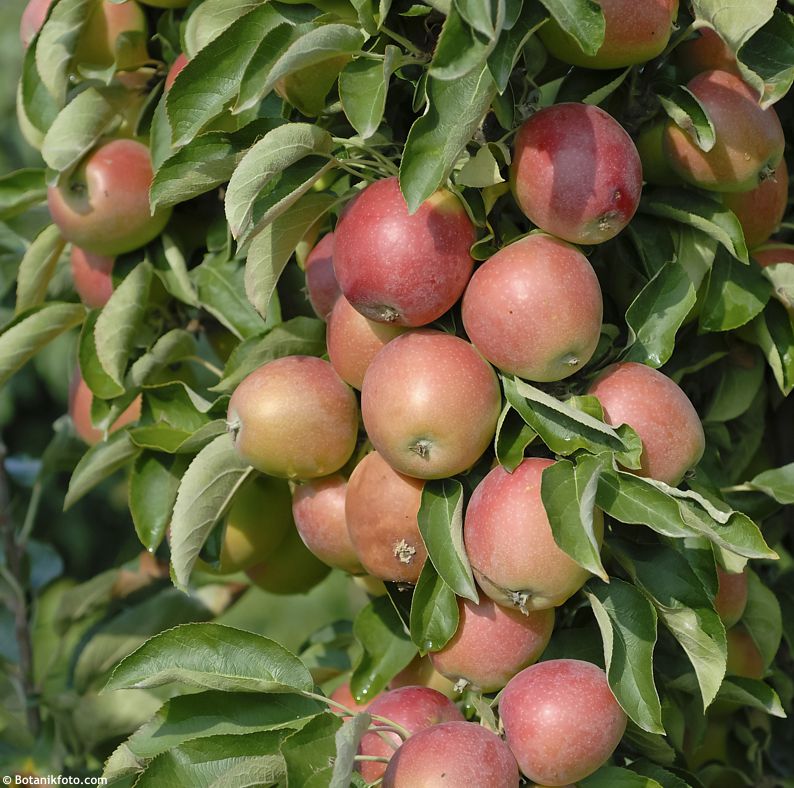
Malus domestica 'POLKA' columnar apple - medium late

 Symbivit Tric (arbuscular)
 Symbivit (arbuscular)
Malus
Columnar apple trees form a distinctive branch in the long history of Malus domestica, which began when wild apples from the Caucasus and Central Asia gradually spread into Europe and became one of the most widely grown fruit trees of the temperate zone. The modern columnar form, however, originated only in the 1960s as a spontaneous bud mutation on the cultivar McIntosh, later named McIntosh Wijcik. The tree developed a strong upright leader, extremely short internodes and, instead of long lateral branches, produced dense fruiting brachyblasts (short, stubby shoots bearing flower buds) – a feature that immediately attracted the attention of breeders. Since columnar apples are naturally rather compact in habit, they are often grafted onto more vigorous rootstocks such as MM106 or MM111 to improve growth, although this is not essential.
The genetic basis of this growth form is linked to the dominant Co gene, located on chromosome 10. Later molecular analyses showed that the columnar habit is associated with the insertion of a Ty3/Gypsy-type retrotransposon into a non-coding region of the genome, present in all columnar cultivars and absent in standard forms. This insertion alters the expression of growth-related genes, particularly those regulating auxin transport, gibberellin levels and strigolactone production, leading to the suppression of lateral branching and the promotion of short fruiting shoots. The Co gene is inherited dominantly, and its presence can be traced throughout the entire lineage of columnar cultivars, from the original Wijcik to modern selections intended for intensive orchards as well as small gardens.
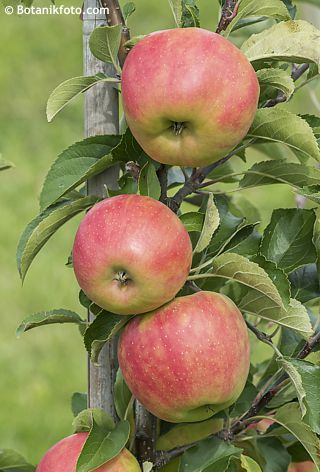
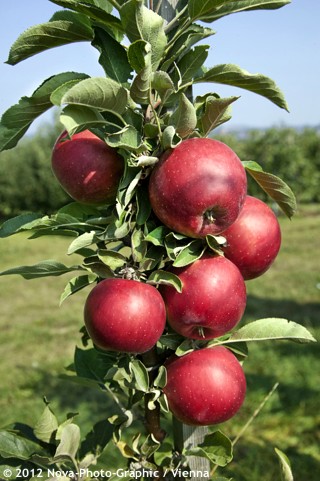
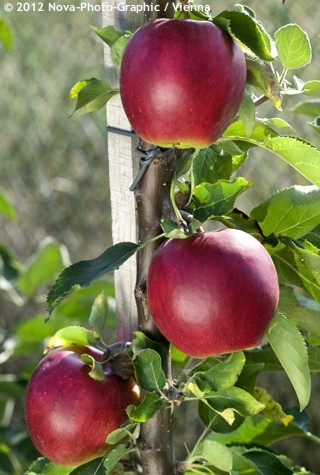
Polka belongs to the Ballerina® series and is one of the most reliable columnar apples for temperate gardens. It bears medium-sized fruit, mostly round to slightly conical, with a light green skin that develops a rosy red blush as it ripens. The flesh is pale to white, very juicy, crisp yet firm, with a pleasantly sweet flavour balanced by a gentle acidity reminiscent of Spartan. It ripens from late September and, when properly stored, keeps at least until the end of January without losing texture or aroma. It was bred at the East Malling Research Station in Kent as a cross between Wijcik McIntosh and Golden Delicious and was introduced in 1976. Like most columnar apples, it shows good resistance to common diseases, especially scab and powdery mildew.
Polka is self-sterile, so it requires another apple tree flowering at the same time to ensure reliable cropping. Suitable pollinators include Golden Delicious, James Grieve, Discovery, Idared, Spartan, Elstar and Cox’s Orange Pippin. All are widely available cultivars with mid to mid-late flowering, making them well matched to Polka.
Last update: 09-02-2023; 30-04-2026
Columnar apples can also be grown in containers, provided the container is large enough and offers excellent drainage. A minimum volume of 40–60 litres is recommended, ideally a ceramic or wooden pot that does not overheat. The substrate must be airy, fertile and consistently slightly moist, as roots in containers dry out more quickly – especially in winter, which is the most dangerous period for apples. In hot summers, regular watering is essential, often every other day, along with twice-yearly feeding – organic fertiliser in spring and a light dose of potassium in summer to support wood ripening. The container should be placed in a sheltered spot to prevent the tree from toppling in strong winds. Wintering is reliable as long as the root ball does not freeze too deeply; placing the pot on an insulating layer (wood, polystyrene) and wrapping it with jute or spruce branches helps stabilise temperature. Container growing works best with trees on medium-vigour rootstocks (MM106, MM111), which tolerate restricted root space better. Under these conditions, container cultivation is long-term sustainable, typically for 8–12 years.
They also grow reliably in almost any non-waterlogged soil, but for the best growth and fruiting they prefer deep, fertile ground that retains moisture without becoming heavy. After planting they require regular watering, especially during the first two years and during fruit development; later they cope well with short dry periods. They fruit mainly on horizontally oriented wood, but their columnar habit naturally produces short lateral fruiting spurs, so pruning is minimal – remove only damaged or crossing shoots and always preserve the leader, which determines the height of the tree. Regular pruning is NOT recommended, as it can lead to overcrowding and the formation of vigorous, unproductive shoots. Growth is moderate, and the tree responds well to compost or a spring dose of organic fertiliser. Rootstocks such as MM106 or MM111 provide stable growth and good vitality even in poorer soils. Hardiness is around –30 °C (USDA zone 5)
Goods are shipped all over Europe. For Russia and U.K. and for further details please read about SHIPPING OPTIONS HERE.
Are you interested in a serious discount for orders NOV-FEB? Check your options here.
THE PRICES INCLUDE VAT of 15%. For quick conversion you can use 1 CZK = approx. 0.04 EUR
- STANDARD QUALITY - Plants of this group are 1st class quality with number of branches and overall density adequate to their size and age, considering they were container grown.
- DE LUXE QUALITY - This label guarantees a luxurious quality of manually selected plants that, compared to their height and age, are exceptionally dense and beautiful.
- EXTRA - These plants are usually mature and bigger specimens with exceptional overall appearance.
- STANDARD (as described in the plant form) means a tree with a trunk of 190-210 cm and a crown at the top, unless specified differently. The commercial size for trees is their girth measured in the height of 1m from ground.
- HOBBY - These plants are of the same quality as our standard-quality plants but younger and therefore cheaper.
- SHRUB - a woody plant with branches growing bushy from the ground level.
- HALF-STANDARD or MINI-STANDARD - a small tree with shorter trunk, its size is usually specified.
- FEATHERED - These are trees with branches growing already from the base of the trunk and up along the stem.
- GRASSES and PERENNIALS - Sizes given usually read the diameter of the pot or the clump, as specified.
